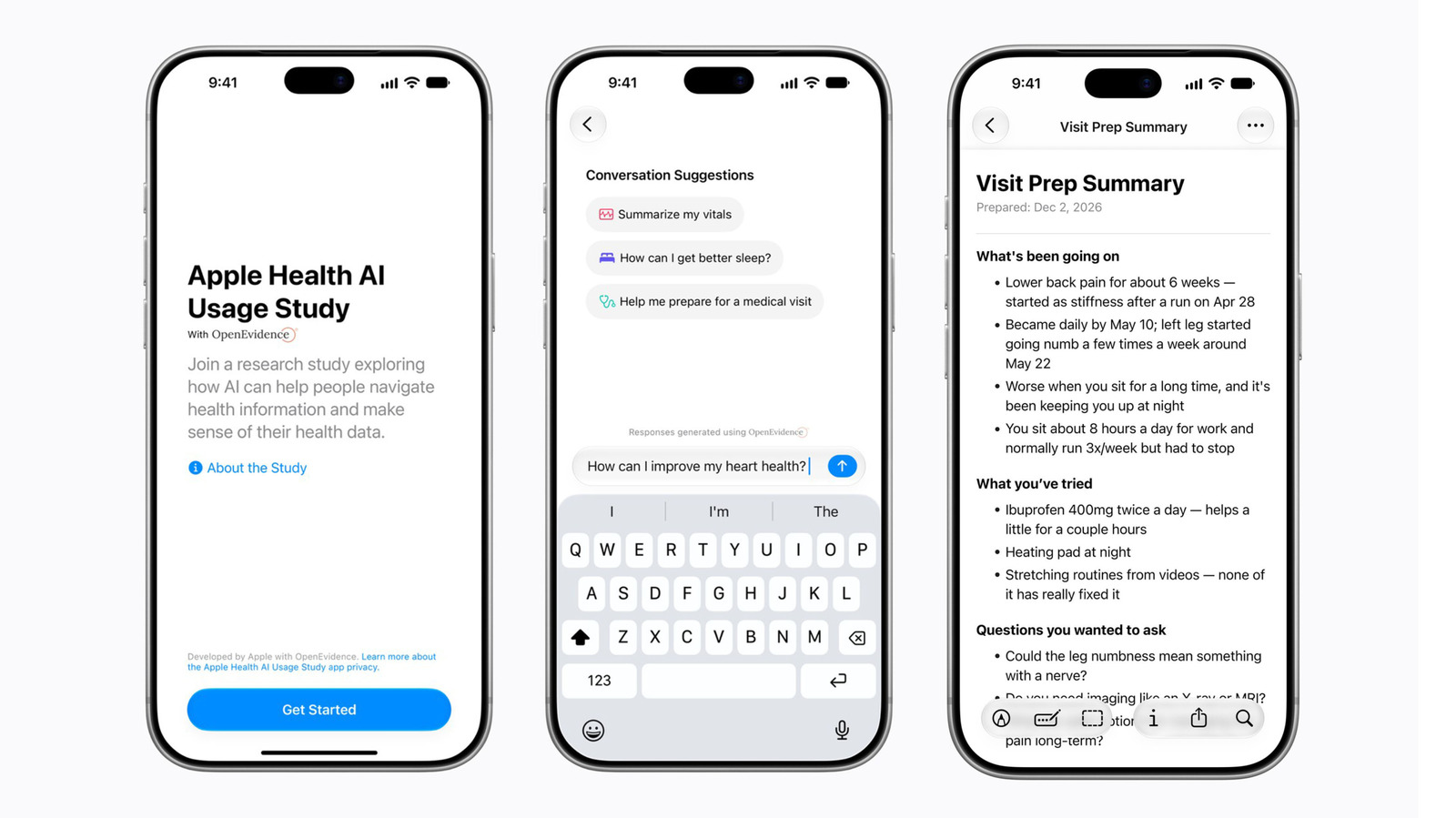
What happened
Apple has launched a US research study examining how people understand and use answers from health-focused artificial intelligence. Announced on Sunday 15 November, the Health AI Usage Study combines an Apple-designed app with technology from OpenEvidence, which supplies medical information tools for healthcare professionals.R1S2
The company is seeking up to 200,000 participants. Apple says users can ask everyday health questions, inspect links to clinical research and rate the responses. It wants to understand whether the information is clear, useful and appropriately trusted, including whether it helps people prepare for conversations with their doctors.S2S4
Why it matters
The study concerns how people use an answer, as well as whether the underlying medical information is accurate. Apple health executive Dr Sumbul Desai told ABC News that the company wants to study interactions that help people navigate conventional care. The launch itself provides no results showing improved health decisions.S2R1
Apple says participants may choose to share HealthKit information such as activity, sleep, resting heart rate or laboratory results. The company says this can provide personal context for answers. It describes sharing those measurements as optional, so enrolment does not require granting access to all the health information stored on an iPhone.S1S2S4
Apple says questions pass through protections designed to remove identifying information before reaching OpenEvidence, which deletes question-and-answer data within 24 hours and does not use it for model training. These are the company's privacy assurances. ABC News also reports that the app offers no live medical monitoring or replacement for professional care.S2
The background
A separate Nature Medicine study published in February tested 1,298 UK adults across ten hypothetical medical scenarios, comparing assistance from three other chatbots with usual resources. Researchers found that chatbot assistance did not improve decisions about what care to seek. That experiment did not test Apple's app or OpenEvidence.R2
The distinction matters when interpreting figures about AI medical accuracy. In the earlier experiment, models were also tested alone, a different task from helping a person interpret symptoms. The authors recommend testing systems with human users; their results do not establish the effectiveness of this newly launched study app.R2
What happens next
Eligible participants can download the app and complete informed consent. Apple's requirements are US residence, age 21 or above and an Apple Intelligence-enabled iPhone, specified as iPhone 15 Pro or later, running iOS 26 or later. TechCrunch's reference to iPhone 15 or later is broader than Apple's wording.R1S2S3
Apple says feedback and surveys will inform the research. It describes the app as a study tool, not something intended to diagnose or treat conditions. No findings from the new study are included in the launch announcement.S2R1