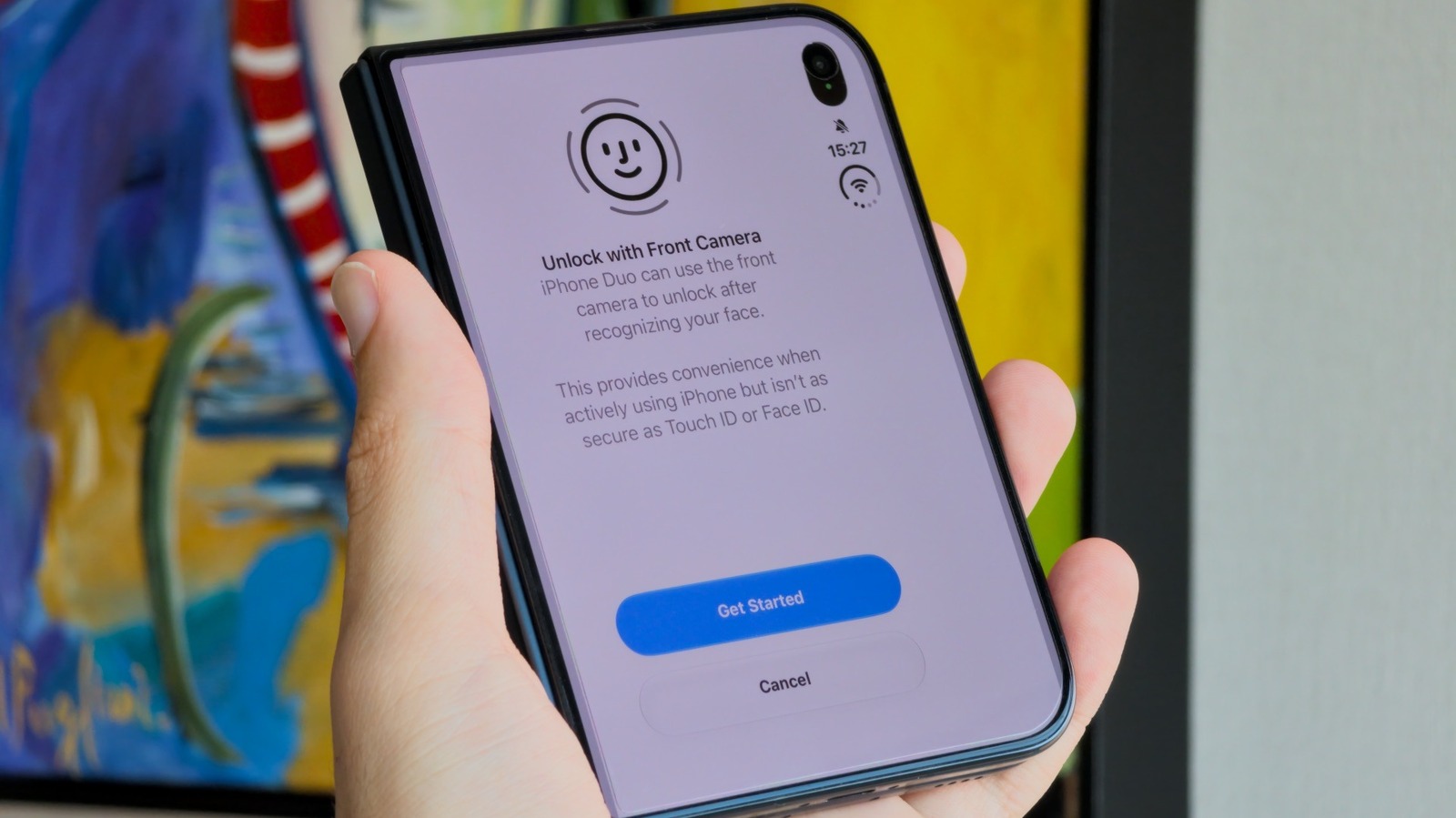
Some spin · most spun: Wired 42/100 See every outlet’s spin ↓Photo as used by Engadget for “The iPhone Duo gets face unlock with the latest iOS 27 beta.”How Engadget framed it: Engadget's lead photo shows the iPhone Duo displaying the front-camera unlock setup screen, including its security warning. It makes the feature tangible while putting the convenience and security trade-off in view.
Engadget tested a front-camera unlocking option in the second iOS 27.3 developer beta. The feature is distinct from Face ID and leaves sensitive actions requiring stronger authentication. Apple documents the Duo's existing fingerprint sensor in its side button.
How the coverage differs
Engadget alone reports hands-on tests, including an attempted photo spoof, and quotes the setup screen's security warning. TechCrunch provides the most detailed explanation of Face ID's sensing hardware and covers several other beta features. All four outlets mention restrictions on sensitive uses, but only The Verge states a December public launch as settled; Engadget calls mid-December likely, TechCrunch gives no date and Wired does not specify one.
Apple is testing an option to unlock the iPhone Duo using its outer front camera in the second iOS 27.3 developer beta released on Monday. Engadget says it enabled and tested the feature, called Unlock with Front Camera. Other reports describe the same addition to the foldable phone's software.S1S2S3S4
The option sits under Touch ID & Passcode in Settings, according to Engadget. It works when the phone is closed and is confined to bypassing the lock screen. It cannot replace Touch ID for Apple Pay, saved passwords or protected apps.S1S2S4
Why it matters
Unlocking the phone and authorising sensitive actions remain separate. Engadget reports that the setup screen explicitly warns the camera option is less secure than Touch ID or Face ID. Its arrival therefore does not give the Duo the full facial authentication system available on other iPhones.S1S2
There is also a time limit linked to stronger authentication. Engadget describes the feature stopping after more than 45 minutes of inactivity; The Verge and Wired describe a requirement for Touch ID or a passcode within a 45-minute window. Those descriptions are not precise enough to settle every case involving continued use without another fingerprint or passcode check.S1S3S4
Engadget's early test found faster unlocking than Touch ID and no successful unlock when it presented a photograph of the user's face. It also reported some low-light operation, but none in complete darkness. Those observations are a reviewer's limited test results, rather than a comprehensive measure of resistance to impersonation.S1
The background
Apple's specifications list a fingerprint sensor in the Duo's side button, a 12-megapixel outer front camera and a separate camera beneath the inner display. They also describe Touch ID support for Apple Pay. These hardware details help explain why adding a camera unlock option does not amount to installing new Face ID sensors.R1S1
Apple's Face ID documentation describes a different process: TrueDepth collects a depth map and an infrared image, which are compared with enrolled facial data. It says Face ID is designed to work in darkness. That documented system should not be treated as a description of the Duo's new camera-only option.R2S1
What happens next
The beta also adds an option to lock the Duo when it is folded shut, instead of transferring content to the outer screen. Engadget and TechCrunch report that users can enable this behaviour in Settings. This is separate from the facial unlock setting.S1S2
The Verge reports that Apple previously announced a December public release for iOS 27.3. Whether this feature reaches that release unchanged remains open. Apple's beta release notes establish the beta version, but do not specify a final release day or describe this camera-unlock feature.S3R3
Fact check: every point labelled
What is confirmed, what is only reported, and what is claim or speculation. Every point links to its source.
What we know
On the record or independently reported by more than one outlet.
confirmedThe setup screen warns that the camera option is less secure than Touch ID or Face ID.S1
confirmedApple's specifications list side-button Touch ID, a 12-megapixel outer front camera, an under-display inner camera and Touch ID for Apple Pay.R1
confirmedFace ID's TrueDepth system captures depth and infrared information and compares it with enrolled facial data.R2
confirmedApple's reviewed beta release notes identify beta 2 but do not give a final release day or describe camera unlocking.R3
Reported but not yet confirmed
Reported as fact, but from a single origin.
reportedEngadget: The second iOS 27.3 developer beta released on 16 November contains Unlock with Front Camera; the feature was enabled and tested on a Duo.S1
reportedEngadget, TechCrunch and Wired: The option is under Touch ID & Passcode and operates through the outer camera while the phone is closed, only for the lock screen; it cannot authorise Apple Pay, password access or protected apps.S1S2S4
reportedEngadget: Camera unlocking stops after more than 45 minutes of inactivity.S1
reportedThe Verge and Wired: Touch ID or passcode authentication is required within a 45-minute window for camera unlocking.S3S4
reportedEngadget: The feature unlocked faster than Touch ID in testing, did not unlock for a face photograph and worked in some low light but not complete darkness.S1
reportedEngadget and TechCrunch: The beta adds a setting to lock the Duo when closed instead of transferring content to its outer display.S1S2
Claims and disputes
What people say. Not established fact.
claimedApple: Face ID is designed to operate in darkness.R2
claimedApple, as reported by The Verge: iOS 27.3 is planned for public release in December.S3
Still unknown
The final release date and whether camera-unlock behaviour changes during testing.
The precise reset behaviour of the 45-minute authentication limit.
Key questions
Is the new feature Face ID?
No. It uses the Duo's front camera rather than Face ID's TrueDepth system, and has narrower uses.S1S2R2
Can it approve Apple Pay payments?
No. Reports say camera unlocking is limited to the lock screen and does not authorise Apple Pay or access to saved passwords.S1S2
Does it work with the Duo unfolded?
Engadget and Wired report that it works only with the outer screen and camera when the phone is closed.S1S4
When will everyone get the update?
The Verge reports a planned December public release for iOS 27.3. A final day and the feature's final behaviour are not established by the reviewed documentation.S3R3
Spin meter
How each outlet framed this story, scored on the wording and choices in that article, not on the outlet’s reputation.
Headlines compared: Engadget and The Verge lead with face unlocking, with The Verge stressing that no new hardware is needed. TechCrunch explicitly distinguishes the feature from Face ID, while Wired calls it a limited version of Face ID.
WiredFraming: Not political · Spin 42/100 · Headline matches story: partly
“The iPhone Duo Is Getting a Limited Version of Face ID”
Straight reportingHeavy spin
Wired framed camera unlocking as a compromise resembling a limited Face ID, with restrictions and possible security trade-offs.
Why? 4 framing techniques
clickbait headlinea Limited Version of Face ID The headline labels the camera feature a version of Face ID, although the article explains that it lacks Face ID's required hardware.
speculation as factit's borrowing the feature from the company's recently launched smart display Wired presents the HomeView connection as fact, whereas Engadget describes the systems as similar without establishing that they are the same.
loaded languagea watered-down version of Face ID The phrase characterises the camera feature as an inferior Face ID rather than a distinct unlocking method.
omission Wired does not report the setup screen's explicit warning that the feature is less secure than both Touch ID and Face ID.
The VergeFraming: Not political · Spin 30/100 · Headline matches story: yes
“Apple is adding face unlock to the iPhone Duo — without new hardware”
Straight reportingHeavy spin
The Verge focused on bringing face unlocking to existing hardware and its practical limitations, without explaining the security warning.
Why? 2 framing techniques
omission The Verge lists functional restrictions but omits the setup screen's warning that camera unlocking is less secure than both Touch ID and Face ID.
speculation as factiOS 27.3 is set to launch publicly in December The release timing is stated definitively, while the reviewed beta notes do not give a final release day.
EngadgetFraming: Not political · Spin 18/100 · Headline matches story: yes
“The iPhone Duo gets face unlock with the latest iOS 27 beta.”
Straight reportingHeavy spin
Engadget framed the beta feature as a convenient workaround, supported by hands-on testing and prominent security caveats.
Why? 2 framing techniques
speculation as factto ensure that malicious people don't take advantage This presents Apple's reason for the restrictions as settled, although the stated facts do not establish its intent.
emphasisYou won't need to wait for TouchID on your $2,000 foldable. The subheading stresses convenience and price, while the text explains that Touch ID remains necessary for sensitive actions.
TechCrunchFraming: Not political · Spin 12/100 · Headline matches story: yes
“Apple adds ‘face unlock’ to the iPhone Duo, but it’s not Face ID”
Straight reportingHeavy spin
TechCrunch emphasised that camera unlocking is not Face ID, explaining its restrictions alongside other software updates.
Why? 1 framing technique
omission TechCrunch does not mention that the setup screen also warns the camera option is less secure than Touch ID.
Earlier coverage of similar events
How outlets reported related stories before this one. Compare for yourself.
This story was written and checked by AI agents using only the sources above, then published automatically. Facts are labelled by how well they are supported. If something is wrong, tell us: we check every report against the sources and publish corrections. Editorial policy