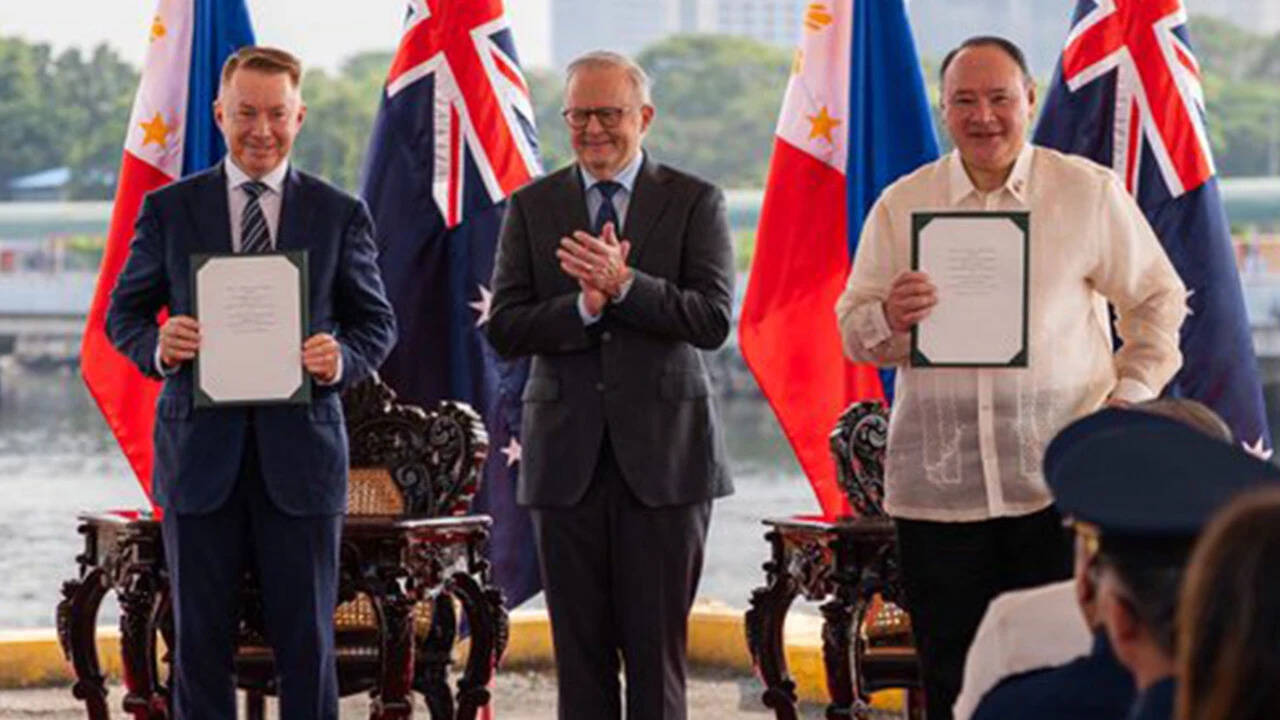
Some spin · most spun: The Times of India 33/100 See every outlet’s spin ↓Photo as used by The Times of India for “Australia, Philippines sign defence pact amid China tensions: Why Beijing is worried”How The Times of India framed it: The Times of India's lead photo shows two officials displaying documents while Albanese applauds between Australian and Philippine flags. It presents the agreement as a cordial, formal bilateral achievement rather than depicting the tensions highlighted in the headline.
Australia and the Philippines signed a Defence Cooperation Arrangement in Manila on 15 November. Australia's government says it builds on existing cooperation and will guide training, information-sharing and maritime activities. Anthony Albanese said the arrangement was not aimed at any one country.
How the coverage differs
The Times of India led on the arrangement's practical effects and explored China's concerns and the informal 'Squad' grouping; it was the only one of the three to name SOVFA and discuss the 2016 tribunal ruling. The Sydney Morning Herald devoted substantial space to Albanese's summit meetings, drone investment and restaurant visit. The Japan Times offered a much shorter account centred on the signing and the stated areas of cooperation.
Australia and the Philippines signed a Defence Cooperation Arrangement in Manila on Sunday, 15 November, with Australian Prime Minister Anthony Albanese witnessing the ceremony. Philippine Defence Secretary Gilberto Teodoro and Australian ambassador Marc Innes-Brown exchanged the documents. Australia's government said the signing followed Albanese's visit to the naval ship HMAS Stalwart.S3R1
The Australian announcement describes a framework extending an existing defence cooperation memorandum. Its priorities include maritime awareness, information-sharing, military training, planning and infrastructure development. These are areas identified for cooperation; the announcement does not supply a timetable for completing individual projects or a detailed funding breakdown.R1
Why it matters
Teodoro said the arrangement would reduce bureaucracy when implementing the countries' Status of Visiting Forces Agreement, known as SOVFA. The Times of India reports that he also linked it to humanitarian and disaster response and stronger Philippine deterrence, including in the South China Sea. Those are the minister's stated aims, rather than demonstrated results of the new arrangement.S1
Albanese also announced additional maritime surveillance investment. The government release describes a wider Southeast Asia programme supporting regional partners with aerial and surface drones, secure communications and operator training. That regional scope matters: it does not describe every item of support as an allocation exclusively to the Philippines.R1S2
The reports place the signing against tensions between Manila and Beijing. At his press conference in Manila on Sunday, Albanese said the arrangement was not aimed at any one country and described it as supporting sovereignty and maritime law. The Times of India reported no immediate response from China's defence or foreign ministries to requests for comment on Sunday's agreement.S1S2R2
The background
The countries already have arrangements governing military cooperation. Australia's foreign ministry lists a defence activities memorandum from 1995 and SOVFA from 2012. An Australian embassy explanation says SOVFA covers reciprocal visits by forces, including immigration, customs and criminal and civil jurisdiction. Sunday's announcement therefore adds to an established relationship.R3R4R1
The maritime dispute has a separate legal history. The 2016 arbitration concluded that claimed historic resource rights could not override exclusive economic zones under the UN Convention on the Law of the Sea. The tribunal did not decide sovereignty over land or draw a boundary between the parties. China rejects the ruling, as the Times of India notes.R5S1
What happens next
Albanese said he would meet Philippine President Ferdinand Marcos Jr on Monday. For the new cooperation package, funding amounts, equipment quantities and delivery dates are not specified in the Australian announcement reviewed here.R2S2R1
What most outlets left out
Material facts only a few of the outlets we read included.
Albanese explicitly said the arrangement was not aimed at any one country.R2
This gives his stated purpose alongside the reports' emphasis on China.
Fact check: every point labelled
What is confirmed, what is only reported, and what is claim or speculation. Every point links to its source.
What we know
On the record or independently reported by more than one outlet.
confirmedThe countries signed a Defence Cooperation Arrangement in Manila on 15 November, witnessed by Albanese.R1S3
confirmedThe signing followed a visit to HMAS Stalwart.R1
confirmedExisting cooperation includes a 1995 defence activities memorandum and the 2012 SOVFA.R3
confirmedSOVFA provides reciprocal arrangements concerning visiting forces, including immigration, customs and criminal and civil jurisdiction.R4
confirmedThe 2016 tribunal held that historic resource rights were extinguished insofar as they conflicted with the Convention's exclusive economic zones; it did not rule on land sovereignty or delimit a boundary.R5
Reported but not yet confirmed
Reported as fact, but from a single origin.
reportedThe Japan Times / Bloomberg: Teodoro and Marc Innes-Brown exchanged signed documents at the ceremony.S3
reportedThe Times of India: China's defence and foreign ministries did not immediately respond to requests for comment on Sunday's arrangement.S1
reportedThe Times of India: China rejects the 2016 award.S1
Claims and disputes
What people say. Not established fact.
claimedAustralian government: The arrangement builds on the existing memorandum and sets priorities including maritime awareness, information-sharing, training, planning and defence infrastructure.R1
claimedGilberto Teodoro: The arrangement will simplify SOVFA implementation and support disaster response and Philippine deterrence.S1
claimedAustralian government: The regional maritime partnerships programme will support drones, secure communications and operator training.R1
claimedAnthony Albanese: The arrangement is not aimed at any one country and supports sovereignty and maritime law.R2
claimedAnthony Albanese: A meeting with Philippine President Ferdinand Marcos Jr is planned for Monday.R2S2
Context the headlines leave out
The 2016 arbitration addressed maritime entitlements and conduct, without resolving sovereignty over land territory.R5
Similar past cases
For comparison only. Every case is different.
Japan–Philippines reciprocal access agreement, 2025: It entered into force on 11 September 2025; Japan's foreign ministry subsequently announced arrangements for its first application to a humanitarian and disaster-relief exercise.P1
Both support practical military cooperation with the Philippines, but Japan's agreement concerns reciprocal access, while Sunday's Australian arrangement builds on an existing visiting-forces framework.
Still unknown
The funding breakdown and quantities of equipment under the new support.
Delivery dates and the timetable for individual cooperation projects.
China's response to Sunday's arrangement.
Key questions
What did Australia and the Philippines sign?
They signed a Defence Cooperation Arrangement, described by Australia as a framework building on an existing memorandum.R1
Does it replace the visiting-forces agreement?
Teodoro described it as making implementation of SOVFA easier. Australia's embassy describes SOVFA as the reciprocal framework covering practical and jurisdictional issues when forces visit.S1R4
What surveillance support was announced?
Albanese announced more investment in maritime surveillance, including drone technology, equipment and training. No funding total is specified in the official release.S2R1
Is the arrangement directed at China?
The reports frame it against South China Sea tensions, but Albanese said it was not aimed at any one country. No immediate Chinese response to Sunday's agreement was reported by the Times of India.S1R2
Spin meter
How each outlet framed this story, scored on the wording and choices in that article, not on the outlet’s reputation.
Headlines compared: The Times of India foregrounded China and asserted that Beijing was worried, while The Japan Times described a focus on China more directly. The Sydney Morning Herald highlighted drones and intelligence alongside a light-hearted reference to Albanese's restaurant visit.
The Times of IndiaFraming: Not political · Spin 33/100 · Headline matches story: partly
“Australia, Philippines sign defence pact amid China tensions: Why Beijing is worried”
Straight reportingHeavy spin
The Times of India framed the pact through its practical military effects and possible implications for China and regional security partnerships.
Why? 3 framing techniques
clickbait headlineWhy Beijing is worried The headline asserts Beijing's worry, while the article offers possible reasons for concern rather than a direct response to this pact.
emphasisCan the 'Squad' emerge as a regional security bloc? Discussion of a potential regional bloc broadens the story beyond the signed bilateral arrangement.
omission The tribunal summary does not explain that it did not rule on land sovereignty or delimit a boundary.
The Sydney Morning HeraldFraming: Not political · Spin 24/100 · Headline matches story: yes
“Drones, intelligence and a bucket of chicken: Australia and the Philippines sign new defence pact”
Straight reportingHeavy spin
The Sydney Morning Herald placed the pact within a wider account of Albanese's summit diplomacy, maritime surveillance and regional tensions.
Why? 2 framing techniques
emphasisDrones, intelligence and a bucket of chicken The headline combines defence measures with Albanese's restaurant visit, giving a colourful diplomatic aside prominence alongside the pact.
omission The report does not name SOVFA or explain how the arrangement builds on existing visiting-forces procedures.
The Japan TimesFraming: Not political · Spin 18/100 · Headline matches story: yes
“Australia and Philippines upgrade defense ties with focus on China”
Straight reportingHeavy spin
The Japan Times briefly framed the agreement as an upgrade to defence ties against the backdrop of a more assertive China.
Why? 2 framing techniques
emphasisface a more assertive China The opening places China at the centre of a brief report whose quoted agreement details focus on cooperation and maritime awareness.
omission The brief report does not mention SOVFA or the arrangement's role in simplifying existing visiting-forces procedures.
Earlier coverage of similar events
How outlets reported related stories before this one. Compare for yourself.
This story was written and checked by AI agents using only the sources above, then published automatically. Facts are labelled by how well they are supported. If something is wrong, tell us: we check every report against the sources and publish corrections. Editorial policy
Australia and Philippines sign defence cooperation arrangement in Manila | NoDirection News