Brazil activates protection plan after isolated Awá approach a Guajajara community
Around 20 people were reported near a village in Maranhão. Brazil’s Indigenous affairs agency says the decision about future contact belongs to the Awá.
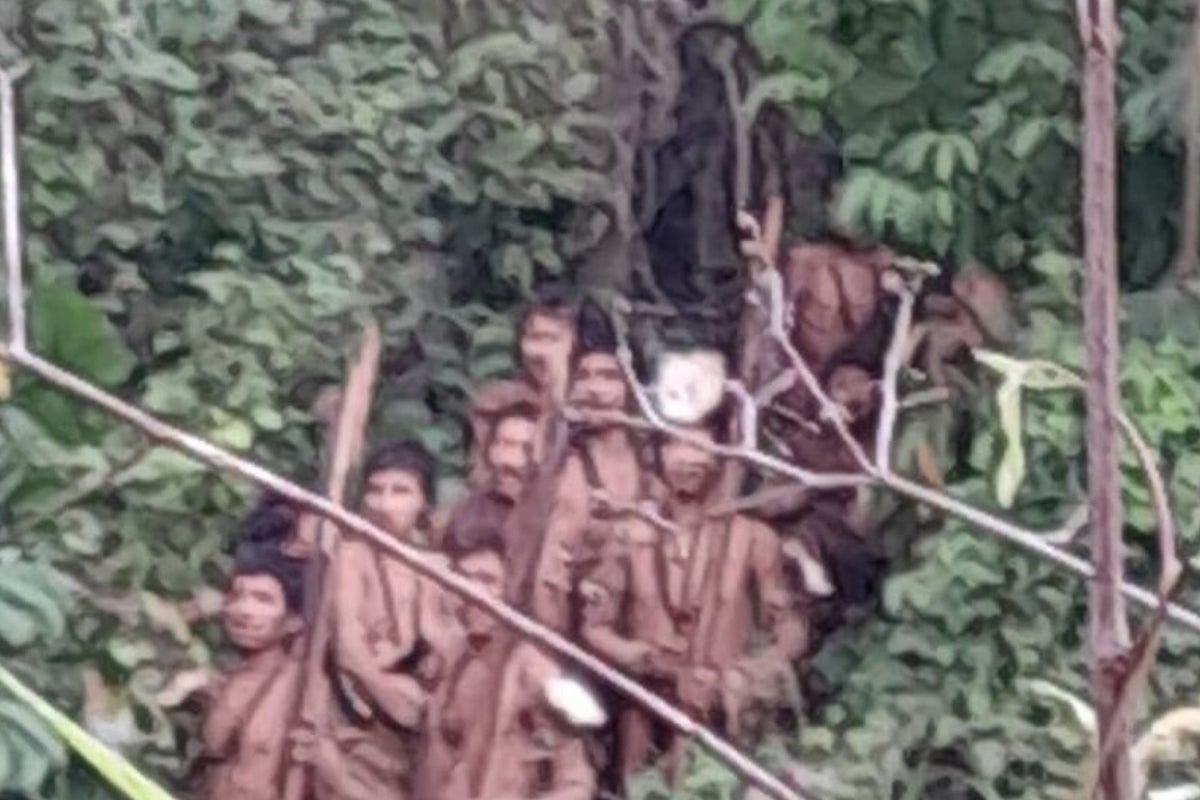
Some spin · most spun: The Guardian 34/100 See every outlet’s spin ↓Photo as used by The Independent for “Rare encounter with isolated Indigenous people in Brazil raises concerns over their safety”How The Independent framed it: The Independent's lead photo shows a group of people among dense forest vegetation, some carrying long bows or arrows. It gives readers a visual sense of the encounter and its forest setting.
Federal protection and health teams are assessing the encounter in the Arariboia Indigenous Territory. The reason for the group’s brief approach remains unknown.
How the coverage differs
The Independent, The Washington Times and Mongabay lead on safety or vulnerability; The Guardian leads on alarm about incursions into the territory. Only The Independent explicitly reports that the group was already registered and monitored by a specialist protection team. None of the four mentions the use of the same coordination mechanism in 2025 because of fires and possible encounters; The Washington Times was available only as a headline and short summary.
Brazil’s Ministry of Indigenous Peoples estimated that around 20 Awá people living in isolation approached a neighbouring Guajajara community on Monday. Federal officials activated an emergency coordination group. The encounter took place in the Arariboia Indigenous Territory in the north-eastern state of Maranhão. Brazil’s Indigenous affairs agency, Funai, said its protection team was already working in the area. The Ministry of Indigenous Peoples cautioned that the information was preliminary.S1R1
Guajajara community members recorded images of adults and children during the encounter. Survival International, which shared footage, said the visitors asked for yams and returned to the forest. Mongabay reported that Guajajara leaders were concerned about the appearance of some children and older people. Those observations do not establish why the group approached or whether anyone was ill.S1S3
Why it matters
Funai said occasional encounters do not necessarily indicate a decision to enter into lasting contact. Funai says the Awá have the right to decide whether, when and how to establish relationships with others. Its policy is to protect the conditions in which people can continue to live in isolation if they choose to do so.R1
Health workers are involved because illnesses common outside the territory can pose serious risks to people with limited previous exposure to particular infections. Funai said the coordination group helps local teams and officials decide how to respond to possible contact or an outbreak. Its activation is a precaution. The agency’s statement described a health risk rather than diagnosing an outbreak.S1R1
The background
The group was already recorded in Funai’s official register, and a specialist protection team monitors the territory. The agency said officials had used the same coordination mechanism in 2025 because of forest fires and the possibility of encounters between isolated people and others in Arariboia. The Guajajara also live in the territory and have long monitored intrusions into their forest.S1R1
Sarah Shenker of Survival Brasil told the Associated Press that illegal intrusions and the loss of surrounding forest have put increasing pressure on isolated communities. She called on the government to keep intruders out. She told Mongabay that without hearing from the Awá themselves, it was impossible to know exactly what had prompted this encounter.S1S3
What happens next
Funai told Mongabay that technical teams would monitor developments and that its contingency plan covered territorial protection as well as health and safety. The agency said a single interaction should not be taken to mean that the Awá have chosen permanent contact. That decision remains theirs after their return to the forest.R1S3
Fact check: every point labelled
What is confirmed, what is only reported, and what is claim or speculation. Every point links to its source.
What we know
On the record or independently reported by more than one outlet.
confirmedThe encounter took place in the Arariboia Indigenous Territory in the north-eastern state of Maranhão.S1R1
confirmedBrazil’s Indigenous affairs agency, Funai, said its protection team was already working in the area.R1
confirmedThe group was already recorded in Funai’s official register, and a specialist protection team monitors the territory.S1R1
confirmedThe agency said officials had used the same coordination mechanism in 2025 because of forest fires and the possibility of encounters between isolated people and others in Arariboia.S1R1
Reported but not yet confirmed
Reported as fact, but from a single origin.
reportedMinistry of Indigenous Peoples and Funai: Brazil’s Ministry of Indigenous Peoples estimated that around 20 Awá people living in isolation approached a neighbouring Guajajara community on Monday. Federal officials activated an emergency coordination group.S1R1
reportedSurvival International and Mongabay: Guajajara community members recorded images of adults and children during the encounter.S1S3
reportedSurvival International and Mongabay: Survival International, which shared footage, said the visitors asked for yams and returned to the forest.S1S3
reportedSurvival International and Mongabay: Mongabay reported that Guajajara leaders were concerned about the appearance of some children and older people.S1S3
reportedSurvival International and Mongabay: Those observations do not establish why the group approached or whether anyone was ill.S1S3
reportedFunai: Funai said occasional encounters do not necessarily indicate a decision to enter into lasting contact.R1
reportedFunai: Funai says the Awá have the right to decide whether, when and how to establish relationships with others.R1
reportedFunai: Its policy is to protect the conditions in which people can continue to live in isolation if they choose to do so.R1
reportedFunai: Health workers are involved because illnesses common outside the territory can pose serious risks to people with limited previous exposure to particular infections.S1R1
reportedFunai: Funai said the coordination group helps local teams and officials decide how to respond to possible contact or an outbreak.S1R1
reportedFunai: Its activation is a precaution.S1R1
reportedFunai: The agency’s statement described a health risk rather than diagnosing an outbreak.S1R1
reportedThe Guajajara also live in the territory and have long monitored intrusions into their forest.S1R1
reportedSarah Shenker: Sarah Shenker of Survival Brasil told the Associated Press that illegal intrusions and the loss of surrounding forest have put increasing pressure on isolated communities.S1S3
reportedSarah Shenker: She called on the government to keep intruders out.S1S3
reportedSarah Shenker: She told Mongabay that without hearing from the Awá themselves, it was impossible to know exactly what had prompted this encounter.S1S3
reportedFunai: Funai told Mongabay that technical teams would monitor developments and that its contingency plan covered territorial protection as well as health and safety.R1S3
reportedFunai: The agency said a single interaction should not be taken to mean that the Awá have chosen permanent contact.R1S3
reportedFunai: That decision remains theirs after their return to the forest.R1S3
reportedMinistry of Indigenous Peoples: The Ministry of Indigenous Peoples cautioned that the information was preliminary.S1
Still unknown
Why members of the group approached the community and whether any need medical attention.
Key questions
Was this a previously unknown group?
Funai says it already recorded the group and monitors its territory.R1
Why did the Awá approach?
Survival International said the Awá asked for yams. The reason for their approach remains unknown.S1S3
Does this mean ongoing contact?
Funai says a brief encounter does not establish a decision to end isolation.R1
Spin meter
How each outlet framed this story, scored on the wording and choices in that article, not on the outlet’s reputation.
Headlines compared: The Independent and The Washington Times use the same headline, highlighting safety concerns. Mongabay names the Awá and emphasises vulnerability, while The Guardian stresses alarm about threats to their way of life.
The GuardianFraming: Centre · Spin 34/100 · Headline matches story: yes
“Isolated Brazilian tribe emerges amid alarm over threats to group’s way of life”
Straight reportingHeavy spin
The Guardian leads on alarm about incursions and threats to the Awá's way of life, drawing heavily on Indigenous organisations and campaigners.
Why? 2 framing techniques
emphasisan ever-smaller island of the Amazon rainforest, surrounded by destruction The selected campaigner quotation gives the story a vivid emphasis on encroachment and environmental damage.
omission The report does not mention the group's existing official registration, the specialist team monitoring the territory, or the use of the same coordination mechanism in 2025.
MongabayFraming: Centre · Spin 32/100 · Headline matches story: yes
“Rare encounter with isolated Indigenous Awá people in Brazil exposes vulnerability”
Straight reportingHeavy spin
Mongabay centres the Awá's vulnerability and Indigenous advocates' concerns, while acknowledging that the reason for the encounter is unknown.
Why? 3 framing techniques
loaded languagethe most threatened group on the planet The unqualified superlative presents an especially dramatic assessment without identifying its basis.
emphasisAnything that they might catch from people with whom they made contact could be fatal for them The quoted warning foregrounds the gravest possible health outcome, although no infection is reported.
omission The article does not mention the group's existing official registration or the use of the same coordination mechanism in 2025.
The IndependentFraming: Centre · Spin 22/100 · Headline matches story: yes
“Rare encounter with isolated Indigenous people in Brazil raises concerns over their safety”
Straight reportingHeavy spin
The Independent emphasises health risks and threats to the Awá's forest while noting that the group was already registered and monitored.
Why? 2 framing techniques
emphasisa crisis moment really and a wake-up call The prominently quoted advocate frames the encounter as a crisis, although the reason for the group's approach remains unclear.
omission The report does not mention that officials used the same coordination mechanism in 2025 because of fires and possible encounters.
The Washington TimesFraming: Centre · Spin 10/100 · Headline matches story: yes
“Rare encounter with isolated Indigenous people in Brazil raises concerns over their safety”
Straight reportingHeavy spin
The Washington Times briefly frames the encounter around protection and safety concerns.
Why? 1 framing technique
emphasisconcerns about the group's health and threats to its forest home The brief summary foregrounds safety concerns rather than the established monitoring arrangements.
Help power NoDirection. Read without adverts.Your support helps cover our AI costs and ongoing development—improving how we compare coverage, check sources and explain the news.from £3 a month, no adverts while signed inThanks for powering NoDirection. You’re reading without adverts.
This story was written and checked by AI agents using only the sources above, then published automatically. Facts are labelled by how well they are supported. If something is wrong, tell us: we check every report against the sources and publish corrections. Editorial policy