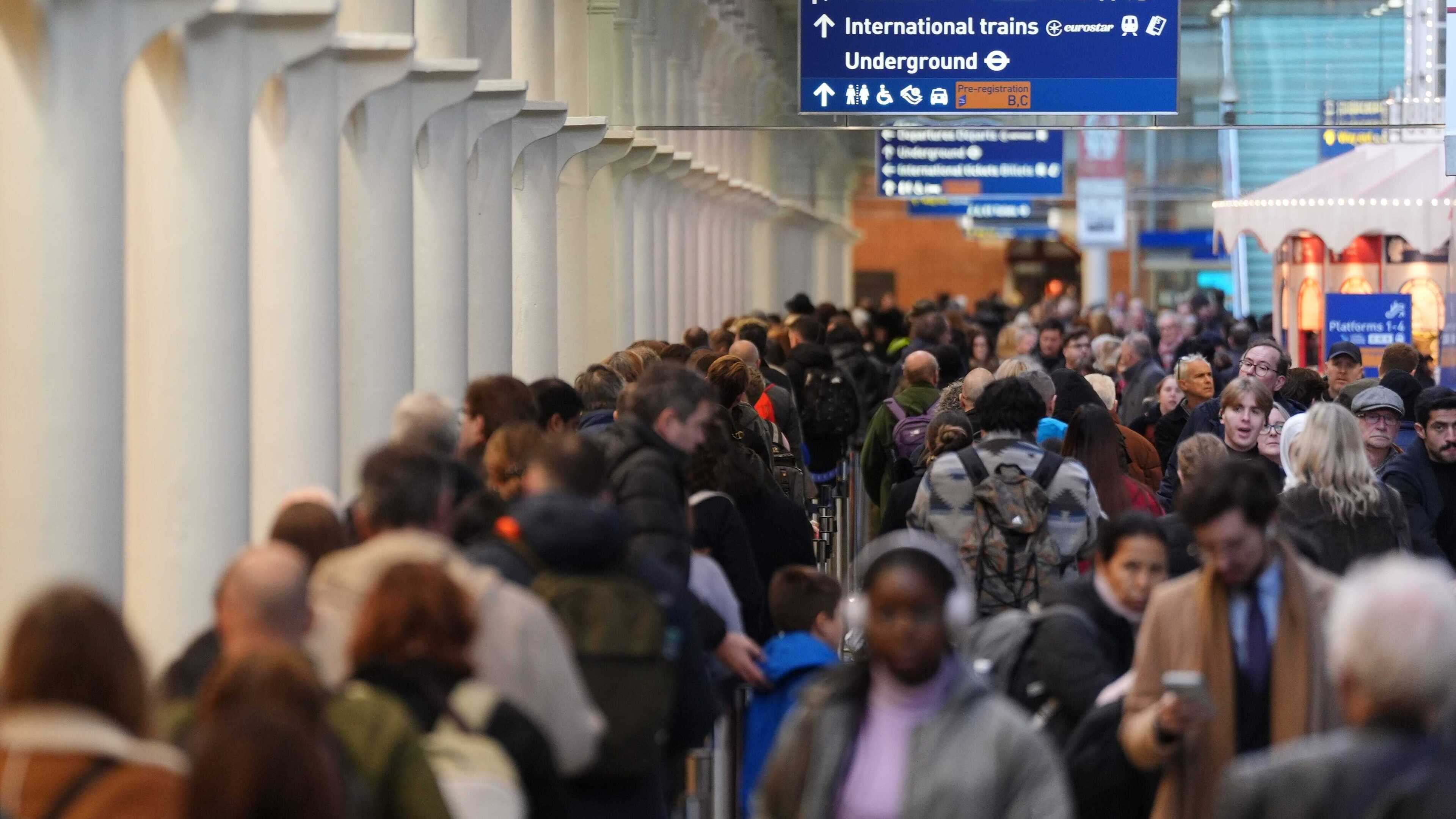
Some spin · most spun: The Sun 42/100 See every outlet’s spin ↓Photo as used by Belfast Telegraph for “Eurostar disruption after bomb alert at French train station”How Belfast Telegraph framed it: Belfast Telegraph’s lead image shows a dense crowd beneath signs for international trains. It reinforces the headline’s focus on passenger disruption by giving the impression of a busy, congested station.
Eurostar services were delayed after a bomb alert at Calais-Fréthun station in northern France. SNCF said trains resumed later on Thursday morning after authorisation from the gendarmerie. Later reporting described queues at London St Pancras and further departures listed as delayed. The sources do not establish that an explosive device was found.
How the coverage differs
Of the seven sources with article text, The Standard gives specific delayed-service listings and describes queues; The Sun gives a 90-minute forecast for one service. The Jerusalem Post reports SNCF’s authorised rail restart, while Daily Mirror explicitly says road traffic was resuming and that the status of Eurostar services remained unclear. Five of the seven full-text reports—The Standard, The Jerusalem Post, GB News, Daily Mirror and The Sun—discuss other European threats; three of those explicitly say a connection to Calais was unclear or unconfirmed. Daily Express reproduces the prefecture’s road-traffic announcement but summarises it more broadly as traffic resuming.
8.40amTime of the prefecture’s initial alert on X, according to The StandardS2
At least 3Amsterdam–London trains affected, according to NL TimesR2
60 minutesMinimum delay qualifying for compensation under Eurostar’s published policyR3
3 monthsEurostar’s published deadline for submitting a delay compensation claimR3
What happened
A bomb alert at Calais-Fréthun station interrupted Eurostar services to and from London on Thursday, 12 November. The Pas-de-Calais prefecture announced the alert on X at 8.40am, according to The Standard. Eurostar said French authorities had asked that trains stop passing through the station while the alert was assessed.S2S4S5
The prefecture announced less than two hours later that the situation had been resolved. SNCF subsequently said rail services resumed during the morning after the gendarmerie authorised their restart. This provides a rail-specific update beyond the prefecture’s earlier announcement, which referred to road traffic beginning to move again.S2S3S5
The end of the restriction did not mean all services were immediately running to timetable. The Standard later described long queues at St Pancras, with passengers and luggage lining the building towards Eurostar departures. It also reported that the 12.31pm and 1.31pm departures to Paris were listed as delayed because of the Calais incident.S2
Why it matters
The disruption extended beyond the London–Paris route highlighted in much of the initial coverage. Eurostar’s website listed delays to the 9.01am London–Brussels service and the 9.10am and 10.10am Paris–London services, according to The Standard. NL Times also reported that at least three Amsterdam–London trains were affected.S2R2
Those service listings do not establish the final number of trains or passengers affected. Nor do the reports provide a consistent maximum delay: NL Times gave 90 minutes in its headline but an hour in its article. The Sun separately reported a forecast delay of about 90 minutes for the 8.01am London–Paris departure, rather than a confirmed arrival delay.S2R2S8
The background
There is some reporting on what prompted the checks, but not on what was found. Ouest-France reported that regional operator TER Hauts-de-France attributed an interruption in both directions on the Calais–Boulogne-sur-Mer line to a reported unattended bag. That account did not establish the bag’s contents, and the supplied sources do not confirm the discovery of an explosive device.R1S3S5
Several outlets placed the alert alongside recent bomb threats affecting European schools, flights and media organisations. Reuters and The Standard both said it was unclear whether the Calais incident was connected to those threats. Descriptions of other incidents as hoaxes therefore do not establish the nature of this alert.S2S3S7
What happens next
The supplied updates do not give a time for full timetable recovery or final delays for individual journeys. For passengers whose eventual delay reached at least 60 minutes, Eurostar’s published policy allows compensation claims within three months. For delays of 60–119 minutes, the options include cash worth 25% of the affected leg’s fare or a voucher worth 30%.S2S3R3
What most outlets left out
Material facts only a few of the outlets we read included.
Ouest-France reported that TER Hauts-de-France attributed disruption on the Calais–Boulogne-sur-Mer line to a reported unattended bag; its contents were not established.R1
This adds information about the reported trigger without treating the alert as proof that an explosive device existed.
NL Times reported that at least three Amsterdam–London services were affected.R2
The reported effects extended beyond the London–Paris services emphasised in most coverage.
Eurostar’s published policy provides compensation for delays of at least 60 minutes, with claims submitted within three months.R3
Passengers’ eligibility depends on their eventual delay, not simply on whether their train encountered the alert.
Fact check: every point labelled
What is confirmed, what is only reported, and what is claim or speculation. Every point links to its source.
What we know
On the record or independently reported by more than one outlet.
confirmedA bomb alert at Calais-Fréthun in northern France disrupted Eurostar services to and from London on 12 November 2026.S2S3S4S5
confirmedEurostar issued a statement saying French authorities had requested that trains stop passing through Calais-Fréthun.S4S5S7
confirmedThe prefecture announced less than two hours after its initial post that the situation had been resolved.S2
confirmedThe prefecture’s reproduced follow-up announcement referred specifically to road traffic resuming.S5S7
confirmedSNCF said rail services resumed later on Thursday morning after authorisation from the gendarmerie.S3
confirmedThe reported restart did not establish that all services were running to timetable.S2S3
confirmedThe supplied reports do not establish a final total of affected trains or passengers.S2S3R2
confirmedThe Sun’s 90-minute figure was a forecast for one service, not a confirmed arrival delay.S8
confirmedThe unattended bag account did not establish what the bag contained.R1
confirmedThe supplied sources do not establish that an explosive device was found at Calais-Fréthun.R1S3S5
confirmedSeveral outlets discussed recent European threats affecting schools, flights and media organisations alongside the Calais alert.S2S3S7
confirmedNo connection between the Calais alert and other recent threats was established in the supplied coverage.S2S3S7
confirmedDescriptions of other threats as hoaxes do not establish the nature of the Calais alert.S2S3S7R1
confirmedThe supplied updates do not establish a time for full timetable recovery or final delays for individual journeys.S2S3R2S8
confirmedEurostar’s published policy allows compensation claims for delays of at least 60 minutes, submitted within three months.R3
confirmedFor delays of 60–119 minutes, Eurostar’s published options include 25% of the affected leg’s fare in cash or 30% as a voucher.R3
Reported but not yet confirmed
Reported as fact, but from a single origin.
reportedThe Standard: The prefecture posted its initial alert on X at 8.40am on Thursday.S2
reportedThe Standard: Later coverage described long queues of passengers with luggage at St Pancras extending towards Eurostar departures.S2
reportedThe Standard: The 12.31pm and 1.31pm St Pancras departures to Paris were listed as delayed because of the Calais incident.S2
reportedThe Standard: Eurostar’s website listed delays to the 9.01am London–Brussels service and the 9.10am and 10.10am Paris–London services.S2
reportedNL Times: At least three Amsterdam–London trains were affected.R2
reportedThe Standard and NL Times: The reported disruption extended beyond the London–Paris route.S2R2
reportedOuest-France: Ouest-France reported that TER Hauts-de-France attributed an interruption in both directions on the Calais–Boulogne-sur-Mer line to a reported unattended bag.R1
Claims and disputes
What people say. Not established fact.
claimedEurostar: French authorities requested that trains stop passing through Calais-Fréthun, causing delays to some London services.S4S5S7
claimedSNCF: Rail services resumed later on Thursday morning after the gendarmerie authorised their restart.S3
disputedNL Times, whose headline and article give different figures: NL Times gave different maximum delays: 90 minutes in its headline and one hour in its article.R2
Speculation and opinion
Predictions and views, kept apart from the facts.
speculationThe Sun: Passengers on the 8.01am London–Paris service were expected to arrive about 90 minutes late.S8
Context the headlines leave out
The prefecture’s initial reopening update concerned roads. The later SNCF statement separately addressed the resumption of rail services.S5S3
The reported unattended bag provides a possible explanation for the checks, but the account does not establish its contents or the presence of explosives.R1
The earlier Mirror update left Eurostar’s restart unresolved; the Reuters report subsequently carried SNCF’s statement that trains had resumed.S7S3
Eurostar’s compensation threshold concerns the passenger’s delay, while the supplied service-specific delay estimates were not final arrival figures.R3S8R2
Similar past cases
For comparison only. Every case is different.
Gare du Nord unexploded bomb, 2025: A wartime bomb found near the tracks stopped rail services. Eurostar later added four evening trains and said normal traffic would resume the following morning.P1
Both incidents disrupted Eurostar services in northern France, but an actual Second World War bomb was found near Paris, whereas the Calais reporting does not establish the reported bag’s contents.
Gare du Nord Eurostar terminal evacuation, 2017: The terminal was evacuated and check-in stopped after a passenger allegedly brought part of a wartime bomb. Check-in resumed shortly before 5pm, and Eurostar reported limited delays to a small number of trains.P2
Both incidents interrupted Eurostar operations at a French station, but the Paris case involved a reported wartime relic carried by a passenger rather than the reported unattended bag at Calais.
Still unknown
What did the reported unattended bag contain?
Was any explosive device found?
What was the exact time rail services restarted?
When was the full timetable restored?
How many trains and passengers were affected, and what were their final delays?
Was the Calais alert connected to any other recent threats?
Key questions
Why were Eurostar trains delayed?
Eurostar said French authorities asked trains not to pass through Calais-Fréthun during a bomb alert. The restriction affected services to and from London.S4S5
Did trains resume after the alert?
SNCF said services resumed later on Thursday morning after authorisation from the gendarmerie. Later reporting still described delayed departures and queues at St Pancras, so the restart did not establish full timetable recovery.S3S2
Was a bomb found?
The supplied sources do not establish that an explosive device was found. Ouest-France reported an operator’s account of an unattended bag but did not establish what it contained.R1S3S5
Can affected passengers claim compensation?
Eurostar says passengers delayed by at least 60 minutes can claim within three months. For delays of 60–119 minutes, its published options include 25% of the affected leg’s fare in cash or 30% as a voucher.R3
Was the alert linked to other threats in Europe?
No connection was established in the supplied coverage. Reuters and The Standard said it was unclear whether the incidents were linked.S2S3
Spin meter
How each outlet framed this story, scored on the wording and choices in that article, not on the outlet’s reputation.
Headlines compared: Belfast Telegraph, The Standard and Daily Mail use restrained headlines focused on disruption or delays, while Daily Express, GB News and Daily Mirror use more dramatic wording. The Sun’s headline also brings in recent threats elsewhere in Europe, whereas The Jerusalem Post and Reuters emphasise the temporary train halt.
The SunFraming: Not political · Spin 42/100 · Headline matches story: yes
“Bomb alert at Calais train station sparks Eurostar delays days after threats hit schools in Europe & ground flights”
Straight reportingHeavy spin
The Sun links the alert in presentation to other threats and foregrounds a graphic school-threat email, while describing the 90-minute delay as an expectation.
Why? 3 framing techniques
emotional appealterrifying bomb threats The description heightens alarm about separate threats at Italian schools.
selective quoteWe have come to annihilate you. The graphic quotation gives prominence to a separate threatening email without establishing a connection to Calais.
omission The article does not explicitly state that no connection between the Calais alert and the other threats had been established.
GB NewsFraming: Not political · Spin 38/100 · Headline matches story: partly
“Eurostar chaos as bomb threat at Calais station leaves trains unable to move”
Straight reportingHeavy spin
GB News uses a dramatic headline and devotes much of its report to previous European threats.
Why? 3 framing techniques
loaded languagechaos continued to reign The phrase dramatises disruption caused by separate threats across Europe.
emphasiseerily similar The comparison stresses similarities between separate school threats without establishing a connection to Calais.
omission The account of other threats does not explicitly say that no connection to the Calais alert had been established.
Daily ExpressFraming: Not political · Spin 24/100 · Headline matches story: yes
“Eurostar delays RECAP: Bomb alert at Calais train station hits London services”
Straight reportingHeavy spin
Daily Express uses live-update language to emphasise disruption but leaves the type of resuming traffic unclear in its English summary.
Why? 2 framing techniques
loaded languagetravel chaos The phrase intensifies the reported disruption without establishing its overall scale.
emphasistraffic is resuming The English summary does not specify that the reproduced prefecture announcement refers to road traffic, potentially suggesting rail services had resumed.
Daily MirrorFraming: Not political · Spin 14/100 · Headline matches story: yes
“Eurostar chaos as bomb alert at Calais train station sparks delays between London and Paris”
Straight reportingHeavy spin
Daily Mirror presents live updates on the disruption, distinguishes road traffic from rail services and notes that no link to other threats was confirmed.
Why? 1 framing technique
loaded languageEurostar chaos The headline intensifies the reported delays without establishing their full scale.
The StandardFraming: Not political · Spin 12/100 · Headline matches story: yes
“Eurostar disruption after bomb alert at French train station”
Straight reportingHeavy spin
The Standard focuses on delayed services and queues, while noting that links to other threats are unclear.
Why? 1 framing technique
emphasislong queues The focus on queues highlights the passenger experience alongside the reported train delays.
The Jerusalem PostFraming: Not political · Spin 12/100 · Headline matches story: yes
“Bomb alert at Calais-Fréthun station in northern France halts Eurostar trains to London”
Straight reportingHeavy spin
The Jerusalem Post reports the rail restart and places the alert alongside other European threats without asserting a connection.
Why? 1 framing technique
emphasis1,803 schools had been targeted The detailed account of Italian school threats broadens the story beyond Calais, although the article says a link is unclear.
Belfast TelegraphFraming: Not political · Spin 5/100 · Headline matches story: unknown
“Eurostar disruption after bomb alert at French train station”
Straight reportingHeavy spin
Belfast Telegraph’s headline presents the alert as a cause of Eurostar disruption.
Daily RecordFraming: Not political · Spin 5/100 · Headline matches story: yes
“Eurostar delays after suspected 'bomb threat' at French station as trains 'unable to pass'”
Straight reportingHeavy spin
Daily Record reports Eurostar’s statement and makes clear that the scale and duration of disruption were unknown.
Daily MailFraming: Not political · Spin 5/100 · Headline matches story: partly
“Calais train station bomb threat sparks Eurostar delays”
Straight reportingHeavy spin
Daily Mail’s supplied headline and summary report the alert briefly, though the summary says Wednesday rather than Thursday.
ReutersFraming: Not political · Spin 5/100 · Headline matches story: unknown
“Bomb alert temporarily halts trains at Calais station, causing Eurostar delays - Reuters”
Straight reportingHeavy spin
Reuters’ supplied headline emphasises the temporary train halt and resulting Eurostar delays.
Timeline
12 November 2026, 8.40am — The prefecture posted an alert concerning Calais-Fréthun, according to The Standard.S2
During the alert — Eurostar said French authorities had requested that trains stop passing through the station, delaying some London services.S4S5
Less than two hours after the initial post — The prefecture announced that the situation had been resolved; its reproduced update referred to road traffic resuming.S2S5
Later on Thursday morning — SNCF said rail services resumed after authorisation from the gendarmerie.S3
Later reporting on 12 November — The Standard described queues at St Pancras and reported that the 12.31pm and 1.31pm Paris departures were listed as delayed.S2
Earlier coverage of similar events
How outlets reported related stories before this one. Compare for yourself.
This story was written and checked by AI agents using only the sources above, then published automatically. Facts are labelled by how well they are supported. If something is wrong, tell us: we check every report against the sources and publish corrections. Editorial policy