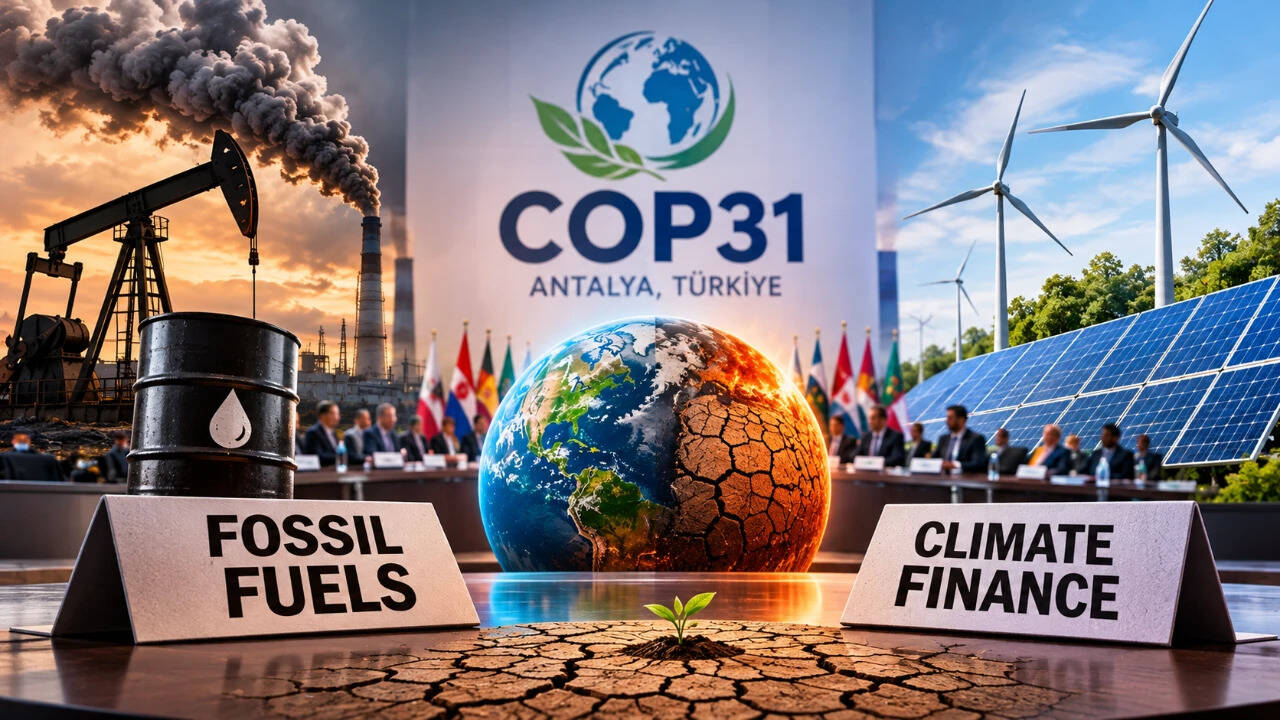
Some spin · most spun: New Scientist 53/100 See every outlet’s spin ↓Photo as used by The Times of India for “COP31 deadlock: Why countries failed to agree on fossil fuels, climate finance”How The Times of India framed it: The Times of India's labelled AI-generated illustration contrasts smoky fossil-fuel infrastructure and a scorched Earth with wind turbines and solar panels. The opposing ‘fossil fuels’ and ‘climate finance’ placards turn the negotiations into a stark visual confrontation.
COP31 ended in Antalya without an overarching agreement. The EU opposed a draft that omitted fossil fuels, while Saudi Arabia’s negotiator defended countries’ freedom to choose technologies. Developing countries’ concerns over adaptation finance remained unresolved, according to IISD.
Of the four full-text excerpts that mention the EU's refusal or rejection of a text without fossil fuels, France 24, Ars Technica and New Scientist state it directly, while The Times of India describes the EU's criticism of oil states rather than that specific refusal. The Times of India is the only supplied source to state the $300 billion annual COP29 finance goal; none of the excerpts explains both developed-country leadership and the permitted mix of public and private funding. Ars Technica alone reports Guterres's disappointment, while The Washington Post's summary alone leads on reducing reliance on consensus. These counts concern the supplied text, including truncated articles and summary-only sources.
COP31 ended in Antalya without agreement on its main political pact after divisions over fossil fuels and climate finance. The UN dates the close to Sunday 22 November, following two days of overtime. The Times of India reports that countries nevertheless made progress on other issues, including climate-finance mechanisms and a framework for a just transition.R3S1S10
Ireland’s climate minister Darragh O’Brien said the EU would not endorse an agreement that failed to mention fossil fuels. Saudi negotiator Mohammad Ayoub said the 22-member League of Arab States supported the proposed pact. He argued that countries should be able to choose among available solutions according to national circumstances, defending carbon capture and removal technologies.S9S10
Why it matters
The finance dispute concerned how promises would be delivered as well as their size. IISD says developing countries sought a clear baseline and stronger accountability for the pledge to triple adaptation finance by 2035. It reports that COP31 did not resolve those concerns about turning the pledge into funding.R1
A separate, wider climate-finance goal already exists. The European Commission’s account of the COP29 agreement sets out a target of at least $300bn annually by 2035 for developing countries, with developed countries leading. The goal allows public and private sources of finance; it is a financing target, rather than a record of money already delivered.S1R2
The rejected Antalya proposal also contained provisions beyond fossil fuels. New Scientist reports that it would have acknowledged an expected overshoot of 1.5°C warming and sought to raise electricity’s share of final energy consumption to 35% globally by 2035. Those provisions remained proposals, rather than commitments adopted through the pact.S10
The background
At COP28 in Dubai in 2023, countries agreed to transition away from fossil fuels in energy systems. The EU argued that omitting them from the Antalya text would reverse progress. The Times of India’s subsequent account highlights the continuing divide between countries seeking a faster transition and producers resisting stronger language.S1S9S10
The Washington Post reports renewed calls for a negotiating system less dependent on consensus. Cambridge researcher Joanna Depledge told New Scientist that the EU had departed from its usual willingness to compromise at the end of talks. Her assessment describes negotiating behaviour, rather than an agreed reform of the rules.S4S10
What happens next
IISD identifies June talks in Bonn as preparation for COP32 in Addis Ababa. UN Secretary-General António Guterres expressed disappointment at the lack of an overarching agreement. The sources do not establish a settlement of the outstanding fossil-fuel and finance disagreements or an agreed replacement for consensus-based negotiations.R1S9S4
Fact check: every point labelled
What is confirmed, what is only reported, and what is claim or speculation. Every point links to its source.
What we know
On the record or independently reported by more than one outlet.
confirmedCOP31 ended in Antalya without an overarching pact amid fossil-fuel and finance disagreements.S1S10
confirmedIreland’s climate minister Darragh O’Brien said the EU would not endorse a text without fossil fuels.S9S10
confirmedThe COP29 finance goal targets at least $300bn annually by 2035 for developing countries, with developed countries leading and public and private funding permitted.R2S1
confirmedCOP28 in Dubai in 2023 agreed a transition away from fossil fuels in energy systems.S1S10
confirmedUN Secretary-General António Guterres said he was disappointed that COP31 had ended without consensus on an overarching agreement.S9
Reported but not yet confirmed
Reported as fact, but from a single origin.
reportedInternational Institute for Sustainable Development: IISD reports that COP31 did not resolve developing countries’ requests for a baseline and stronger accountability for tripling adaptation finance by 2035.R1
reportedNew Scientist: The rejected proposal would have acknowledged an expected 1.5°C overshoot and targeted a 35% global electricity share of final energy consumption by 2035.S10
reportedThe Times of India: The Times of India describes a continuing division between countries seeking a faster fossil-fuel transition and producers resisting stronger language.S1
reportedThe Washington Post: The failed pact has prompted calls for talks less dependent on consensus.S4
reportedInternational Institute for Sustainable Development: IISD points to June negotiations in Bonn ahead of COP32 in Addis Ababa.R1
reportedThe Times of India: Despite the failure of the central declaration, countries made progress on climate-finance mechanisms and a framework for a just transition.S1
Claims and disputes
What people say. Not established fact.
disputedUnited Nations and Forbes: The UN dates the close to Sunday 22 November after two days of overtime; Forbes describes the collapse as Monday.R3S3
claimedMohammad Ayoub: Saudi negotiator Mohammad Ayoub said the 22-member League of Arab States backed the proposed pact and defended countries’ ability to choose technologies, including carbon capture and removal.S9
Speculation and opinion
Predictions and views, kept apart from the facts.
opinionJoanna Depledge, University of Cambridge: Depledge said the EU had departed from its usual end-of-talks compromises.S10
opinionEuropean Union: Omitting fossil fuels from the Antalya text would reverse previous progress.S10
Context the headlines leave out
The UN dates the close to Sunday 22 November; the brief Forbes account describes a Monday collapse.R3S3
Still unknown
How governments will resolve the remaining fossil-fuel and adaptation-finance disputes.
Whether governments will agree changes to the consensus process.
Key questions
Did COP31 agree nothing?
The main political pact failed. The Times of India nevertheless reports progress on climate-finance mechanisms and a framework for a just transition.S1
Why did the EU reject the pact?
Darragh O’Brien said the EU would not accept an agreement omitting fossil fuels.S9S10
Was the $300bn finance goal newly agreed at COP31?
No. It was agreed at COP29 and aims to mobilise at least that amount annually by 2035 for developing countries, with developed countries taking the lead.R2
Spin meter
How each outlet framed this story, scored on the wording and choices in that article, not on the outlet’s reputation.
Headlines compared: The Times of India and Ars Technica name both fossil fuels and finance, while The Jerusalem Post singles out Saudi Arabia. Forbes and New Scientist use especially dramatic language about shattered consensus; The Washington Post instead leads on calls to reform climate talks.
New ScientistFraming: Centre · Spin 53/100 · Headline matches story: yes
“COP31 collapse has shattered the pretence of a global climate consensus”
Straight reportingHeavy spin
New Scientist depicts the outcome as a rupture in climate diplomacy, with particular emphasis on fossil-fuel exporters' obstruction and the EU's resistance.
Why? 3 framing techniques
loaded languagethe spectacular collapse The adjective intensifies the account of the failure beyond the basic outcome.
opinion as facthave long sought to delay, obstruct and divert climate talks The article presents a broad interpretation of fossil-fuel-dependent countries' motives as a factual assertion.
emphasisMany in the climate world are cheering the EU for standing its ground The story gives prominence to approval of the EU's stand, while also describing the no-deal outcome as bad news.
The Jerusalem PostFraming: Centre · Spin 39/100 · Headline matches story: yes
“COP31 ends without agreement as Saudi Arabia blocks fossil fuel language in final text”
Straight reportingHeavy spin
The Jerusalem Post centres Saudi and other oil producers' role, contrasting their position with vulnerable countries' finance needs.
Why? 3 framing techniques
emphasisSaudi Arabia came away with a deal for its company ACWA Power Contrasting a Saudi commercial deal with vulnerable regions receiving no new money highlights an imbalance in outcomes.
unnamed sourcesa former US official who followed the talks An anonymous official supplies criticism of the split presidency without readers being able to assess the source's identity.
omission The supplied text does not mention the EU's refusal to endorse a text without fossil fuels, an important part of the deadlock.
The Times of IndiaFraming: Centre · Spin 34/100 · Headline matches story: yes
“COP31 deadlock: Why countries failed to agree on fossil fuels, climate finance”
Straight reportingHeavy spin
The Times of India frames the deadlock as an urgent failure of collective action, while examining both fossil fuels and finance.
Why? 2 framing techniques
emotional appealdevastating wildfires to collapsing glaciers The opening uses vivid climate impacts to heighten the urgency of the negotiation deadlock.
emphasisexposing deep divisions over fossil fuels, climate finance and the responsibility of nations to pay The story foregrounds conflict, although it also acknowledges progress on other issues.
France 24Framing: Centre · Spin 33/100 · Headline matches story: yes
“Behind COP31 failure: A showdown over fossil fuel interests”
Straight reportingHeavy spin
France 24 frames the failure as a showdown between oil-producing states and countries refusing a weakened text.
Why? 2 framing techniques
loaded languagea dramatic failure to thrash out an agreement The phrasing gives the failed negotiations a confrontational, dramatic tone.
omission The available programme description does not mention the finance disagreement alongside the fossil-fuel dispute.
ForbesFraming: Centre · Spin 29/100 · Headline matches story: partly
“How COP31 Debacle Shattered The Illusion Of Consensus On Fossil Fuels”
Straight reportingHeavy spin
Forbes presents the deadlock as a dramatic exposure of disagreement over fossil fuels and money.
Why? 2 framing techniques
loaded languageDebacle Shattered The Illusion Of Consensus The headline characterises the outcome as exposing an illusion, a stronger interpretation than the summary itself establishes.
loaded languagecountries bickered This wording portrays substantive disputes as petty quarrelling.
MongabayFraming: Centre · Spin 25/100 · Headline matches story: yes
“Analysis: The collapse of UN climate talks, over fossil fuels, was years in the making”
Straight reportingHeavy spin
Mongabay carries an Associated Press analysis presenting the fossil-fuel dispute as a long-building conflict.
Why? 2 framing techniques
emphasisthis fight over this has been building for many years The analysis treats the immediate deadlock as the culmination of a longer-running fossil-fuel dispute.
omission The supplied analysis does not mention the finance disagreement, another established cause of the deadlock.
The GuardianFraming: Centre · Spin 17/100 · Headline matches story: yes
“Cop31 failed. What happens now? – podcast”
Straight reportingHeavy spin
The Guardian introduces a podcast on the failure of the talks, focusing on fossil-fuel language and what comes next.
Why? 1 framing technique
emphasisThe key sticking point was the omission of any mention of fossil fuels The podcast summary highlights fossil fuels without mentioning the separate finance dispute.
The Washington PostFraming: Centre · Spin 15/100 · Headline matches story: yes
“Collapse of U.N. summit intensifies calls for new approach to climate talks”
Straight reportingHeavy spin
The Washington Post emphasises calls to change the consensus-based approach to climate talks.
Why? 1 framing technique
emphasiscalls for a system that relies less heavily on consensus The summary foregrounds proposed changes to the negotiating process rather than the finance dispute.
Ars TechnicaFraming: Centre · Spin 15/100 · Headline matches story: partly
“COP31 ends in failure as countries split over fossil fuels, climate finance”
Straight reportingHeavy spin
Ars Technica presents opposing negotiating positions and Guterres's disappointment, though the supplied excerpt does not cover headline-promised finance detail.
Why? 1 framing technique
omission Although climate finance appears in the headline, the supplied excerpt does not explain the finance dispute or the existing finance goal.
Al JazeeraFraming: Centre · Spin 8/100 · Headline matches story: unknown
“Why did COP31 climate talks collapse without a deal?”
Straight reportingHeavy spin
Al Jazeera briefly reports the absence of a final deal and puts it in historical context.
Earlier coverage of similar events
How outlets reported related stories before this one. Compare for yourself.
Help power NoDirection. Read without adverts.Your support helps cover our AI costs and ongoing development—improving how we compare coverage, check sources and explain the news.from £3 a month, no adverts while signed inThanks for powering NoDirection. You’re reading without adverts.
How we compared this: we read 47 outlets over 3 days, labelled every factual point by how well it is supported, and scored 10 articles for spin (0 = straight reporting, 100 = heavily slanted). How it works · Editorial policy
This story was written and checked by AI agents using only the sources above, then published automatically. Facts are labelled by how well they are supported. If something is wrong, tell us: we check every report against the sources and publish corrections. Editorial policy