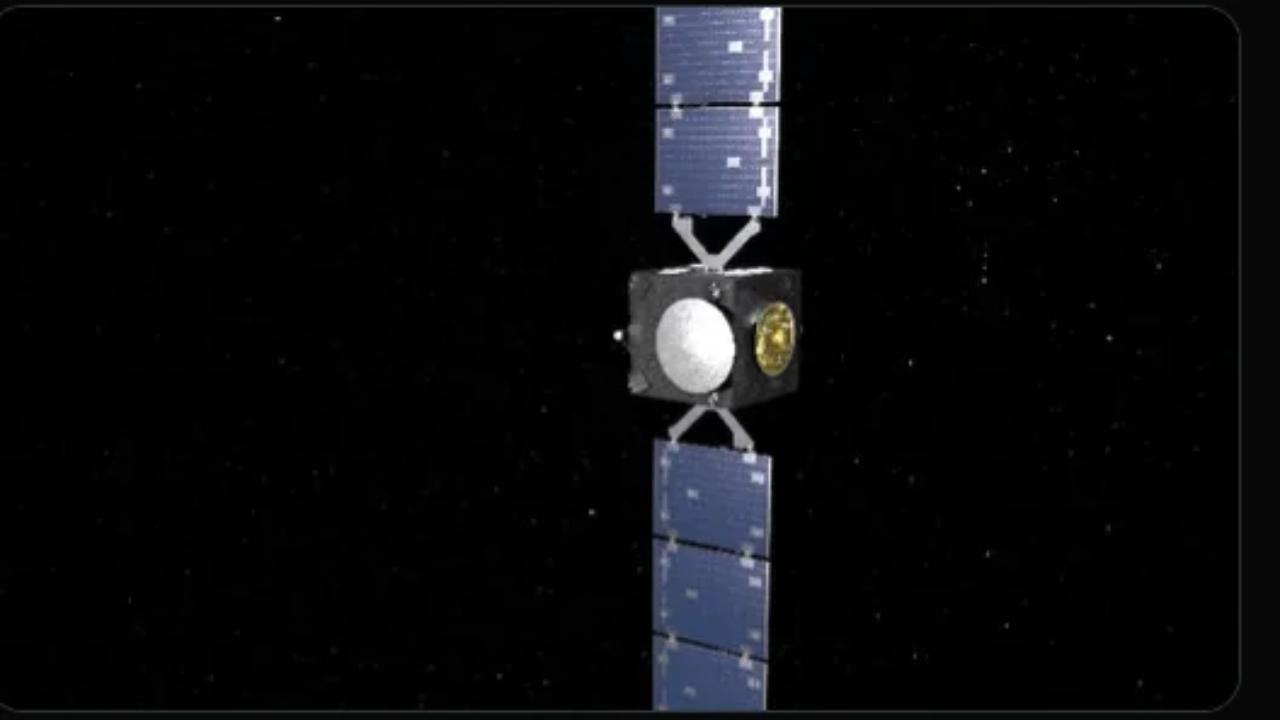
Some spin · most spun: Euronews 32/100 See every outlet’s spin ↓Photo as used by The Times of India for “Nasa asteroid crash site reached by European probe to assess deflection”How The Times of India framed it: The Times of India's lead image depicts a spacecraft against a dark, starry background. It centres the robotic mission rather than the impact or the asteroid pair.
ESA announced on 11 November that Hera had begun observing the asteroid pair from 25–30 kilometres away. NASA’s DART deliberately struck Dimorphos in 2022 and shortened its orbit around Didymos. The new investigation will examine the impact’s physical effects.
How the coverage differs
The Times of India provides the roughly 33-minute reduction in Dimorphos's orbit around Didymos; neither Euronews nor The Independent quantifies it. Euronews and The Independent both highlight the separate change in the pair's path around the Sun, but neither gives its 0.15-second scale. The Times of India describes Hera's outstanding questions about the asteroid's mass, structure and impact damage, while the other two accounts focus more briefly on the inspection and instruments. None of the three supplied texts explicitly says the asteroid pair poses no threat to Earth.
About 33 minutesReduction in Dimorphos’s orbital period around DidymosR3
0.15 secondsChange in the pair’s orbital period around the Sun reported in 2026 researchR5
What happened
Europe’s Hera spacecraft has begun examining the asteroid that NASA deliberately struck in 2022. ESA announced on 11 November that the probe was observing Didymos and its smaller companion, Dimorphos, from 25–30 kilometres away. Hera launched in October 2024.R1S1
The visit follows NASA’s Double Asteroid Redirection Test, or DART, which hit Dimorphos on 26 September 2022. Earth-based observations established that the collision shortened the smaller asteroid’s orbit around Didymos by approximately 33 minutes. Hera’s task is to investigate the physical consequences of that collision.R3R2
Why it matters
Neither asteroid threatens Earth, according to NASA. This was a test of a possible defence method, rather than an intervention against an approaching collision. NASA says a future mission would require detection early enough to send an impactor to the threatening object.R3R5
Changing an orbit does not by itself explain how another asteroid would respond. ESA says accurate measurements of Dimorphos’s mass, composition and structure are needed to interpret the impact and apply the results elsewhere. Material thrown into space added momentum beyond the spacecraft’s own impact; understanding that extra push is part of the investigation.R2
There are two orbital changes to distinguish. The roughly 33-minute reduction concerns Dimorphos’s journey around Didymos. Research described by NASA in March 2026 also found that the pair’s 770-day journey around the Sun changed by just 0.15 seconds. These figures measure different motions, rather than competing estimates of the same effect.R3R5
The background
Scientists have already inferred changes to the asteroid’s shape without inspecting it at close range. A 2024 study described by NASA used DART approach images, radar observations and variations in reflected light to model a more elongated Dimorphos. Hera’s observations offer a way to examine that earlier interpretation directly.R4
The same study calculated that the orbital period continued shortening after the collision as rocky material escaped. Its estimate settled at 11 hours, 22 minutes and three seconds, down by 33 minutes and 15 seconds. That more precise result explains what the commonly rounded 33-minute figure represents.R4R3
What happens next
ESA schedules a closer phase in December, starting at around 20 kilometres from the pair. The mission also plans to deploy two small CubeSats for further inspection and eventual landing attempts. These are future operations, rather than results already obtained.R1S3
The investigation still needs to establish the detailed surface changes, including whether the collision left a crater or substantially reshaped the body. The asteroid’s internal structure and precise mass are also central questions. ESA’s arrival announcement does not yet provide those final measurements.R2R1
What most outlets left out
Material facts only a few of the outlets we read included.
NASA says neither asteroid poses a threat to Earth.R3
The mission tests a future defence technique rather than responding to an imminent collision.
NASA described modelled shape changes in 2024 using spacecraft images, radar and reflected-light observations.R4
Hera can examine an existing interpretation through a close survey.
Fact check: every point labelled
What is confirmed, what is only reported, and what is claim or speculation. Every point links to its source.
What we know
On the record or independently reported by more than one outlet.
confirmedESA announced on 11 November 2026 that Hera had begun observing Didymos and Dimorphos from 25–30 kilometres away.R1
confirmedDART deliberately struck Dimorphos on 26 September 2022; Earth-based observations measured an orbital-period reduction of about 33 minutes around Didymos.R3
confirmedThe asteroid pair does not threaten Earth.R3
confirmedResearch described by NASA in March 2026 found a 0.15-second change in the pair’s 770-day orbital period around the Sun, a different motion from Dimorphos’s orbit around Didymos.R5
confirmedA 2024 study modelled a more elongated Dimorphos using DART approach images, radar and reflected-light observations; Hera is intended to survey the reshaping directly.R4
confirmedThe 2024 study calculated continued orbital shortening as material escaped, settling at 11 hours, 22 minutes and three seconds, a reduction of 33 minutes and 15 seconds.R4
confirmedThe detailed impact morphology, internal structure and precise mass remain questions for Hera; the arrival announcement does not report final measurements.R1R2
Reported but not yet confirmed
Reported as fact, but from a single origin.
reportedThe Times of India: Hera launched in October 2024.S1
Claims and disputes
What people say. Not established fact.
claimedNASA: A future impactor mission would require sufficiently early detection of a threatening asteroid.R5
claimedESA: Hera is intended to investigate physical changes and measure mass, composition and structure to interpret the impact and apply its results to other asteroids; ejected material added momentum.R2
claimedESA: A closer phase is scheduled for December, starting around 20 kilometres away.R1
claimedESA: Two CubeSats are intended to conduct closer inspections and attempt landings.R1S3
Context the headlines leave out
The changes to the moonlet’s orbit around Didymos and the pair’s orbit around the Sun are distinct measurements.R3R5
Still unknown
The detailed surface changes and whether a distinct impact crater remains.
Dimorphos’s precise mass and internal structure as measured by Hera.
The results of the planned closer surveys and CubeSat operations.
Key questions
Why did NASA crash a spacecraft into Dimorphos?
DART tested whether an impact could change an asteroid’s motion. The target pair does not threaten Earth.R3
What did DART change?
It shortened Dimorphos’s orbit around Didymos by roughly 33 minutes. Later research also found a 0.15-second change in the pair’s orbit around the Sun.R3R5
What will Hera investigate?
ESA plans to examine the impact’s effects and measure Dimorphos’s mass, composition and structure. These measurements are needed to interpret the deflection and apply the findings to other asteroids.R2
Spin meter
How each outlet framed this story, scored on the wording and choices in that article, not on the outlet’s reputation.
Headlines compared: The Times of India emphasises the crash site and assessing deflection. Euronews foregrounds the planetary-defence mission, while The Independent stresses the asteroid's connection to NASA's 2022 test.
EuronewsFraming: Not political · Spin 32/100 · Headline matches story: yes
“Europe's Hera spacecraft begins close inspections of asteroid in planetary defence mission”
Straight reportingHeavy spin
Euronews framed Hera's observations as a planetary-defence investigation, highlighting the solar-orbit change and the prospect of a future asteroid threat.
Why? 3 framing techniques
emotional appeala killer space rock The phrase evokes a catastrophic threat, although the tested asteroid pair does not threaten Earth.
emphasisMore importantly, it nudged the moonlet into a slightly different path around the sun The article prioritises the solar-orbit change without giving its 0.15-second scale or the roughly 33-minute shortening of the moonlet's orbit around Didymos.
omission Euronews does not state that the asteroid pair poses no threat to Earth or explain that Hera has yet to resolve the detailed impact morphology and mass.
The IndependentFraming: Not political · Spin 32/100 · Headline matches story: yes
“Europe's Hera spacecraft begins close inspections of an asteroid rammed by NASA in a 2022 test”
Straight reportingHeavy spin
The Independent framed Hera's observations as a follow-up to a planetary-defence test, highlighting the solar-orbit change and a possible future asteroid threat.
Why? 3 framing techniques
emotional appeala killer space rock The phrase evokes a catastrophic threat, although the tested asteroid pair does not threaten Earth.
emphasisMore importantly, it nudged the moonlet into a slightly different path around the sun The article prioritises the solar-orbit change without giving its 0.15-second scale or the roughly 33-minute shortening of the moonlet's orbit around Didymos.
omission The Independent does not state that the asteroid pair poses no threat to Earth or explain that Hera has yet to resolve the detailed impact morphology and mass.
The Times of IndiaFraming: Not political · Spin 15/100 · Headline matches story: yes
“Nasa asteroid crash site reached by European probe to assess deflection”
Straight reportingHeavy spin
The Times of India framed Hera's arrival as a detailed follow-up to a successful planetary-defence test, with several impact questions still unanswered.
Why? 2 framing techniques
emphasisNASA's historic collision The description emphasises the event's significance rather than simply identifying the 2022 test.
omission The supplied text does not state that the asteroid pair poses no threat to Earth, despite discussing a possible planetary emergency.
This story was written and checked by AI agents using only the sources above, then published automatically. Facts are labelled by how well they are supported. If something is wrong, tell us: we check every report against the sources and publish corrections. Editorial policy
ESA’s Hera begins close inspection of asteroid struck by NASA’s DART | NoDirection News