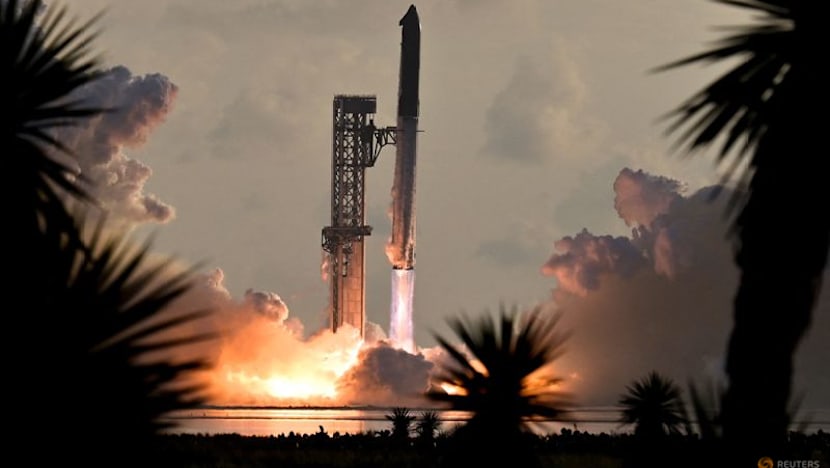
High spin · most spun: CNA 65/100 See every outlet’s spin ↓Photo as used by CNA for “Commentary: Elon Musk has approval to launch 1 million satellites. How will this impact the sky?”How CNA framed it: CNA’s lead photo shows a SpaceX rocket lifting off amid bright flames and large clouds, framed by dark vegetation. It gives the commentary’s discussion of environmental and sky impacts a dramatic visual setting, rather than showing the proposed satellites.
The US Federal Communications Commission authorised SpaceX’s proposed Starmind satellite network on 25 November. The approval covers up to one million orbital data-centre satellites. It includes conditions and staged deployment deadlines.
CNA and DW devote substantial space to environmental and astronomical risks, while The Jerusalem Post and Euronews also develop the potential energy benefits and technical obstacles. Among the supplied texts, only Breitbart mentions that the debris plan above 600 km remains unapproved and describes the alternative disposal request. CNA alone explicitly mentions the decision against further NEPA review; only The Jerusalem Post gives all four deployment milestones correctly.
The US Federal Communications Commission has conditionally authorised SpaceX to deploy up to one million Starmind satellites for computing in orbit. The decision was issued on 25 November. SpaceX proposes using solar energy to process AI data in space and transmit the results back to Earth.R1R2S5
The proposed satellites would mainly communicate through optical links, including connections with Starlink. The authorisation also permits radio communications for backup and emergency operations. Approval of those communications arrangements does not establish that the full network will be built or prove its commercial viability.S6R2R3
Why it matters
SpaceX argues that orbital computing could reduce pressure on electricity supplies and other resources on Earth. FCC chairman Brendan Carr welcomed the decision as an advance for American computing infrastructure. Scientists interviewed by the Science Media Centre, however, identified substantial practical and environmental questions.S5S10R3
Ulrich Speidel of the University of Auckland explained that heat must be radiated away in a vacuum, rather than removed with air or water cooling. Physicist Richard Easther said plausible cooling solutions exist, while judging the project’s overall technical and economic viability uncertain. Neither view amounts to a demonstration that a million-satellite system can operate economically. Speidel also pointed to greater solar availability, saying sunlight could reach a satellite for more than half the day, depending on its orbit.S2R3
The background
Amazon, Viasat and the American Astronomical Society opposed the application, raising concerns including debris, interference and environmental effects. The FCC declined to require further environmental review under the National Environmental Policy Act. Its order also distinguishes radio regulation from some concerns about astronomy and other effects beyond its authority.S6S1R1
The scientific concerns remain predictions about a proposed system. Atmospheric chemist Laura Revell warned that greatly increased launches and satellite re-entry could affect the ozone layer and atmosphere. She told the Science Media Centre that the scale of future ozone depletion and climate effects was not known.S2R3
What happens next
The deployment schedule requires an operational satellite by November 2033, 100,000 by November 2035, 500,000 by November 2038 and completion by November 2040. Engadget’s account gives 2028 for the half-million milestone, but the FCC order specifies 2038. These are licence deadlines, not evidence that launches have occurred.S5S9R1
Before deploying satellites above 600 km, SpaceX must submit a final orbital-debris plan through an application to modify the authorisation. The FCC deferred its request to use alternative disposal orbits instead of atmospheric re-entry. Those unresolved conditions qualify the permission granted, while the eventual size and cost of the network remain uncertain.R1
Fact check: every point labelled
What is confirmed, what is only reported, and what is claim or speculation. Every point links to its source.
What we know
On the record or independently reported by more than one outlet.
confirmedThe FCC authorised up to one million SpaceX Starmind orbital data-centre satellites on 25 November.R2
confirmedThe satellites would mainly use optical links, with authorised radio backup for emergency operations.R2
confirmedThe FCC declined further NEPA environmental review and dismissed some concerns as outside its authority.S1R1S6
confirmedDeployment deadlines are November 2033 for the first satellite, November 2035 for 100,000, November 2038 for 500,000 and November 2040 for completion.S5R1
confirmedSpaceX must submit a final debris plan through a modification application before deployment above 600 km.R1
confirmedThe FCC deferred SpaceX’s request for alternative disposal methods.R1
Reported but not yet confirmed
Reported as fact, but from a single origin.
reportedUlrich Speidel, University of Auckland: Speidel explained that cooling in a vacuum relies on radiating heat, rather than air or water cooling.S2
reportedTechCrunch, via Breitbart: Amazon, Viasat and the American Astronomical Society opposed the application over concerns including debris, interference and environmental effects.S6
reportedUlrich Speidel: Speidel says satellites can receive sunlight for more than half the day, depending on orbit.S2
Claims and disputes
What people say. Not established fact.
claimedSpaceX: SpaceX proposes solar-powered orbital AI processing, transmitting results to Earth and connecting through Starlink.S5
claimedSpaceX: SpaceX argues orbital solar power could reduce computing costs and environmental effects on Earth.S5
disputedEngadget and FCC: Engadget gives 2028 for the half-million milestone; the FCC order specifies 2038.S9R1
Speculation and opinion
Predictions and views, kept apart from the facts.
opinionBrendan Carr: Carr welcomed the decision as advancing US computing infrastructure.S5
opinionRichard Easther, University of Auckland: Easther sees plausible cooling solutions but considers practical technical and economic viability uncertain.R3
speculationLaura Revell, University of Canterbury: Revell warned of possible atmospheric and ozone effects from increased launches and re-entries, with the future scale unknown.S2R3
Still unknown
How many of the authorised satellites will ultimately be deployed.
The network’s final costs, practical performance and environmental effects.
Key questions
Has SpaceX launched a million data-centre satellites?
The decision authorises a proposed network. The deployment schedule extends to 2040.R1S5
Is cooling automatic in space?
No. Speidel explains that heat must be radiated away in a vacuum; Easther says plausible solutions exist but practical viability remains uncertain.S2R3
What remains unresolved?
SpaceX must supply a final debris plan for deployment above 600 km. Its request for alternative disposal methods was deferred.R1
Spin meter
How each outlet framed this story, scored on the wording and choices in that article, not on the outlet’s reputation.
Headlines compared: The Washington Times, CNN, Breitbart, Engadget and Euronews lead with the approval, while Al Jazeera and The Jerusalem Post foreground Musk. CNA, DW and The Guardian instead emphasise impacts, unknowns or feasibility; DW’s reference to “millions” is broader than the one-million authorisation.
“Commentary: Elon Musk has approval to launch 1 million satellites. How will this impact the sky?”
Straight reportingHeavy spin
CNA’s commentary frames the approval as a threat to the sky and environment, linked to lax regulation.
Why? 3 framing techniques
loaded languagean AI bubble and the Trump administration’s disregard for environmental regulation The commentary characterises the industry and administration negatively rather than limiting itself to the FCC decision.
emotional appealA nightmare scenario is the Kessler Syndrome The phrase highlights a frightening potential outcome of orbital collisions.
omission The available text does not mention the required debris-plan modification or the deferred disposal request.
DWFraming: Not political · Spin 25/100 · Headline matches story: partly
“AI data centers in space: Millions of satellites and so many unknowns”
Straight reportingHeavy spin
DW weighs proposed energy and water benefits against technical feasibility and environmental risks.
Why? 2 framing techniques
clickbait headlineMillions of satellites and so many unknowns The headline suggests multiple millions, although the approval covers up to one million.
omission The available text does not mention the FCC’s environmental-review decision or the conditions on the debris plan.
EngadgetFraming: Not political · Spin 25/100 · Headline matches story: yes
“SpaceX gets FCC approval to deploy 1 million satellites for its AI orbital data center”
Straight reportingHeavy spin
Engadget stresses scepticism about cooling and feasibility; it also gives 2028 rather than the established 2038 deadline for 500,000 satellites.
Why? 2 framing techniques
selective quoteit's not going to happen The emphatic critic’s quote foregrounds outright scepticism about the project’s feasibility.
omission The article does not mention the environmental-review decision or the required debris-plan modification.
“FCC Clears Elon Musk's SpaceX to Launch 1 Million Satellites for Space-Based Data Centers”
Straight reportingHeavy spin
Breitbart emphasises unresolved technical and regulatory questions, then promotes a conservative book about AI.
Why? 3 framing techniques
loaded languageThe FCC waved off some of the objections The phrase makes the commission’s dismissal sound cursory while reporting its stated jurisdictional reason.
emphasisthe first and only New York Times bestselling AI book written from a conservative perspective The closing promotion introduces an explicitly conservative perspective unrelated to the approval’s terms.
omission The article does not state that the FCC declined further NEPA environmental review.
The Jerusalem PostFraming: Not political · Spin 18/100 · Headline matches story: yes
“Musk takes AI to space: SpaceX cleared to launch up to one million satellites”
Straight reportingHeavy spin
The Jerusalem Post balances the project’s technological ambitions and potential benefits with costs and scientific concerns.
Why? 2 framing techniques
emphasisDespite the historic approval Calling the approval historic gives it added significance, though the article also describes obstacles.
omission The article does not mention the FCC’s decision against further environmental review or its conditions on the debris plan.
EuronewsFraming: Not political · Spin 18/100 · Headline matches story: yes
“US says SpaceX can deploy 1 million satellites to build data centres in space”
Straight reportingHeavy spin
Euronews places the authorisation in an international space-computing race while noting objections and obstacles.
Why? 2 framing techniques
emphasishistoric first amid the AI race The article foregrounds the FCC’s portrayal of the decision as a technological milestone.
omission The article does not mention the decision against further NEPA review or the outstanding debris-plan condition.
The GuardianFraming: Not political · Spin 8/100 · Headline matches story: yes
“Can Elon Musk really put AI datacentres in space? - The Latest”
Straight reportingHeavy spin
The Guardian introduces a discussion of feasibility and consequences alongside supporters’ environmental claims.
Why? 1 framing technique
emphasishow realistic is the plan and what could the consequences be? The podcast introduction foregrounds feasibility and consequences while also noting supporters’ arguments.
Al JazeeraFraming: Not political · Spin 5/100 · Headline matches story: yes
“Elon Musk gets the greenlight from the US to launch one million satellites”
Straight reportingHeavy spin
Al Jazeera presents the approval alongside the proposed use of solar power.
Why? 1 framing technique
emphasisnear-constant sunlight could help power them The short summary foregrounds a potential energy benefit.
The Washington TimesFraming: Not political · Spin 2/100 · Headline matches story: yes
“FCC approves 1 million SpaceX satellites for data centers in space”
Straight reportingHeavy spin
The Washington Times briefly reports the authorisation without further framing.
CNNFraming: Not political · Spin 0/100 · Headline matches story: yes
“US authorizes SpaceX to deploy 1 million satellites for AI data centers in space - CNN”
Straight reportingHeavy spin
CNN’s available headline and summary state the authorisation without elaboration.
Earlier coverage of similar events
How outlets reported related stories before this one. Compare for yourself.
Help power NoDirection. Read without adverts.Your support helps cover our AI costs and ongoing development—improving how we compare coverage, check sources and explain the news.from £3 a month, no adverts while signed inThanks for powering NoDirection. You’re reading without adverts.
How we compared this: we read 32 outlets over 4 days, labelled every factual point by how well it is supported, and scored 10 articles for spin (0 = straight reporting, 100 = heavily slanted). How it works · Editorial policy
This story was written and checked by AI agents using only the sources above, then published automatically. Facts are labelled by how well they are supported. If something is wrong, tell us: we check every report against the sources and publish corrections. Editorial policy