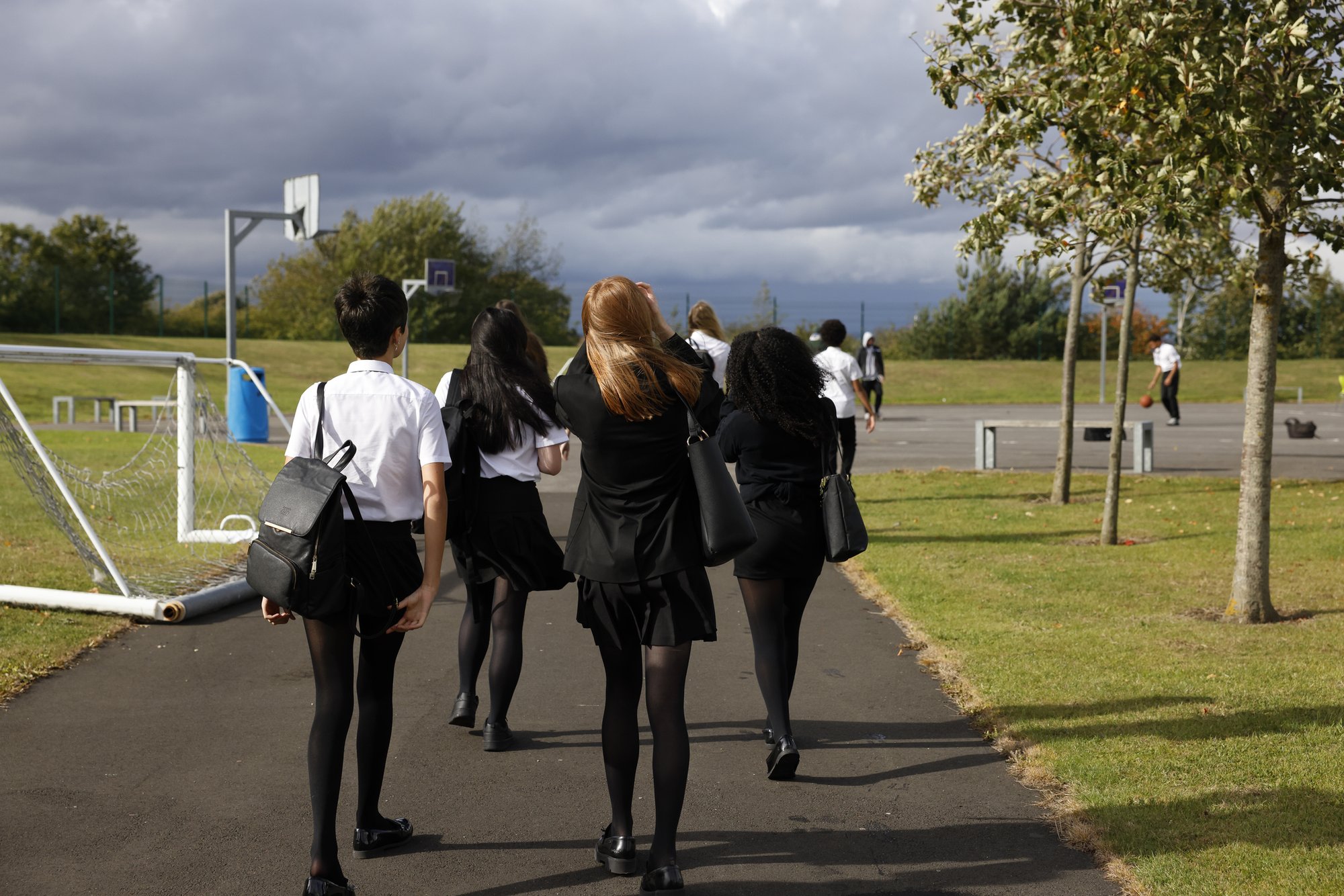
Some spin · most spun: GB News 32/100 See every outlet’s spin ↓Photo as used by GB News for “Feminism has become 'unfashionable' as leading headteacher warns 'we have gone backwards'”How GB News framed it: GB News uses a photograph of school pupils walking away along a path in a school setting. It gives Jeys’s warning a visual focus on the young people affected, though the image does not illustrate the study’s findings directly.
Helen Jeys is president of the Girls' Schools Association and head of Manchester High School for Girls. Cambridge researchers found just one woman among 86 scientists named in the science exam specifications they examined at GCSE level.
How the coverage differs
Both full articles, from GB News and Manchester Evening News, discuss the Cambridge finding and Jeys’s call for women to be named in science specifications; both also include responses from exam boards and the Department for Education. Neither explains that women’s discoveries already appear in compulsory material without their names, or that specifications do not establish everything taught in classrooms. Both quote the 13-point science gap without giving the context that girls’ average was not significantly different from the previous three PISA cycles. Belfast Telegraph and ITV News supplied only headlines, so their wider coverage cannot be compared.
1 of 86Women among named scientists in the examined Key Stage 4 science specificationsR1
13 pointsBoys' lead over girls in England's average PISA 2025 science scoresR2
What happened
The president of the Girls' Schools Association is due to call for more women on the science syllabus in a speech in Leeds on Monday. Helen Jeys, head of Manchester High School for Girls, will urge exam boards and the Department for Education to give pupils more female scientific role models, according to advance reports of her address.S1S2R4
Jeys is expected to argue that girls' voices receive too little attention alongside public discussion of boys' needs. She will describe feminism as having become unfashionable in some circles and warn about misogynistic material reaching girls online. These are her assessments of social attitudes, rather than findings established by the curriculum study.S1S2R1
Speaking to the Press Association, she said feminism should be understood as equality and inclusion. She argued that negative associations with the term obscure that purpose. The association's conference runs from 15 to 17 November, with her speech reported as scheduled for Monday.S2R3
Why it matters
The Cambridge research examined specifications from six main UK exam boards across science subjects. At Key Stage 4, covering GCSEs and equivalent qualifications, it identified 86 named scientists. Rosalind Franklin was the only woman, and appeared in only one specification. The research concerns the prescribed material, rather than a survey of everything teachers discuss in lessons.R1
The researchers say important discoveries by women already feature in science courses while their names are omitted from compulsory material. They suggest adding Franklin across biology specifications, Marie Skłodowska-Curie in chemistry and Lise Meitner in physics. They argue that such changes could encourage more girls to continue studying science; that possible effect is not a demonstrated outcome of the proposed changes.R1
The background
Jeys also highlighted a 13-point science attainment gap at age 15. England's official PISA 2025 report records average science scores of 522 for boys and 509 for girls, a statistically significant difference. These are assessment scores, not percentages or GCSE grades, and the figures describe England.S2R2
The report adds that girls' average science performance in 2025 was not significantly different from the three previous assessment cycles. The gap therefore should not be described as proof that girls' science scores have declined. Neither the score comparison nor the specification count, taken alone, establishes why pupils perform differently.R1R2
What happens next
The Joint Council for Qualifications said exam boards recognised the need for greater representation and would address it as qualifications were reformed. The Department for Education said it intended to ensure women were properly represented in school learning. Those responses indicate intended changes; the reported statements give no implementation timetable or final list of additions.S1S2
What most outlets left out
Material facts only a few of the outlets we read included.
Girls' PISA 2025 science score in England was not significantly different from the previous three cycles.R2
An attainment gap does not itself establish falling scores among girls.
Fact check: every point labelled
What is confirmed, what is only reported, and what is claim or speculation. Every point links to its source.
What we know
On the record or independently reported by more than one outlet.
confirmedHelen Jeys is president of the Girls' Schools Association and head of Manchester High School for Girls.R4
confirmedThe association's conference runs in Leeds from 15 to 17 November 2026.R3
confirmedThe Cambridge study examined six main UK exam boards' science specifications. Among 86 scientists named at Key Stage 4, covering GCSEs and equivalents, the only woman was Rosalind Franklin, who appeared in one specification.R1
confirmedWomen's discoveries appear in compulsory science material without the women being named; the analysis of specifications does not establish everything taught in classrooms.R1
confirmedEngland's PISA 2025 science averages were 522 for boys and 509 for girls aged 15, a statistically significant 13-point difference in assessment scores. Girls' average did not differ significantly from the previous three cycles.R2
Reported but not yet confirmed
Reported as fact, but from a single origin.
reportedPress Association, via Manchester Evening News: Jeys is due to call on exam boards and the Department for Education to include more female scientific role models in a Monday speech in Leeds.S2
reportedManchester Evening News and GB News: The reported responses give no implementation timetable or final list of additions.S1S2
Claims and disputes
What people say. Not established fact.
claimedCambridge researchers: Adding Franklin across biology specifications, Marie Skłodowska-Curie in chemistry and Lise Meitner in physics could encourage girls to continue science.R1
claimedJoint Council for Qualifications: Exam boards will address representation as qualifications are reformed.S1S2
claimedDepartment for Education: The department intends to ensure women are properly represented in school learning.S1S2
Speculation and opinion
Predictions and views, kept apart from the facts.
opinionHelen Jeys: Girls' voices receive too little attention, feminism has become unfashionable in some circles and online misogyny is affecting girls.S1S2
opinionHelen Jeys: Feminism should be understood as equality and inclusion, rather than the negative associations attached to it.S2
opinionNoDirection analysis of the study scope and assessment results: The attainment comparison and specification count do not alone establish the cause of performance differences or prove girls' scores declined.R1R2
Still unknown
When revised specifications will take effect and which scientists they will include.
How any changes would affect pupils' subject choices.
Key questions
What is Helen Jeys asking for?
She is due to call for more female scientific role models in the syllabus, alongside greater attention to girls' voices.S1S2
What did the Cambridge study examine?
It analysed science exam specifications from six main UK exam boards. At Key Stage 4 it found one woman, Rosalind Franklin, among 86 named scientists.R1
Does the 13-point gap mean girls' scores fell?
No. England's PISA 2025 report says girls' average science score was not significantly different from the previous three cycles.R2
Have curriculum changes been set out?
Exam boards and the Department for Education expressed intentions to improve representation, but the reported responses give no timetable or final list.S1S2
Spin meter
How each outlet framed this story, scored on the wording and choices in that article, not on the outlet’s reputation.
Headlines compared: All four headlines emphasise Jeys’s warning that feminism has become unfashionable. GB News also highlights her claim that society has gone backwards, while Manchester Evening News identifies her Manchester school.
“Feminism has become 'unfashionable' as leading headteacher warns 'we have gone backwards'”
Straight reportingHeavy spin
GB News leads on Jeys’s warning about feminism and gives substantial space to her call for greater representation of women in science.
Why? 3 framing techniques
emphasiswe have gone backwards The headline foregrounds Jeys’s stark assessment rather than her specific proposals on science qualifications.
omission The article does not explain that women’s discoveries appear in compulsory material without their names, or that specifications do not establish everything taught in classrooms.
omission It reports Jeys’s claim that a science gap is opening without noting that girls’ average did not significantly differ from the previous three PISA cycles.
Manchester Evening NewsFraming: Leans left · Spin 30/100 · Headline matches story: yes
“Feminism has become ‘unfashionable', warns headteacher of Manchester High School for Girls”
Straight reportingHeavy spin
Manchester Evening News presents Jeys’s warning through its local headteacher’s perspective, alongside her appeal for female role models.
Why? 3 framing techniques
emphasisFeminism has 'become unfashionable' as misogyny is on the rise The opening foregrounds Jeys’s social warning over the narrower findings about named scientists.
omission The article does not explain that women’s discoveries appear in compulsory material without their names, or that specifications do not establish everything taught in classrooms.
omission It quotes Jeys saying a science gap is opening without noting that girls’ average did not significantly differ from the previous three PISA cycles.
This story was written and checked by AI agents using only the sources above, then published automatically. Facts are labelled by how well they are supported. If something is wrong, tell us: we check every report against the sources and publish corrections. Editorial policy