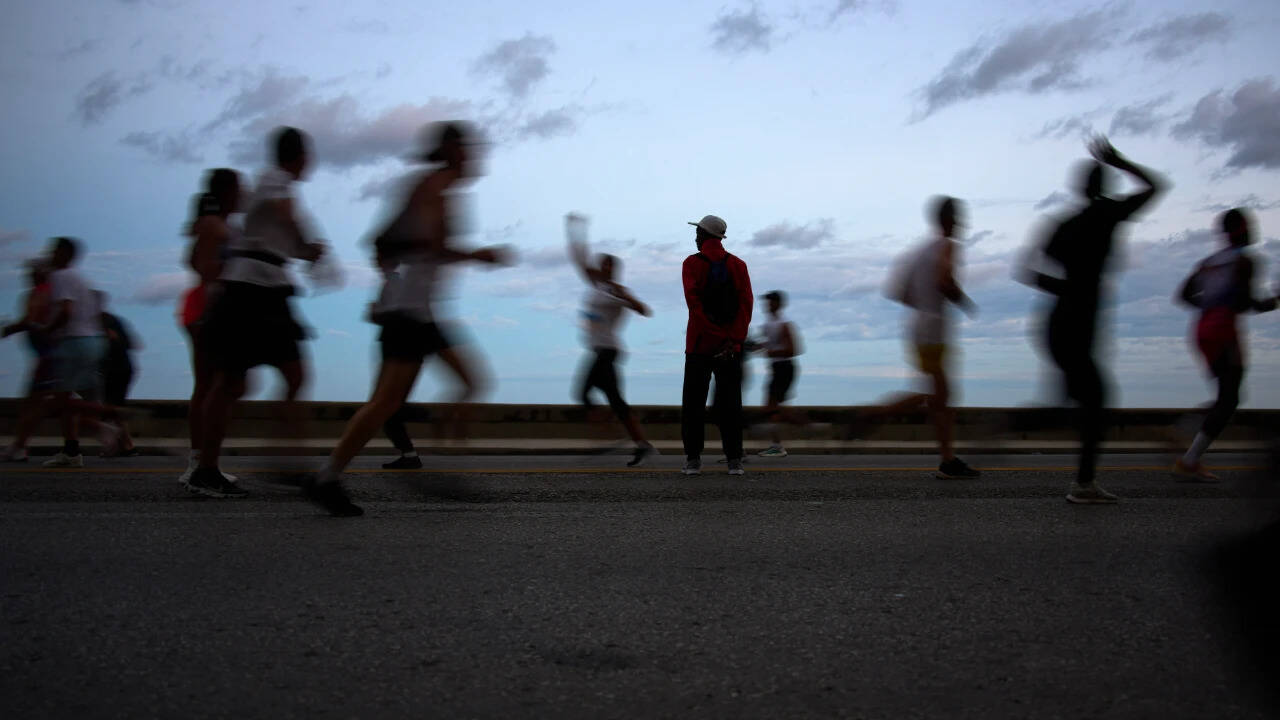
Some spin · most spun: The Times of India 48/100 See every outlet’s spin ↓Photo as used by The Times of India for “'Blockade is suffocating us': Cubans use Havana marathon to protest US sanctions”How The Times of India framed it: The Times of India’s lead image shows runners blurred in motion against a subdued sky, with a stationary figure in the centre. It emphasises the race’s atmosphere rather than visibly documenting the sanctions protest.
Havana hosted the Marabana running event on Sunday, 15 November. The Associated Press reported about 3,000 participants, some displaying messages against US sanctions. Organisers described it as the event's 40th edition.
How the coverage differs
The Times of India leads on solidarity, while The Independent and The Washington Times lead on participation alongside protest; The Washington Times is available only as a summary. Of the three, only The Independent names Adidas as a sponsor that did not provide support that year and mentions Meliá’s withdrawal from Cuba. The Times of India and The Independent discuss the January tariff announcement and fuel shortages, but neither mentions the February order ending additional emergency-law duties under the Cuba order.
Some runners in Havana's Marabana event used Sunday's races to protest US economic sanctions against Cuba. The Associated Press reported about 3,000 participants, with many wearing messages opposing Washington's policy. That figure describes attendance at the event, rather than a separately counted number of protesters or full-marathon finishers.S2
The running programme included a marathon, half-marathon, 10-kilometre and five-kilometre races. Organisers identified 15 November as the date of the 40th edition, and the Association of International Marathons and Distance Races lists Marabana as a full member. The shorter distances formed part of the same event alongside the longer races.R1R2
AP described families with children and people with disabilities taking part, with spectators watching from the pavements. The route passed landmarks including the Paseo del Prado and the Capitol building. Foreign participants were among those displaying solidarity messages; the report describes some wearing red-and-white sweatshirts carrying the words “Cuba is not alone”.S2
Why it matters
Yuraldi Cava, a 58-year-old state employee interviewed while running, blamed US policy for hardship on the island. “The blockade is suffocating the Cuban people,” Cava told AP. The comment expresses a participant's assessment of the sanctions, rather than a measurement of their effect on every aspect of Cuba's economy.S2
Havana's provincial sports coordinator, Mayté Vigoa, said difficult economic conditions had required a major effort to stage the race. She said Adidas, previously a longstanding sponsor, had provided no support this year. AP also reported widespread electricity cuts affecting water supplies, telephone services and internet access, and linked fuel shortages to US pressure on suppliers.S2
The background
President Donald Trump's 29 January executive order established a process for additional US import duties on goods from countries supplying oil to Cuba. It required findings and recommendations by US officials before a presidential decision on tariffs. Trump justified the measure on national-security and foreign-policy grounds; that rationale was the administration's stated position.R3
A later order, dated 20 February, ended the additional duties imposed under the emergency-powers law through the listed orders, including the January Cuba order. It preserved the declared emergencies and other actions outside those tariff provisions. The January threat and the later treatment of those duties are therefore distinct parts of the policy record.R4
The White House subsequently announced broader sanctions on 1 May against people and entities supporting Cuba's government and security apparatus. Those measures provide further context for the runners' opposition, without establishing that any single US action explains the race's sponsorship losses or the island's wider economic difficulties.R5S2
Fact check: every point labelled
What is confirmed, what is only reported, and what is claim or speculation. Every point links to its source.
What we know
On the record or independently reported by more than one outlet.
confirmedThe report's attendance figure is not a separately established count of protesters or marathon finishers.S2
confirmedOrganisers scheduled the 40th edition for 15 November with marathon, half-marathon, 10km and 5km events; AIMS lists Marabana as a full member.R1R2
confirmedThe 29 January order created a process for additional tariffs on countries supplying oil to Cuba, requiring official findings, recommendations and a presidential decision.R3
confirmedThe 20 February order ended additional emergency-law duties under listed orders including the Cuba order, while preserving emergencies and other non-tariff actions.R4
confirmedOn 1 May the White House announced broader sanctions against people and entities supporting the Cuban government and security apparatus.R5
confirmedThe cited announcements do not establish the contribution of any individual policy action to race sponsorship losses or Cuba's wider economic difficulties.R3R4R5S2
Reported but not yet confirmed
Reported as fact, but from a single origin.
reportedAssociated Press: About 3,000 people participated in Havana's Marabana on 15 November; some wore protest messages against US sanctions.S2
reportedAssociated Press: Families, children and people with disabilities participated; the route passed Paseo del Prado and the Capitol, and foreigners wore solidarity messages.S2
reportedAssociated Press: Yuraldi Cava is a 58-year-old state employee interviewed while running.S2
reportedAssociated Press: Electricity cuts disrupt water, internet and telephone services, with fuel shortages linked to US pressure on suppliers.S2
Claims and disputes
What people say. Not established fact.
claimedMayté Vigoa, Havana provincial sports coordinator: Economic conditions made staging the race difficult, and Adidas provided no support this year.S2
claimedDonald Trump: The measure was necessary to protect US national security and foreign policy.R3
Speculation and opinion
Predictions and views, kept apart from the facts.
opinionYuraldi Cava: US policy is suffocating the Cuban people.S2
Still unknown
The independently verified number of participants who protested.
The extent to which particular policy measures affected race sponsorship.
Key questions
What happened at the Havana marathon?
Some participants displayed messages opposing US sanctions during the Marabana races, according to AP.S2
Was the event only a full marathon?
No. The programme also included a half-marathon and 10km and 5km races.R1
What did organisers say about sponsorship?
Provincial sports coordinator Mayté Vigoa said Adidas had not supported this year's event.S2
Spin meter
How each outlet framed this story, scored on the wording and choices in that article, not on the outlet’s reputation.
Headlines compared: The Times of India leads with a protester’s emotive quotation and presents the marathon as a vehicle for protest. The Independent and The Washington Times use the same headline, foregrounding both attendance and opposition to sanctions.
The Times of IndiaFraming: Leans left · Spin 48/100 · Headline matches story: yes
“'Blockade is suffocating us': Cubans use Havana marathon to protest US sanctions”
Straight reportingHeavy spin
The Times of India frames the race as a show of solidarity against US restrictions amid Cuba’s economic crisis.
Why? 3 framing techniques
emphasisbecame a show of solidarity The opening presents solidarity as the event’s defining feature, although the attendance figure does not establish how many protested.
speculation as factThe threat has effectively cut off fuel supplies to the island The article states a policy’s contribution to fuel shortages as established, although the cited announcements do not establish its contribution.
omission The article omits that the February order ended additional emergency-law duties under the Cuba order while preserving other actions.
The IndependentFraming: Leans left · Spin 44/100 · Headline matches story: partly
“Thousands run Cuba’s Marabana marathon as many protest US sanctions”
Straight reportingHeavy spin
The Independent combines race coverage with participants’ criticism of sanctions and an account of Cuba’s economic difficulties.
Why? 4 framing techniques
speculation as facthe would impose tariffs on any country that sells or provides oil to Cuba The January order created a decision process rather than automatically imposing tariffs on every supplying country.
speculation as factThe warning has effectively cut off fuel to the island The article presents the warning’s contribution to fuel shortages as established, although the cited announcements do not establish it.
omission The article omits that the February order ended additional emergency-law duties under the Cuba order while preserving other actions.
emphasismany of the 3,000 participants The wording uses the reported attendance figure to characterise the scale of protest, though it is not a separately established protester count.
The Washington TimesFraming: Not political · Spin 10/100 · Headline matches story: partly
“Thousands run Cuba's Marabana marathon as many protest U.S. sanctions”
Straight reportingHeavy spin
The Washington Times briefly reports participation in the race and protests against US sanctions.
Why? 1 framing technique
emphasismany protest U.S. sanctions The headline emphasises the protest more strongly than the summary’s description that some participants used the race to protest.
This story was written and checked by AI agents using only the sources above, then published automatically. Facts are labelled by how well they are supported. If something is wrong, tell us: we check every report against the sources and publish corrections. Editorial policy