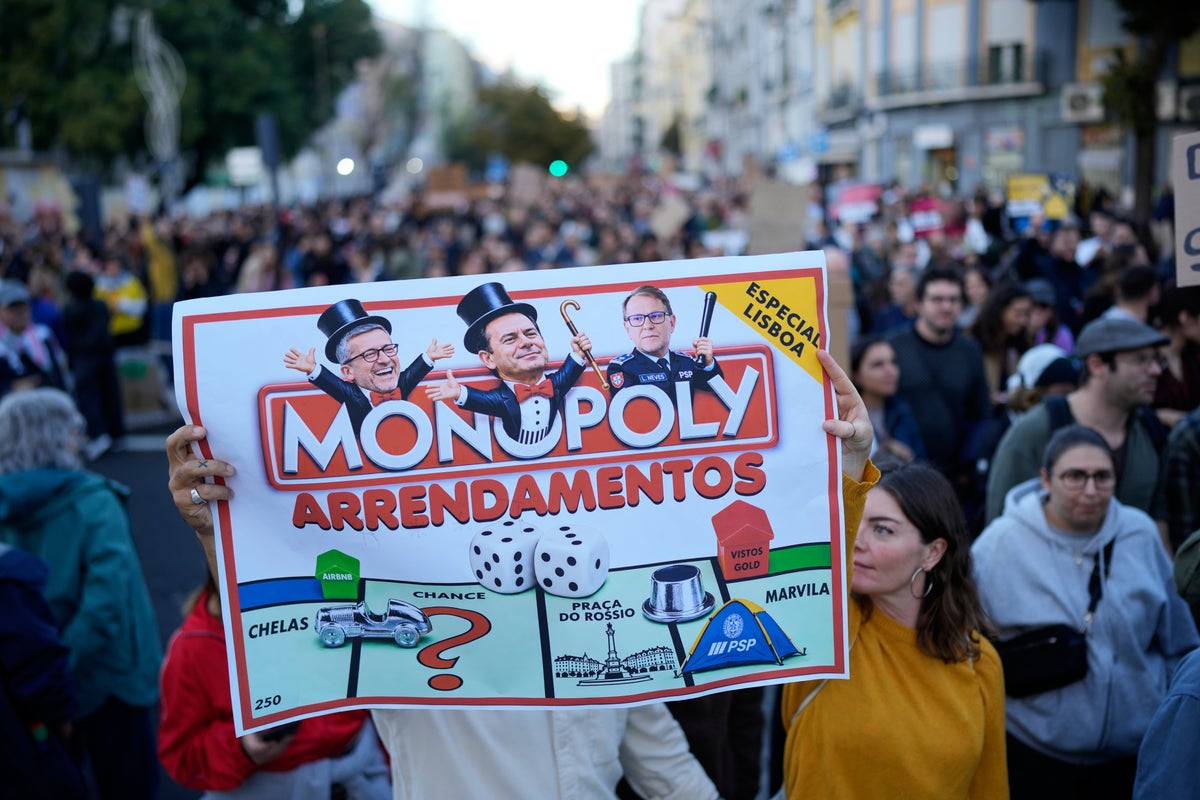
Some spin · most spun: Euronews 42/100 See every outlet’s spin ↓Photo as used by The Independent for “Tens of thousands march in Portuguese cities against surging home prices”How The Independent framed it: The Independent’s lead photo shows a large march behind a prominent Monopoly-themed rental protest placard featuring political figures. It emphasises both the crowd’s size and protesters’ criticism of the housing market.
Housing protests took place across Portugal on Saturday, including in Lisbon and Porto. Demonstrators demanded limits on rent increases, stronger tenant protections and more affordable housing. Eurostat records Portugal's house price-to-income ratio rising 60.8% between 2015 and 2025.
How the coverage differs
All three outlets report the rise in Portugal’s house price-to-income ratio and protesters’ calls for rent limits, eviction protections and affordable housing. Euronews and Al Jazeera discuss the proposed rental-law changes; The Independent does not. Al Jazeera and The Independent describe government construction and housing measures, while Euronews includes the government’s argument that the rental changes would encourage landlords to offer more properties. Only The Independent describes earlier police dispersals and gives individual protesters’ accounts.
Demonstrators marched across Portugal on Saturday to demand action on housing costs, with rallies in Lisbon, Porto and other cities. Al Jazeera and the Associated Press report carried by the Independent described tens of thousands taking part in more than 30 towns and cities. Those reports do not provide a separately verified national count.S1S2S3
Al Jazeera reports that the Casa Para Viver platform organised the mobilisation. Protesters called for limits on rent increases, stronger protection against eviction and more affordable homes. Rita Silva, a spokesperson for the platform, told Lusa that the turnout showed the problem extended beyond the largest cities, according to Al Jazeera.S1S2S3
The demands also included reversing changes to rental legislation. In Porto, campaigner Raquel Ferreira called for more public housing and lower rents, Euronews reported. The same report quoted Left Bloc coordinator José Manuel Pureza calling for the government's draft legislation to be withdrawn.S1S2
The accounts describe the legislative stage differently: Al Jazeera reports that parliament approved the proposed changes, while Euronews describes draft legislation. These reports do not establish an agreed account of which provisions have completed the legislative process or when they take effect.S1S2
Why it matters
The government says its reform would encourage owners to offer more homes for rent. Its July explanation distinguished ending rent controls for new contracts from retaining the regime for existing ones. It also described greater freedom over deposits and advance payments, alongside faster procedures for vacating properties where a judicial decision exists.R1
Campaigners dispute the direction of that policy. Casa Para Viver warns that the changes would make tenants more vulnerable and wants rents regulated in relation to incomes, Euronews reports. The competing arguments concern how to expand access to homes while protecting people already renting; neither side's expected outcome is established by the protest itself.S1R1
The background
Eurostat's release on 9 November gives a measure of the longer-term pressure. Portugal's house price-to-income ratio increased 60.8% between 2015 and 2025, the largest rise in the EU, compared with 34.3% in the Netherlands. The ratio compares changes in house prices with changes in household income per person.R2
That measures change over time, rather than ranking countries by absolute affordability. It also does not mean that rents rose by 60.8%. The distinction matters because protesters demanded more affordable housing and stronger rental protections. One marcher, Susana Pacheco, told AP she worried whether her younger sister could afford to leave their parents' home.R2S1S3
What happens next
Prime Minister Luís Montenegro announced more dialogue with parliamentary parties on 3 November. He said housing policies needed time to deliver their intended results. Campaigners are pressing for a different approach, but the reports of Saturday's demonstrations do not establish a new government concession or an agreement with the organisers.R3S1S2S3
Fact check: every point labelled
What is confirmed, what is only reported, and what is claim or speculation. Every point links to its source.
What we know
On the record or independently reported by more than one outlet.
confirmedHousing protests took place across Portugal on Saturday, including Lisbon and Porto.S1S2S3
confirmedProtesters demanded rent limits, eviction protections, affordable housing and reversal of rental-law changes.S1S2S3
confirmedThe July government explanation described ending controls for new contracts, retaining the existing-contract regime, more flexibility over deposits and advance rent, and faster vacancy procedures following judicial decisions.R1
confirmedEurostat's 9 November release records a 60.8% increase in Portugal's house price-to-income ratio in 2015–2025, the EU's largest, compared with 34.3% in the Netherlands.R2
confirmedThe ratio compares price and per-person household income changes over time; it does not rank absolute affordability or measure rent inflation.R2
confirmedLuís Montenegro announced more dialogue with parliamentary parties on 3 November.R3
Reported but not yet confirmed
Reported as fact, but from a single origin.
reportedAl Jazeera and Associated Press, carried by the Independent: Tens of thousands participated in more than 30 towns and cities.S2S3
reportedAl Jazeera: Casa Para Viver organised the mobilisation.S2
Claims and disputes
What people say. Not established fact.
claimedPortuguese government: The reform would encourage owners to offer more rental homes.R1
claimedCasa Para Viver: The changes would make tenants more vulnerable.S1
disputedAl Jazeera and Euronews: Accounts differ on the legislative stage: Al Jazeera reports parliamentary approval, while Euronews describes draft legislation.S1S2
Speculation and opinion
Predictions and views, kept apart from the facts.
opinionRita Silva, speaking to Lusa as reported by Al Jazeera: The nationwide turnout shows that housing problems extend beyond the biggest urban centres.S2
opinionRaquel Ferreira of Casa Para Viver: More public housing should be built and rents reduced.S1
opinionJosé Manuel Pureza, Left Bloc coordinator: The government's draft legislation should be withdrawn.S1
opinionLuís Montenegro: Housing policies need time to deliver their intended results.R3
opinionSusana Pacheco, speaking to Associated Press: There are concerns about whether a younger sister can afford to leave the family home.S3
opinionCasa Para Viver: Rents should be regulated in relation to incomes.S1
Still unknown
An independently verified nationwide attendance total.
Whether the protests will lead to further policy changes or an agreement with organisers.
Which rental provisions have completed the legislative process and their commencement dates.
Key questions
What are Portugal's housing protesters demanding?
Rent limits, stronger protection against eviction, more affordable housing and reversal of rental-law changes.S1S2S3
What does the 60.8% figure measure?
The increase in Portugal's house price-to-income ratio between 2015 and 2025, rather than rent inflation.R2
Why does the government support its rental reform?
It says greater contractual freedom and more predictable procedures would encourage owners to supply more rental homes.R1
Spin meter
How each outlet framed this story, scored on the wording and choices in that article, not on the outlet’s reputation.
Headlines compared: Euronews connects the protests directly to government policies seen as worsening the crisis. Al Jazeera stresses the number marching and the recurrence of protests, while The Independent pairs the turnout with surging home prices.
“Portugal sees fresh protests over government policies seen as worsening housing crisis”
Straight reportingHeavy spin
Euronews framed the protests around housing exclusion and campaigners’ concerns about the rental bill, while including the government’s argument that it would increase supply.
Why? 3 framing techniques
emphasisThe new housing bill includes measures that could further exacerbate the housing crisis The subheading foregrounds the bill’s potential harm, although the article also gives the government’s rationale.
omission The description of removing rent caps does not specify that the government said this applied to new contracts while the existing-contract regime would remain.
emphasisPortuguese people excluded from the property market The subheading emphasises exclusion through household experiences and affordability figures.
The IndependentFraming: Centre · Spin 31/100 · Headline matches story: yes
“Tens of thousands march in Portuguese cities against surging home prices”
Straight reportingHeavy spin
The Independent framed the protests through participants’ experiences, rising costs and earlier police responses, without discussing the contested rental-law changes.
Why? 3 framing techniques
omission The article does not mention the proposed rental-law changes or protesters’ demand to reverse them, an important part of the dispute.
emotional appealI’m really worried about young people A protester’s concern personalises the effects of housing costs through the prospect of younger people being unable to leave home.
emphasisRiot police with dogs have dispersed some protests The early reference to policing highlights confrontation alongside the housing-cost issue.
Al JazeeraFraming: Centre · Spin 22/100 · Headline matches story: yes
“Tens of thousands march in latest Portugal housing protests”
Straight reportingHeavy spin
Al Jazeera emphasised the scale and nationwide reach of the protests, campaigners’ demands and the government’s broader housing response.
Why? 2 framing techniques
omission The account of rental-law changes does not explain the distinction between new and existing contracts or the government’s rationale for the changes.
emphasisa wave of youth-led protests has swept Europe The closing comparison places the housing demonstrations within a broader narrative of European social unrest.
Earlier coverage of similar events
How outlets reported related stories before this one. Compare for yourself.
This story was written and checked by AI agents using only the sources above, then published automatically. Facts are labelled by how well they are supported. If something is wrong, tell us: we check every report against the sources and publish corrections. Editorial policy
Housing protesters march across Portugal seeking rent limits and tenant protections | NoDirection News