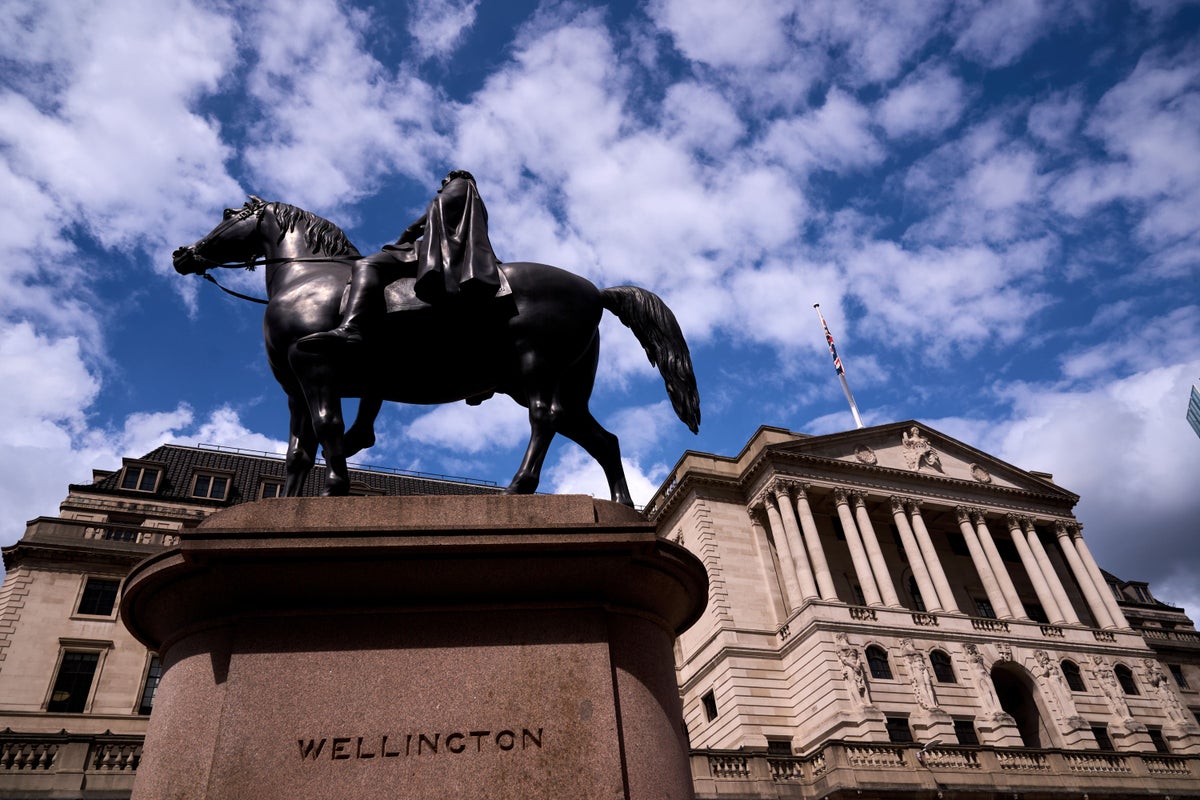
High spin · most spun: The Guardian 68/100 See every outlet’s spin ↓Photo as used by The Independent for “Further interest rate rises needed to tackle inflation, Bank of England’s chief economist says”How The Independent framed it: The Independent’s lead image shows the Bank of England behind the Wellington equestrian statue. Its imposing institutional setting reinforces the focus on the central bank and its authority over interest rates.
Huw Pill has indicated support for further rate rises in comments to the Financial Times reported by the Independent. Bank Rate is currently 4%. The Bank's calendar lists its next decision for 17 December.
How the coverage differs
The Independent gives the most detail on Pill’s remarks, including his qualification about market pricing and the lack of clear evidence of second-round effects. The Guardian leads on household and public-sector costs, arguing that resistance to price increases could limit inflation; it alone names the 17 December meeting. The Financial Times provides only a headline and summary here. Neither of the two full articles reports the 8–1 vote or Mann’s preference for a half-point rise.
Bank of England chief economist Huw Pill expects further interest-rate increases after the rise to 4% announced this month. The Independent, reporting his Financial Times interview, says he indicated support for another quarter-point increase in December and anticipated further increases in 2027. Those are his expectations, rather than decisions already taken by the Monetary Policy Committee.S1S3
Pill described the recent increase as a significant move but said there was more to do. He regarded market expectations of rates approaching 5% next year as plausible, while declining to endorse everything priced into markets. That distinction leaves both the eventual peak and the timing of any further rises uncertain.S1
Why it matters
Pill's concern is that the energy-price shock could spread into broader price increases and wage demands, sustaining inflation. The Independent quotes him acknowledging that evidence next year could develop in different directions. His stated bias is towards worrying that these additional effects will magnify inflation, rather than claiming they have already fully materialised.S1
The Bank's November report records September inflation at 3.5% and projects around 5% by the middle of 2027, before a decline. That 5% is an inflation forecast, separate from discussion of interest rates approaching the same number. The report says evidence of wider effects on prices and wages has so far been limited.R2
The background
The published minutes of November's policy meeting show an 8–1 vote for a quarter-point increase to 4%, with Pill in the majority. Catherine Mann favoured a larger half-point increase to 4.25%. The division was therefore about the size of the increase, not whether rates should rise at that meeting.R1
Support for November's rise did not mean every member backed a fixed sequence of increases. Alan Taylor's published explanation treats it as an insurance move and says further tightening depends on emerging evidence. This gives context to Pill's more definite expectation of additional rises.R1S1
The Independent also reports that the National Institute of Economic and Social Research believes rates need to reach 5% to address persistent inflation risks. The think tank expects one further increase but argues that would be insufficient. Its assessment is another forecast and recommendation, rather than the Bank's adopted policy.S1
What happens next
The Bank's calendar schedules the next announcement for Thursday, 17 December. Its November report says decisions will be reassessed at each meeting, with attention to pay, pricing behaviour and spare capacity in the economy. Whether those indicators justify another increase remains a decision for the committee.R2R3
Fact check: every point labelled
What is confirmed, what is only reported, and what is claim or speculation. Every point links to its source.
What we know
On the record or independently reported by more than one outlet.
confirmedThe November vote was 8–1 for a quarter-point rise to 4%; Pill backed it, while Catherine Mann preferred a half-point rise to 4.25%.R1
confirmedThe calendar lists the next announcement for 17 December 2026.R3
Claims and disputes
What people say. Not established fact.
claimedBank of England: Evidence of broader effects on wages and prices has been limited so far.R2
claimedBank of England: Policy decisions will be reassessed at each meeting using evidence including pay, pricing behaviour and economic slack.R2
Speculation and opinion
Predictions and views, kept apart from the facts.
speculationHuw Pill, in the FT interview reported by the Independent: Further rate rises are expected, with support indicated for a quarter-point rise in December and further increases in 2027.S1
opinionHuw Pill: The recent increase was significant but more tightening is needed.S1S3
opinionHuw Pill: Market expectations of rates approaching 5% are plausible, without endorsing the full priced path.S1
speculationHuw Pill: Second-round effects could magnify the inflationary impact of higher energy prices, although evidence next year could develop in different directions.S1
speculationBank of England: Inflation is projected around 5% by mid-2027 and then to decline.R2
opinionAlan Taylor: November's rise was an insurance move, with further tightening dependent on evidence.R1
opinionNIESR, reported by the Independent: Rates need to reach 5%, and only one further rise would be insufficient.S1
speculationNIESR, reported by the Independent: One further interest-rate increase is expected.S1
Still unknown
The committee's December vote.
The eventual peak of Bank Rate.
The strength of any second-round inflation effects.
Key questions
Has another interest-rate rise been decided?
No new decision is established here. Pill has indicated his preference, while the Bank says policy will depend on the evidence at each meeting.S1R2
When is the next Bank of England decision?
The Bank's published calendar lists 17 December 2026.R3
Are inflation and Bank Rate both forecast to reach 5%?
The Bank projects inflation around 5% by mid-2027. Pill regards market expectations of interest rates approaching 5% as plausible, without endorsing the entire priced path.R2S1
Spin meter
How each outlet framed this story, scored on the wording and choices in that article, not on the outlet’s reputation.
Headlines compared: The Independent and the Financial Times lead on Pill’s call for further rises to combat inflation. The Guardian stresses the apparent inevitability of a rapid rise and its cost to households.
The GuardianFraming: Leans left · Spin 68/100 · Headline matches story: yes
“A rapid interest rate rise seems inevitable – and households are expected to pick up the tab”
Straight reportingHeavy spin
The Guardian frames further rate rises as a burden on households and argues that consumers and public bodies could resist corporate price increases.
Why? 4 framing techniques
loaded languagegreedy corporates The phrase casts businesses as self-interested actors rather than neutrally describing their pricing decisions.
emotional appealdon Scrooge masks The Christmas imagery portrays a possible rate rise as a harsh seasonal blow to households.
opinion as factinflation will not hit the heights forecast by the Bank of England The article states a contested economic prediction definitively, though it depends on uncertain consumer behaviour.
omission The Guardian does not report the September inflation figure or the November vote split and Mann’s preference for a larger rise.
The IndependentFraming: Not political · Spin 22/100 · Headline matches story: yes
“Further interest rate rises needed to tackle inflation, Bank of England’s chief economist says”
Straight reportingHeavy spin
The Independent focuses on Pill’s expectation of further rises, while including his qualifications about market pricing and inflation risks.
Why? 2 framing techniques
emphasiswill likely need to hike interest rates further next month The opening foregrounds a near-term rise, although Pill also acknowledged uncertainty about how inflationary effects might develop.
omission The Independent does not mention the 8–1 vote or Catherine Mann’s preference for a larger half-point rise.
Financial TimesFraming: Not political · Spin 8/100 · Headline matches story: yes
“BoE chief economist says further rate rises needed to combat inflation”
Straight reportingHeavy spin
The Financial Times presents Pill’s view that borrowing costs need to rise further, using his description of the latest increase.
Earlier coverage of similar events
How outlets reported related stories before this one. Compare for yourself.
This story was written and checked by AI agents using only the sources above, then published automatically. Facts are labelled by how well they are supported. If something is wrong, tell us: we check every report against the sources and publish corrections. Editorial policy