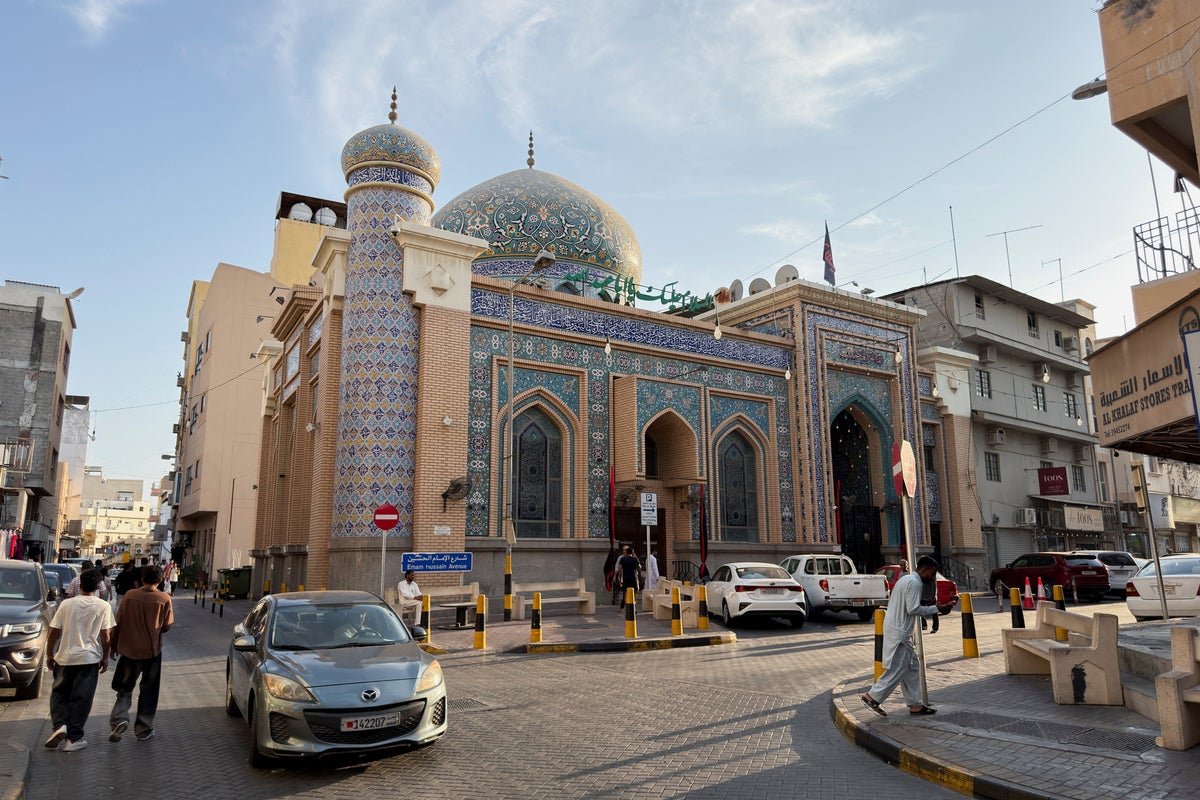
Some spin · most spun: Daily Mirror 48/100 See every outlet’s spin ↓Photo as used by The Independent for “Iran launches strikes on Bahrain as Tehran says it attacked US military base”How The Independent framed it: The Independent’s lead photo shows an ornate domed building beside a street with pedestrians and traffic, rather than the attack or its aftermath. It gives the story a calm, everyday setting in contrast with the headline’s account of strikes.
Bahrain's military announced interceptions on 15 November, after authorities issued shelter alerts. Iran's Revolutionary Guard said six drones targeted a US air-defence radar at Al-Riffa. The latest accounts do not independently establish damage, and a US denial of radar destruction relates to a separate attack on 13 November.
How the coverage differs
Of the six supplied readable full texts, The Guardian alone leads on the four regional condemnations; its excerpt does not include Iran’s stated radar target. The Independent, France 24 and the Daily Mail recount the earlier attack alongside the US account of two intercepted drones without damage, while The Japan Times instead describes the latest strike as the first on Bahrain since September. The Daily Mirror connects the attack to Trump’s assessment and attributes a radar-destruction claim to Iran, whereas France 24 quotes the Sunday statement as saying the radar was targeted. The New York Times provided no readable article text, and Al Jazeera, The Washington Post and Irish Independent were available only as headlines or short summaries.
6 dronesNumber claimed by the Guard for Sunday's radar operationS7
2 dronesNumber CENTCOM says US forces intercepted on FridayR2
13 and 15 NovemberDates of the separate Bahrain attack accountsR2S7
What happened
Bahrain's military says it intercepted and destroyed Iranian aerial attacks on Sunday 15 November before they reached their objectives. Iran's Islamic Revolutionary Guard Corps separately said six drones targeted a US air-defence radar at the Al-Riffa helicopter base. The statements establish competing military accounts, rather than an independently verified assessment of Sunday's damage.R1S7
Bahrain's Interior Ministry issued alerts urging residents to remain calm, move to safety and follow official information. An AFP journalist heard explosions around 4am local time, and residents reported another series around 6.30am. Bahrain's foreign ministry also said Iranian drones had been shot down.S7
Why it matters
The latest announcement follows an earlier radar claim on Friday 13 November. Iran then said it had destroyed a US early-warning radar in retaliation for an alleged strike on a telecommunications tower in Sirik, southern Iran. US Central Command subsequently denied that account, saying American forces had shot down two Iranian drones without injuries or damage.R2
CENTCOM's statement is dated 13 November and identifies two one-way attack drones launched towards Bahrain. Its assertion that there were no injuries or damage therefore concerns Friday. The supplied Sunday reports do not provide an independently verified casualty or damage assessment for the latest operation.R2S1S7
There is another distinction within the reporting. The Guard statement quoted by AFP says the Al-Riffa radar was targeted; the Japan Times reports an Iranian claim of successful impact. Neither is independent evidence that a radar was destroyed. Bahrain's Defence Force statement gives no precise interception count, so Iran's six-drone figure remains its own account.S7S8R1
The background
Bahrain hosts the US Navy's Fifth Fleet. The regional war began with US and Israeli strikes on Iran on 28 February, and subsequent Iranian attacks targeted American assets and infrastructure in Gulf countries. The Sunday operation comes after months of fighting, rather than marking the start of a new conflict.S1S7R3
Saudi Arabia, Qatar, Jordan and Egypt condemned the latest attack, according to statements collected by the Guardian. Qatar's foreign ministry warned that continued attacks would complicate efforts to contain tensions and undermine diplomacy. Those statements express regional governments' positions; they do not resolve the conflicting operational accounts.S6
What happens next
Iranian parliament speaker Mohammad Bagher Ghalibaf said a path to ending the conflict remained open if Washington accepted Iran's conditions, the Japan Times reported. Reuters, cited by the Independent, reported that Donald Trump might refrain from further attacks absent new provocations by Iran or Yemen's Houthis, while maintaining the naval blockade. Neither conditional position amounts to an agreed settlement.S8S1
Fact check: every point labelled
What is confirmed, what is only reported, and what is claim or speculation. Every point links to its source.
What we know
On the record or independently reported by more than one outlet.
confirmedBahrain's military announced on 15 November that its air defences intercepted Iranian aerial attacks.R1
confirmedBahrain's Interior Ministry issued shelter alerts and advised residents to follow official information.S7
confirmedBahrain's foreign ministry said Iranian drones were shot down.S7
confirmedThe Guard claimed on 13 November that a radar was destroyed; CENTCOM denied that account and said two drones were intercepted without injuries or damage.R2
confirmedThe quoted Sunday Guard statement identifies a target; the Bahrain Defence Force statement does not give a precise interception count.S7R1
confirmedBahrain hosts the US Navy's Fifth Fleet; the war began with US-Israeli strikes on 28 February and included subsequent Iranian attacks on US assets and infrastructure in Gulf countries.S1S7R3
confirmedSaudi Arabia, Qatar, Jordan and Egypt issued condemnations of the attack.S6
Reported but not yet confirmed
Reported as fact, but from a single origin.
reportedAFP: An AFP journalist heard explosions around 4am local time; residents reported a further series around 6.30am.S7
Claims and disputes
What people say. Not established fact.
claimedBahrain Defence Force: Incoming Iranian aerial attacks were intercepted and destroyed before reaching their objectives.R1
claimedIslamic Revolutionary Guard Corps: Six drones targeted a US air-defence radar at Al-Riffa helicopter base on 15 November.S7
disputedIslamic Revolutionary Guard Corps, as reported by the Japan Times; disputed by Bahrain Defence Force: The operation achieved a successful impact, a claim disputed by Bahrain's account that attacks were stopped before reaching their objectives.S8R1
disputedIslamic Revolutionary Guard Corps; disputed by US Central Command: A US early-warning radar was destroyed on 13 November, a claim CENTCOM denied.R2
claimedIslamic Revolutionary Guard Corps: The Friday operation was retaliation for an alleged strike on a Sirik telecommunications tower.R2
claimedUS Central Command: US forces intercepted two drones on 13 November without injuries or damage.R2
claimedMohammad Bagher Ghalibaf: A path to ending the conflict remains open if Washington accepts Iran's conditions.S8
claimedDonald Trump, as reported by Reuters: Further attacks might be withheld absent provocations by Iran or Yemen's Houthis, while the naval blockade would remain.S1
Speculation and opinion
Predictions and views, kept apart from the facts.
speculationQatar's Ministry of Foreign Affairs: Continued attacks would complicate containment of tensions and undermine diplomacy.S6
Context the headlines leave out
The US statement addresses Friday's incident, while Sunday's Guard account names Al-Riffa as a target.R2S7
Multiple reports repeating a belligerent's announcement do not independently establish the outcome.S1S7S8
Still unknown
Independent verification of Sunday's damage, casualties and interception count.
The exact radar's operational status following the latest incident.
Whether the parties will agree terms to end the conflict.
Key questions
Was the radar destroyed?
Iranian accounts claim a target and, in one report, a successful impact. The Sunday material does not independently verify destruction; Bahrain says incoming attacks were stopped.S7S8R1
What did the US say about Friday's attack?
CENTCOM denied the Iranian radar claim and said US forces shot down two drones with no injuries or damage. That statement is dated 13 November.R2
What were residents told to do?
Bahrain's Interior Ministry urged residents to remain calm, move to a safe location and follow official information.S7
Has a deal to end the conflict been agreed?
The reports describe conditional positions from Iran and the US, without an agreed settlement.S1S8
Spin meter
How each outlet framed this story, scored on the wording and choices in that article, not on the outlet’s reputation.
Headlines compared: The Independent and Irish Independent pair Bahrain’s interceptions with Tehran’s claim, while France 24 and Al Jazeera foreground the claimed US military target. The Guardian leads on regional condemnation; The New York Times and The Washington Post emphasise repeated attacks. The Japan Times adds prospects for a deal, while the Daily Mirror contrasts a ‘drone blitz’ with Trump’s assessment of the war.
“Iran attacks US radar with drone blitz after Trump claim war 'effectively over'”
Straight reportingHeavy spin
The Daily Mirror casts the attack as a challenge to Trump’s war assessment and conflates the radar-destruction claim with the later attack.
Why? 4 framing techniques
loaded languagedrone blitz The headline uses dramatic language for the reported drone attack.
speculation as factwiped out the US radar system The article attributes a destruction claim to Iran, although the quoted Sunday statement says the radar was targeted, not destroyed.
emphasisdespite claims by Donald Trump The story frames the attack as a contrast with Trump’s assessment of the war.
omission The article does not distinguish the earlier radar-destruction claim from the 15 November statement or include CENTCOM’s denial of damage in the earlier attack.
The Japan TimesFraming: Centre · Spin 28/100 · Headline matches story: partly
“Iran strikes Bahrain base, repeats path to U.S. deal remains open”
Straight reportingHeavy spin
The Japan Times emphasises Iran’s claimed attack and its stated openness to a deal, while reporting Bahrain’s interception account.
Why? 2 framing techniques
emphasisa path to ending the conflict with the U.S. remains open The opening pairs the attack with Iran’s stated willingness to reach a deal.
omission The article does not mention the 13 November attack or CENTCOM’s denial of damage, and instead describes this as the first Bahrain strike since September.
“Bahrain intercepts Iranian drone attacks on US military base”
Straight reportingHeavy spin
The Daily Mail combines the interception account with residents’ anxiety, dramatic descriptions and a separate reported threat against Trump.
Why? 3 framing techniques
loaded languagethe brunt of Tehran's wrath The phrase characterises Iranian attacks in emotive terms rather than describing their effects neutrally.
emotional appealall the worry and uncertainty that go with them A resident’s account foregrounds the anxiety caused by renewed attacks.
emphasisIran has plotted to assassinate him with explosive drones The article connects the Bahrain attack to a separate reported threat against Trump, broadening its threat-focused framing.
The GuardianFraming: Centre · Spin 24/100 · Headline matches story: yes
“Saudi Arabia, Qatar, Jordan, Egypt condemn Iranian attack on Bahrain - Middle East crisis live”
Straight reportingHeavy spin
The Guardian foregrounds regional condemnation and Bahrain’s response in a wider Middle East live blog.
Why? 2 framing techniques
emphasisJordan, Egypt, Saudi Arabia, and Qatar have all strongly condemned the attack The live coverage leads with regional condemnation and solidarity with Bahrain.
omission The supplied excerpt does not include Iran’s stated US radar target or its account of retaliation.
The Washington PostFraming: Leans left · Spin 15/100 · Headline matches story: unknown
“Iran targets Bahrain twice after months of quiet, claiming retaliation against U.S.”
Straight reportingHeavy spin
The Washington Post’s available headline and summary connect repeated attacks with escalation and Trump’s approach to diplomacy.
Why? 1 framing technique
emphasisPresident Donald Trump has turned away from diplomacy The summary foregrounds Trump’s diplomatic posture as the context for escalation concerns.
The IndependentFraming: Centre · Spin 12/100 · Headline matches story: yes
“Iran launches strikes on Bahrain as Tehran says it attacked US military base”
Straight reportingHeavy spin
The Independent frames the attack around Bahrain’s interceptions, Iran’s claimed target and uncertainty over a deal.
Why? 1 framing technique
emphasisamidst uncertainty over a deal to end the US-Israeli war on Iran The opening places the interceptions within stalled diplomacy and identifies the US and Israel as parties to the war.
France 24Framing: Centre · Spin 12/100 · Headline matches story: yes
“Iran claims attack on US military airbase in Bahrain”
Straight reportingHeavy spin
France 24 combines the claimed radar target and Bahrain’s interceptions with shelter alerts and the wider war.
Why? 1 framing technique
emphasisBlasts rang out over Bahrain early on Sunday The opening highlights the audible experience of the attack before detailing the interceptions.
Al JazeeraFraming: Centre · Spin 10/100 · Headline matches story: yes
“Iran targets US military radar in Bahrain in ‘retaliatory’ drone strikes”
Straight reportingHeavy spin
Al Jazeera’s available headline and summary focus on the claimed US radar target and Iran’s description of retaliation.
Why? 1 framing technique
emphasis‘retaliatory’ drone strikes The headline foregrounds Iran’s stated rationale, while the summary attributes the drone count to the IRGC.
The New York TimesFraming: Centre · Spin 5/100 · Headline matches story: unknown
“Iran Attacks Bahrain for the Second Time in Days”
Straight reportingHeavy spin
The New York Times headline emphasises a second attack; no readable article text was provided.
Why? 1 framing technique
emphasisfor the Second Time in Days The headline stresses the recurrence of attacks rather than the claimed military target or interceptions.
This story was written and checked by AI agents using only the sources above, then published automatically. Facts are labelled by how well they are supported. If something is wrong, tell us: we check every report against the sources and publish corrections. Editorial policy