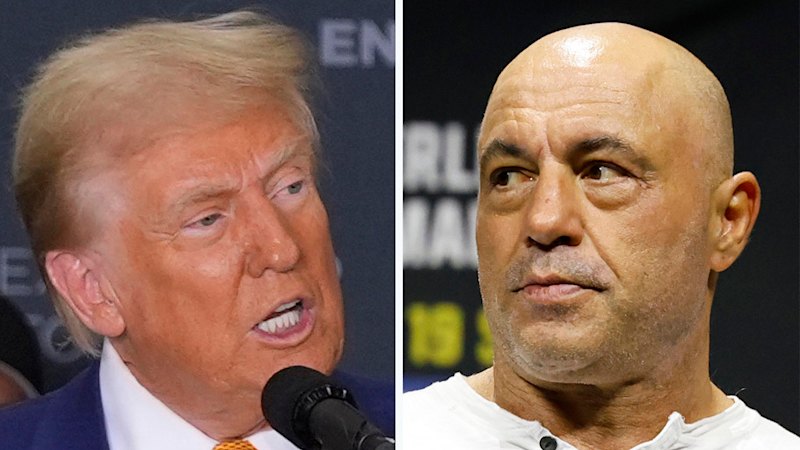
High spin · most spun: The Independent 70/100 See every outlet’s spin ↓Photo as used by The Sydney Morning Herald for “Trump has lost the ‘podcast bros’, says Joe Rogan”How The Sydney Morning Herald framed it: The Sydney Morning Herald uses a split image of Trump speaking and Rogan looking towards him. The juxtaposition gives their relationship a confrontational, personalised emphasis.
Joe Rogan has criticised Donald Trump's policies in comments about the midterm elections. He endorsed Trump in 2024. His latest remarks include an assessment of lost support and an objection to podcasters taking roles in White House press briefings.
How the coverage differs
The Sydney Morning Herald leads on the young male vote and connects it to podcasters’ influence, while The Independent leads on the scale of the defeat and Rogan’s earlier dismissal of polls. Only The Sydney Morning Herald discusses a numerical shift among men under 30; none of the three supplied texts includes CIRCLE’s turnout caveat. The Independent alone names Theo Von and Andrew Schulz, noting their silence rather than quoting a withdrawal of support. The New York Times text is truncated, so comparisons with its full coverage are limited.
Joe Rogan has argued that Donald Trump's political movement lost support well beyond its podcast allies in the midterm elections. Speaking on Friday, the host said: “They didn’t just lose the podcast bros, they lost most of the country.” He pointed to the Iran war and masked immigration officers as reasons for dissatisfaction.S1S2
Those explanations are Rogan's political assessment, not a measured account of why each voter chose a party. The Sydney Morning Herald and Independent report that he criticised the administration for pursuing a war he considered unwanted and for its immigration enforcement methods. His remarks do not establish the views of every other podcast host associated with Trump.S1S2
The same episode also included criticism of the status afforded to podcasters themselves. Mediaite reports that Rogan rejected David Sacks's suggestion that hosts attend White House press briefings, saying the work belonged to journalists. He argued that audiences placed too much importance on podcasters' opinions, providing context for his own comments on the election.R1
Why it matters
Rogan endorsed Trump in 2024 and hosted him during that presidential campaign. His recent criticism therefore comes from a media figure who previously backed the president, rather than a newly identified political opponent. Neither report establishes that Rogan has endorsed a replacement candidate or withdrawn support for every administration policy.S1S2
The Independent interprets the reference to podcast allies as including Theo Von and Andrew Schulz, describing them as quiet since the election. That is the newspaper's interpretation of the group being discussed. Silence after an election does not itself supply a public statement withdrawing an endorsement, and the report quotes no such declaration from either man.S2
The background
CIRCLE, the youth-voting research centre at Tufts University, offers a more specific electoral measure. Its analysis of NORC data estimates that young men backed Democratic House candidates by 59% to 37% in 2026. Its 2024 comparison uses presidential voting, and the researchers warn that turnout changes, rather than the same individuals switching allegiance, may explain part of the shift.R2
The research shows different voting patterns among young men across the two elections, which could partly reflect changes in who turned out. It does not isolate the effect of podcast appearances. Rogan’s claim about losing most of the country is broader than that subgroup analysis and is not an equivalent measure of public opinion.R2S1S2
Before the election, Rogan had dismissed polls pointing towards Democratic gains, according to the Independent. It also reports that he subsequently expressed distaste for discussing politics. His latest intervention adds criticism of the administration, but the cited comments contain no formal plan for political campaigning or a new endorsement.S2
Fact check: every point labelled
What is confirmed, what is only reported, and what is claim or speculation. Every point links to its source.
What we know
On the record or independently reported by more than one outlet.
confirmedThe cited reports contain no replacement endorsement from Rogan or quoted withdrawal declaration from Von or Schulz.S1S2
confirmedCIRCLE estimates young men voted 59% Democratic and 37% Republican in 2026 House races; it warns that comparisons with 2024 presidential voting can reflect turnout changes.R2
Reported but not yet confirmed
Reported as fact, but from a single origin.
reportedThe Sydney Morning Herald and The New York Times: The remarks were made on Friday and concerned the midterm result.S1S3
reportedThe Independent: Rogan endorsed Trump and hosted him during the 2024 campaign.S2
reportedThe Independent: Theo Von and Andrew Schulz have been quiet since the midterms.S2
reportedThe Independent: Rogan dismissed pre-election polling pointing to Democratic gains and later expressed distaste for discussing politics.S2
Speculation and opinion
Predictions and views, kept apart from the facts.
opinionJoe Rogan: Trump's movement lost support beyond podcast allies because of the Iran war and immigration enforcement.S1S2
opinionJoe Rogan: Rogan opposed podcasters attending White House press briefings and argued audiences give their views too much importance.R1
Still unknown
How much podcast coverage influenced individual voting decisions.
Whether Rogan or the other named hosts will issue new endorsements.
Key questions
What did Rogan criticise?
He linked lost support to the Iran war and immigration enforcement, presenting his own explanation of the election result.S1S2
Did he endorse someone else?
The cited remarks contain no replacement endorsement.S1S2
Do the voting figures prove podcast influence?
No. CIRCLE's analysis describes voting patterns and warns that turnout changes can affect comparisons.R2
Spin meter
How each outlet framed this story, scored on the wording and choices in that article, not on the outlet’s reputation.
Headlines compared: The Sydney Morning Herald and The Independent attribute the loss of the ‘podcast bros’ directly to Rogan, with The Independent adding his 2024 endorsement. The New York Times foregrounds his relative silence and refers to MAGA; its supplied text is too limited to assess the headline fully.
The IndependentFraming: Left · Spin 70/100 · Headline matches story: yes
“Joe Rogan admits Trump has ‘lost the podcast bros’ after endorsing him in 2024”
Straight reportingHeavy spin
The Independent framed Rogan’s comments as an embarrassing reversal and paired them with a sharply critical account of Trump’s response to the election.
Why? 4 framing techniques
loaded languagethe blue tsunami swept across the country The disaster metaphor dramatises the Democratic electoral victory.
opinion as factOops. Looks like Rogan was wrong to wave off poll numbers The mocking aside foregrounds the writer’s judgement of Rogan rather than simply reporting his change in emphasis.
speculation as factthat seems to be a reference to the fact that high-profile podcast host supporters The article infers that Rogan meant specific hosts based on their silence, without quoting a withdrawal of support from them.
emphasisit’s someone else’s fault The article uses a pointed characterisation of Trump’s responses to reinforce its critical framing.
The Sydney Morning HeraldFraming: Leans left · Spin 55/100 · Headline matches story: yes
“Trump has lost the ‘podcast bros’, says Joe Rogan”
Straight reportingHeavy spin
The Sydney Morning Herald framed Rogan’s remarks as evidence of a broader collapse in young men’s support for Trump, linking it to policy grievances and the influence of podcasters.
Why? 3 framing techniques
speculation as factThis resulted in the young, male Republican vote collapsing The article presents reduced podcaster support as the cause of the voting shift without establishing that causal link.
omission The article omits CIRCLE’s warning that comparisons with 2024 presidential voting can reflect changes in turnout.
loaded languageMiller masterminded some of the most extreme immigration policies in US history The description uses strongly evaluative language to characterise Miller’s record.
The New York TimesFraming: Centre · Spin 15/100 · Headline matches story: partly
“After Relative Silence, Joe Rogan Said MAGA Has Lost the “Podcast Bros””
Straight reportingHeavy spin
The New York Times framed Rogan’s remarks around his relative silence after the election; the supplied article text is truncated, limiting assessment.
Why? 1 framing technique
emphasishis relative silence until then was surprising The available text highlights Rogan’s silence as noteworthy, setting up a contrast with his earlier political influence.
Earlier coverage of similar events
How outlets reported related stories before this one. Compare for yourself.
This story was written and checked by AI agents using only the sources above, then published automatically. Facts are labelled by how well they are supported. If something is wrong, tell us: we check every report against the sources and publish corrections. Editorial policy