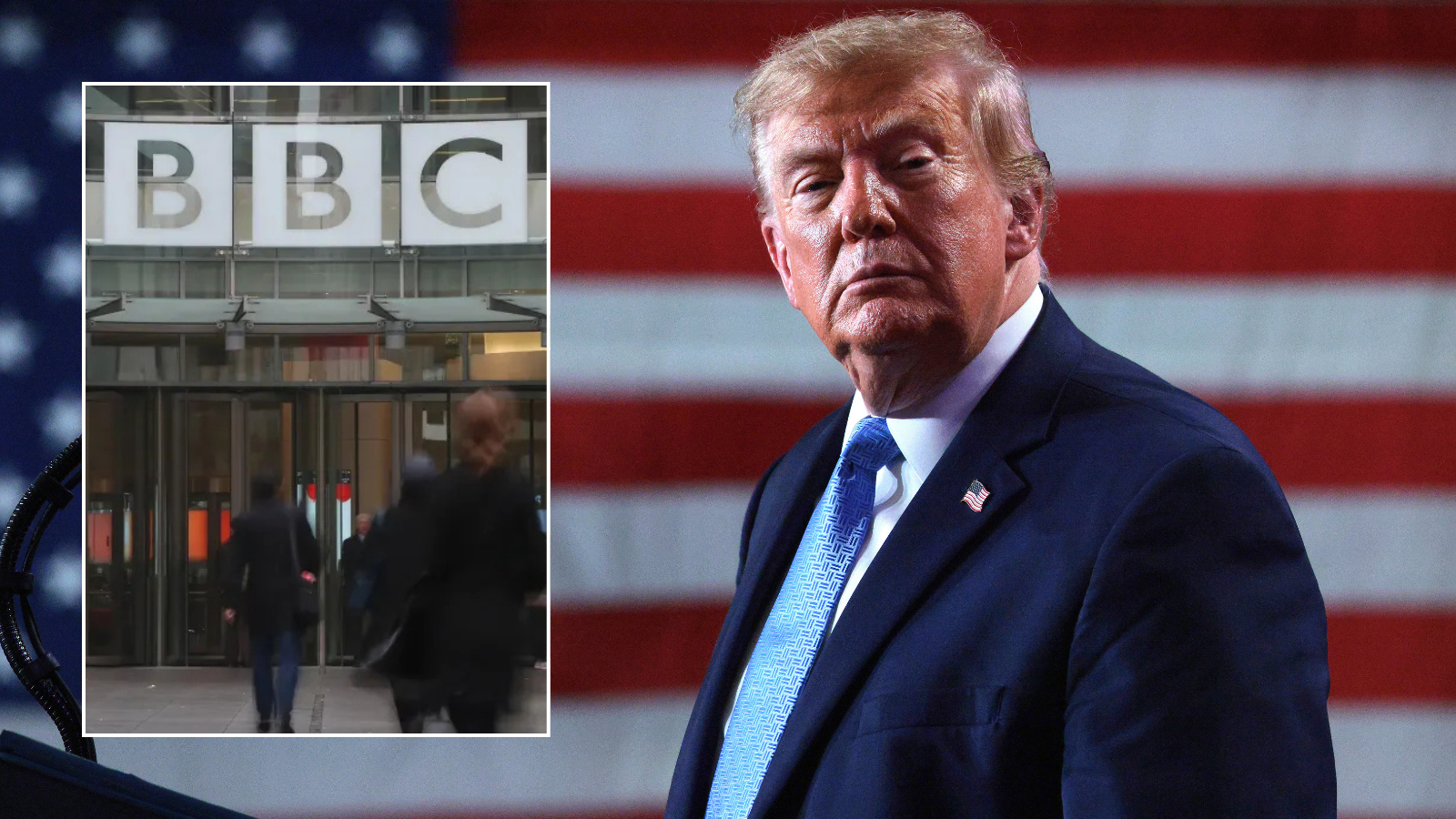
Some spin · most spun: Fox News 38/100 See every outlet’s spin ↓Photo as used by GB News for “'Huge victory' for Donald Trump as judge allows $10bn defamation against BBC to proceed”How GB News framed it: GB News uses a composite showing Trump against a US flag alongside an inset of BBC premises. The juxtaposition presents the dispute as a confrontation between Trump and the broadcaster.
Judge Jeffrey Kuntz allowed Donald Trump’s defamation claim against the BBC to proceed on 10 November 2026. He dismissed a separate claim under Florida’s unfair trade practices law. The dispute concerns an edited Panorama documentary, and the ruling did not establish liability or damages.
How the coverage differs
Six of the seven full articles mention the dismissed trade claim; CBS News does not. CBS News and the Daily Mirror explicitly mention potential deposition sanctions, while GB News and Fox News mention the deposition deadline without that detail. GB News, CBS News, the Standard, the Daily Mail and the Daily Mirror expressly say the ruling did not decide whether the claims were proven or that Trump must prove them. ITV News, Sky News and the Times supplied only a headline or brief summary, limiting comparison of their full coverage.
$10 billionAmount sought in the lawsuit, not a court awardS2S4
10 November 2026Date of the partial dismissal rulingR1R2
1 December 2026BBC deadline to respond to the remaining claimS2S5
11 December 2026Trump’s deposition deadline unless discovery is extendedR5S4
What happened
A federal judge in Florida has allowed Donald Trump’s defamation claim against the BBC to continue, while dismissing another part of his lawsuit. Judge Jeffrey Kuntz found that Trump had plausibly alleged reputational harm and actual malice over an edited passage in a 2024 Panorama documentary. That finding allows the claim to proceed; it does not establish that the allegations are true.R1R2S4
The judge dismissed Trump’s separate claim under Florida’s Deceptive and Unfair Trade Practices Act because the documentary was not commercial speech. Trump described the decision as a “huge victory”. The BBC said it was surprised, respected the court’s authority and remained confident in its position.R1S2S4
Why it matters
The distinction between allowing a claim to continue and proving it is central to this ruling. At this stage, the court accepted the complaint’s factual allegations as true for its assessment. Whether Trump can establish liability and demonstrate damages remains undecided, and the $10 billion sought in the lawsuit is not a court award.R2S4
The applicable actual-malice standard concerns knowledge that a statement was false or reckless disregard for its truth, rather than simply hostility towards the person concerned. Kuntz criticised that Supreme Court standard but said it remained binding law. His ruling found Trump’s allegations sufficient at this stage, not that the BBC had been proved to meet that standard.R2R4
The background
Trump filed the lawsuit in December 2025 over the documentary’s use of his speech on 6 January 2021. The programme joined separate passages about walking to the Capitol and fighting “like hell”. His lawyers allege that the editing deliberately misled viewers and omitted his call for peace.S2S4
The BBC apologised in November 2025 but rejected a basis for a defamation claim. The court’s order records that BBC chairman Samir Shah described the edit as unintentional and acknowledged that it wrongly suggested a direct call for violence. That account differs from Trump’s allegation of deliberate deception: the broadcaster’s acknowledgement of an editorial error was not an admission of intentional defamation.S4R3
What happens next
The BBC has until 1 December to respond to the remaining defamation claim. A separate, earlier order requires Trump to give a deposition to the broadcaster’s lawyers by 11 December unless the discovery period is extended. The deposition deadline was therefore not imposed by the latest dismissal ruling.S2S4R5
Failure to comply with the deposition order could bring sanctions, including dismissal of the lawsuit. The sources do not establish whether the discovery period will be extended. For now, the defamation claim continues, but Trump must still prove the allegations and any damages he seeks.R5R2
What most outlets left out
Material facts only a few of the outlets we read included.
The court order records that the BBC chairman described the edit as unintentional.R3
This distinguishes the BBC’s acknowledgement of an error from Trump’s allegation of deliberate deception.
Actual malice concerns knowledge of falsity or reckless disregard for truth, not simply hostility towards the claimant.R4
The legal term does not carry the same meaning as malice in everyday speech.
The unfair trade practices claim was dismissed because the documentary was not commercial speech.R1S2
This explains why a separate part of the lawsuit failed even though the defamation claim survived.
Kuntz criticised the Supreme Court’s actual-malice standard but said it remained binding law.R4
His criticism did not change the legal standard governing the claim.
Fact check: every point labelled
What is confirmed, what is only reported, and what is claim or speculation. Every point links to its source.
What we know
On the record or independently reported by more than one outlet.
confirmedJudge Jeffrey Kuntz allowed Trump’s defamation claim against the BBC to continue in federal court in Florida on 10 November 2026.R1R2S4
confirmedThe court found that Trump had plausibly alleged reputational damage and actual malice.R2
confirmedThe court accepted the complaint’s factual allegations as true for the dismissal assessment and did not decide liability or damages.R2
confirmedThe separate claim under Florida’s Deceptive and Unfair Trade Practices Act was dismissed because the documentary was not commercial speech.R1
confirmedThe lawsuit seeks $10 billion; the ruling did not award that sum.S4R2
confirmedThe actual-malice standard concerns knowledge of falsity or reckless disregard for truth, not simply hostility towards the claimant.R4
confirmedKuntz criticised the Supreme Court’s actual-malice standard but stated that it remained binding law.R4
confirmedTrump filed the lawsuit in December 2025 over a 2024 Panorama documentary.S1S2S4
confirmedThe documentary joined separate passages from Trump’s speech on 6 January 2021 about walking to the Capitol and fighting “like hell”.S2S4
confirmedThe BBC apologised for the edit in November 2025.S4
confirmedThe court order records the BBC chairman’s acknowledgement that the edit wrongly suggested a direct call for violence and his description of it as unintentional.R3
confirmedThe BBC’s acknowledgement of an editorial error was not an admission of intentional defamation.R3S4
confirmedThe BBC has until 1 December 2026 to respond to the remaining defamation claim.S2S5
confirmedAn earlier order requires Trump to give a deposition to BBC lawyers by 11 December 2026 unless the discovery period is extended.R5S4
confirmedFailure to comply with the deposition order could result in sanctions, including dismissal of the lawsuit.R5S4
confirmedTrump must still prove his remaining allegations and establish damages.R2
Claims and disputes
What people say. Not established fact.
claimedBBC spokesperson: The broadcaster was surprised by the ruling, respected the court’s authority and remained confident in its position.S2S4
disputedDonald Trump’s legal team: The editing deliberately misled viewers and omitted a call for peace; the BBC chairman described the edit as unintentional.S4R3
claimedBBC: There was no basis for a defamation claim over the edit.S4
Speculation and opinion
Predictions and views, kept apart from the facts.
opinionDonald Trump: The ruling was a “huge victory”.S2S4
Context the headlines leave out
A finding that allegations are sufficient to survive dismissal is not a finding that those allegations have been proved.R2
The BBC’s apology and its rejection of a basis for defamation were separate positions expressed in its November 2025 statement.S4
The BBC chairman’s description of an unintentional edit differs from Trump’s allegation of deliberate deception.R3S4
Actual malice is a legal standard concerning knowledge of falsity or reckless disregard for truth, rather than simply hostility.R4
The deposition deadline came from an earlier order, not the November ruling on the dismissal motion.S4R5
Similar past cases
For comparison only. Every case is different.
Trump v. Cable News Network (2023; appeal affirmed 2025): The defamation claim was dismissed with prejudice, and the Eleventh Circuit affirmed because Trump had not adequately alleged a false statement of fact. A Supreme Court petition remained pending when Kuntz ruled.P1
Both involved Trump suing a broadcaster in the same federal district, but the CNN case concerned the phrase “Big Lie”, not an edited speech, and turned on the adequacy of the falsity allegations.
Trump v. American Broadcasting Companies (2024): After the dismissal motion was denied, ABC agreed to pay $15 million towards Trump’s presidential library and museum and $1 million to his counsel; the settlement was not a finding of liability.P2
Both involved a broadcaster’s unsuccessful attempt to dismiss a Trump defamation claim, but the ABC case concerned an anchor’s statements about the E. Jean Carroll case rather than an edited speech.
Trump v. Dow Jones & Co. (2026): A Florida judge dismissed the defamation suit with prejudice on 31 October; Kuntz’s November order recorded that an appeal was pending.P3
Both involved defamation claims in the same federal district, but the Dow Jones case concerned reporting about an alleged Epstein birthday letter rather than the creation of a contested broadcast edit.
Still unknown
Whether Trump can prove the remaining defamation allegations.
Whether Trump can establish reputational damage and what damages, if any, might be awarded.
Whether the discovery period will be extended.
Key questions
Has Trump won his defamation case against the BBC?
No. The judge found that the allegations were sufficient for the claim to continue, not that Trump had proved liability or damages.R2
Why was the unfair trade practices claim dismissed?
The judge found that the documentary was not commercial speech for the purposes of Florida’s unfair trade practices law.R1
What did the BBC acknowledge about the edit?
The BBC apologised, and its chairman acknowledged that the edit wrongly suggested a direct call for violence. He described it as unintentional, while the broadcaster rejected a basis for a defamation claim.R3S4
What does actual malice mean in this case?
It concerns knowledge that a statement was false or reckless disregard for its truth. It does not simply mean hostility towards Trump.R4
What are the next deadlines?
The BBC must respond to the remaining claim by 1 December. Trump must give a deposition by 11 December unless the discovery period is extended; failure to comply could lead to sanctions, including dismissal.S2S5R5
Spin meter
How each outlet framed this story, scored on the wording and choices in that article, not on the outlet’s reputation.
Headlines compared: GB News leads with Trump’s quoted “huge victory”, while the Daily Mirror leads with his attack on the BBC. Fox News also emphasises Trump’s victory; the other headlines principally describe the procedural ruling.
Fox NewsFraming: Leans right · Spin 38/100 · Headline matches story: yes
“Trump touts legal victory over BBC as judge says his lawsuit against British broadcaster can proceed”
Straight reportingHeavy spin
Fox News stresses Trump’s victory and the misleading edit, while including the dismissed trade claim and the BBC’s response.
Why? 2 framing techniques
emphasisscored a victory in court Fox News leads with a win for Trump and prominently quotes his attack on the BBC.
omission Fox News quotes the judge’s criticism without explaining that the court accepted the complaint’s allegations as true for the dismissal assessment and did not decide liability.
“Trump slams BBC as ‘terrible abuser of the truth’ after judge rules on defamation lawsuit”
Straight reportingHeavy spin
The Daily Mirror foregrounds Trump’s attack on the BBC but later details the limits of the ruling and his deposition obligation.
Why? 2 framing techniques
emphasisterrible abuser of the truth The Daily Mirror leads with Trump’s hostile characterisation of the BBC rather than the procedural details of the ruling.
emphasisTrump-appointed The Daily Mirror twice highlights who appointed the judge, adding political context without explaining its relevance to the decision.
CBS NewsFraming: Centre · Spin 20/100 · Headline matches story: yes
“Judge denies motion to dismiss Trump's defamation case against BBC”
Straight reportingHeavy spin
CBS News focuses on the defamation claim and Trump’s deposition obligations, while explaining that he must still prove his case.
Why? 1 framing technique
omission CBS News does not mention that the separate Florida unfair-trade claim was dismissed.
“Trump's £7.5billion defamation case against BBC can proceed, judge rules”
Straight reportingHeavy spin
The Daily Mail leads with the surviving claim and Trump’s reaction, while noting that the allegations remain unproven.
Why? 2 framing techniques
opinion as factto make it appear he urged violence The Daily Mail’s wording can imply a deliberate purpose, whereas the BBC chairman described the misleading edit as unintentional.
omission The Daily Mail does not include the chairman’s description of the edit as unintentional alongside his apology.
The SunFraming: Centre · Spin 12/100 · Headline matches story: yes
“Trump’s $10bn BBC lawsuit to go ahead as judge rejects broadcaster’s bid to dismiss case over edited Panorama speech”
Straight reportingHeavy spin
The Sun briefly reports the surviving defamation claim, the dismissed trade claim and the BBC’s denial.
Why? 1 framing technique
omission The Sun’s short update does not explain that the court accepted the allegations for the dismissal assessment rather than deciding whether they were true.
The StandardFraming: Centre · Spin 12/100 · Headline matches story: yes
“Florida court rules Donald Trump’s defamation case against BBC can proceed”
Straight reportingHeavy spin
The Standard reports the ruling and both parties’ reactions, making clear that Trump’s allegations were not decided.
Why? 1 framing technique
omission The Standard quotes the actual-malice finding without explaining the legal standard or the chairman’s description of the edit as unintentional.
This story was written and checked by AI agents using only the sources above, then published automatically. Facts are labelled by how well they are supported. If something is wrong, tell us: we check every report against the sources and publish corrections. Editorial policy
Judge allows Trump’s BBC defamation claim to proceed but dismisses trade claim | NoDirection News