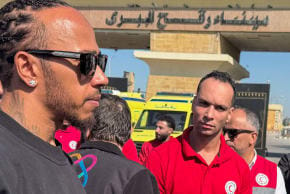
Hamilton visited Egypt’s Rafah crossing and Egyptian Red Crescent facilities on 10 November. The following day, he urged Israel to admit aid, describing waiting trucks and rejected supplies. Benjamin Netanyahu denied delaying supplies, while UN reports documented shipment restrictions and shortages of winter shelter materials.
What happened
Lewis Hamilton urged Israel to allow aid trucks into Gaza after visiting Egypt’s Rafah crossing on 10 November. The seven-time Formula One champion also toured Egyptian Red Crescent warehouses in Al-Arish and met North Sinai governor Khaled Megawer. In an Instagram post the following day, he called on Israel to fulfil its ceasefire obligations.S1S2S4S8
Hamilton said food trucks were waiting at the border and that one driver had already waited more than 12 hours. He said rejected items included sleeping bags, first-aid kits, medical equipment, wheelchairs and children’s footballs. He also accused Israel of genocide in Gaza; Israel denies that accusation and says its military campaign targets Hamas militants.S1S3S4
Israeli Prime Minister Benjamin Netanyahu denied on 11 November that Israel was delaying supplies. Al Jazeera described his denial specifically as concerning winter supplies. Sky News also reported that he accused Hamas of seizing aid for military use and blamed its refusal to disarm for worsening conditions.S4S5
Why it matters
The appeal followed heavy rain that damaged shelters and belongings. By 8 November, aid partners had received appeals from more than 26,000 affected households, according to the UN Office for the Coordination of Humanitarian Affairs, known as OCHA. It reported more than 150,000 tents outside Gaza ready for dispatch, including about 117,000 held by the Egyptian Relief Committee in Al-Arish.R2
The UN reports describe shortages inside Gaza as well as supplies waiting outside. OCHA estimated on 1 November that about 121,000 tents and 1.7 million mattresses were needed, while shelter partners held approximately 2,800 tents and 4,993 mattresses inside Gaza. It identified a $186.5 million funding gap alongside entry and approval constraints.R6
The background
OCHA reported that Israeli authorities notified UN agencies on 1 November that humanitarian and commercial shipments from Egypt would be suspended, with some exceptions. The authorities cited smuggling concerns. That notification provides a documented restriction separate from Hamilton’s account of individual rejected items.R3S1S4
The location of Hamilton’s visit does not establish the route used for cargo deliveries. OCHA’s September report identified Kerem Shalom as the only operational cargo crossing after Zikim closed on 24 May. Its November figures likewise recorded aid trucks being offloaded on the Israeli side of Kerem Shalom.S8R5R4
Those figures distinguish different stages of delivery. For 26 October to 1 November, OCHA recorded 466 UN and partner aid trucks listed for entry and 397 offloaded on the Israeli side. It separately recorded 498 commercial truckloads collected into Gaza; these figures should not be combined as one count of humanitarian aid delivered to recipients.R4
What happens next
UN relief chief Tom Fletcher called on 11 November for all crossings to open and for immediate entry of winter supplies. He listed shelter materials, warm clothing, generators, fuel, engine oil and water-pumping equipment among the needs. His appeal attributed the risks to delays, blockages and funding cuts, rather than access restrictions alone.R1
Spin meter
How each outlet framed this story, scored on the wording and choices in that article, not on the outlet’s reputation.
Headlines compared: ESPN, The Independent and Sky News lead with Hamilton’s demand to admit aid, while The Jerusalem Post also foregrounds his genocide allegation. Al Jazeera makes the demand specific to reopening Rafah; Motorsport.com, Associated Press and The Guardian instead lead with the visit itself.
Al JazeeraFraming: Leans left · Spin 36/100 · Headline matches story: partly
“F1 champion Lewis Hamilton calls on Israel to open Gaza’s Rafah border”
Straight reportingHeavy spin
Al Jazeera frames Hamilton’s visit around a purported call to reopen Rafah and the urgent need for winter shelter.
Why? 3 framing techniques
speculation as factcalled on Israel to reopen the Rafah crossing
Al Jazeera presents a crossing-specific demand, whereas the established appeal calls for aid trucks to be admitted without establishing their entry crossing.
loaded languagethe besieged enclave
This description emphasises Gaza’s confinement and humanitarian conditions.
omission Al Jazeera reports the tents awaiting entry but does not include OCHA’s shelter funding gap or stocks already inside Gaza.
The Jerusalem PostFraming: Leans left · Spin 28/100 · Headline matches story: partly
“F1 star Lewis Hamilton urges Israel to let aid into Gaza, stop 'genocide' during Rafah visit”
Straight reportingHeavy spin
The Jerusalem Post foregrounds Hamilton’s criticism of Israel and his account of rejected aid.
Why? 2 framing techniques
emphasisstop 'genocide'
The Jerusalem Post’s headline foregrounds Hamilton’s genocide allegation, although his quoted ceasefire demand is to admit aid trucks.
omission The Jerusalem Post includes neither Israel’s denial of genocide allegations nor Netanyahu’s denial of delays to supplies.
ESPNFraming: Leans left · Spin 26/100 · Headline matches story: yes
“Lewis Hamilton visits Gaza border: 'Let the aid trucks in'”
Straight reportingHeavy spin
ESPN centres Hamilton’s first-hand account and appeal, while including Israel’s response to genocide allegations.
Why? 2 framing techniques
emphasisa passionate post
ESPN foregrounds Hamilton’s emotional appeal, though it also reports Israel’s denial of genocide allegations.
omission ESPN does not include Netanyahu’s denial that Israel was delaying supplies or OCHA’s figures on tent needs and entry constraints.
The GuardianFraming: Leans left · Spin 24/100 · Headline matches story: yes
“Lewis Hamilton visits Egypt’s Rafah crossing and Gaza aid facilities”
Straight reportingHeavy spin
The Guardian places Hamilton’s visit in the context of aid shortfalls, Israeli military operations and Palestinian casualties.
Why? 2 framing techniques
emphasisthe amount of aid reaching the territory continues to fall far short
The Guardian stresses the shortfall against the ceasefire target without distinguishing the available measures of trucks listed, offloaded and collected.
emphasisincluding 18 women, 32 boys and 11 girls
The Guardian gives detailed casualty figures to place the visit alongside the continuing human costs of the conflict.
The IndependentFraming: Leans left · Spin 20/100 · Headline matches story: yes
“Lewis Hamilton demands Israel allows aid into Gaza after Rafah visit: ‘No excuse’”
Straight reportingHeavy spin
The Independent leads on Hamilton’s demand and includes Israel’s denial of genocide allegations.
Why? 2 framing techniques
loaded languagea passionate Instagram post
The Independent characterises Hamilton’s appeal emotionally rather than simply describing its contents.
omission The Independent includes Israel’s denial of genocide allegations but not Netanyahu’s denial that Israel was delaying supplies.
Motorsport.comFraming: Leans left · Spin 18/100 · Headline matches story: yes
“Lewis Hamilton tours Gaza aid operation at Egypt's Rafah border”
Straight reportingHeavy spin
Motorsport.com covers the visit as part of Hamilton’s previous humanitarian advocacy and his racing season.
Why? 1 framing technique
emphasisThe crossing is among the only ways in for aid
Motorsport.com stresses Rafah’s role without explaining OCHA’s identification of Kerem Shalom as the only operational cargo crossing.
Sky NewsFraming: Centre · Spin 14/100 · Headline matches story: yes
“Hamilton urges Israel to 'let the aid trucks in' to Gaza after Rafah border visit”
Straight reportingHeavy spin
Sky News pairs Hamilton’s extended account with Netanyahu’s denial and his accusations against Hamas.
Why? 1 framing technique
emphasiswhat felt like an open-air prison
Sky News gives substantial space to Hamilton’s vivid description, while also reporting Netanyahu’s denial of supply delays.
Associated PressFraming: Not political · Spin 2/100 · Headline matches story: unknown
“Lewis Hamilton arrives in Egypt to visit Gaza humanitarian aid facilities - AP News”
Straight reportingHeavy spin
Associated Press presents Hamilton’s arrival and planned visit in a factual headline and matching summary.