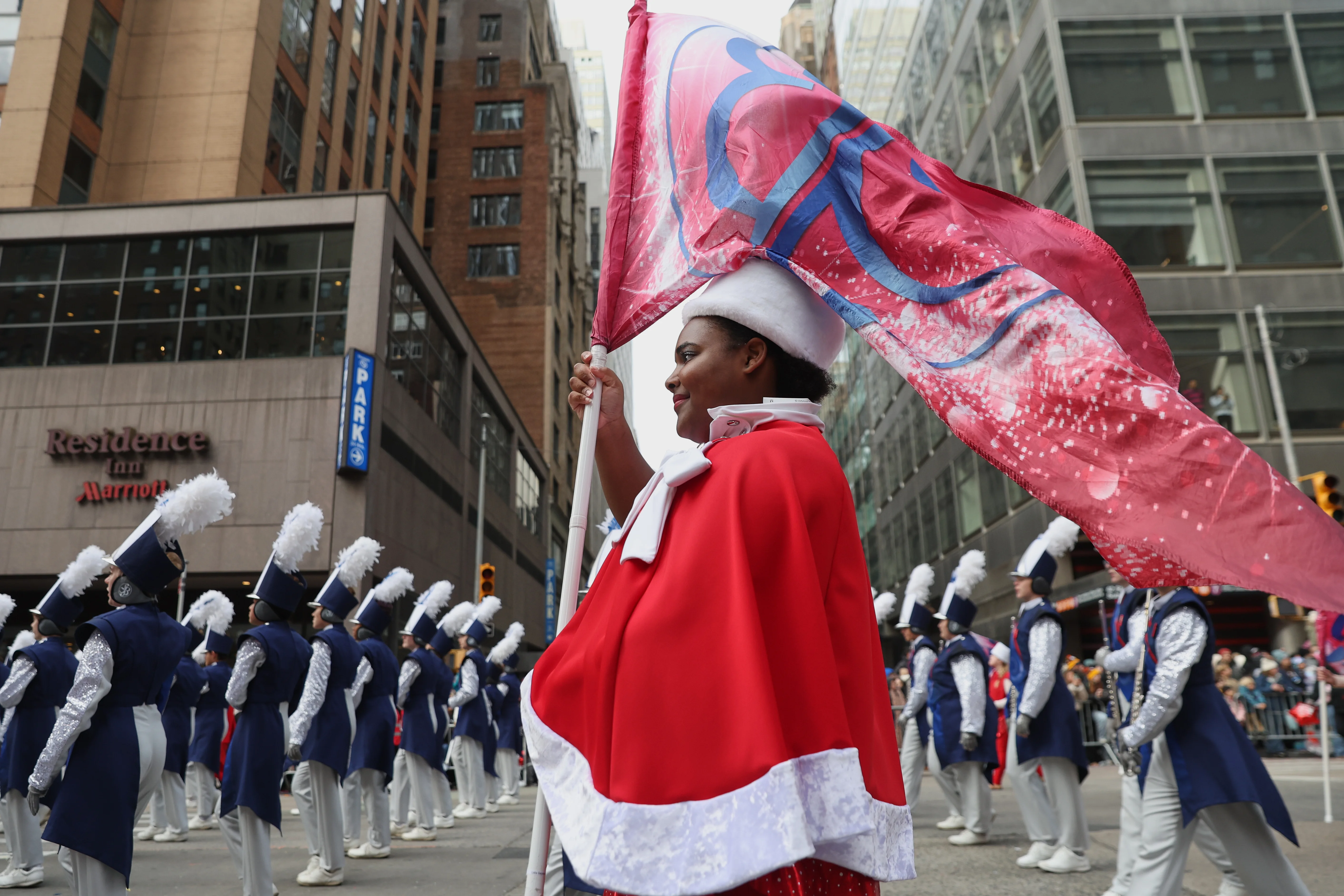
Low spin · most spun: New York Post 23/100 See every outlet’s spin ↓Photo as used by NPR for “After historic Macy's Parade postponement, marching bands fundraise to stay in New York”How NPR framed it: NPR’s lead photo shows a flag bearer in red in the foreground, with marching band members behind her on a New York street. It puts student performers at the centre of the story and gives the fundraising account a celebratory, human focus.
The 100th Macy’s Thanksgiving Day Parade took place in New York on Saturday, 28 November, two days later than planned. It was the event’s first weather postponement. Bands and other participants changed travel arrangements to attend.
NPR, The Guardian, Euronews and the New York Post highlighted the cost or fundraising challenges facing bands, while BBC News concentrated on performers, balloons and parade history. BBC News was the only source to state that Mamdani announced the delay less than 24 hours before the planned start; the New York Post alone cited the NYPD’s estimate of hundreds of thousands of spectators. None of the supplied texts mentioned Coss’s statement that arrangements for covering bands’ hotel and flight costs were still being worked through. Six sources supplied only a headline or brief summary, limiting the detail available for comparison.
Macy’s 100th Thanksgiving Day Parade went ahead in New York on Saturday, 28 November, after severe weather prompted a two-day postponement. Crowds watched the balloons, floats and performers along Manhattan’s streets. BBC coverage described a dry procession following the first weather postponement in the event’s history. The route runs from the Upper West Side to Macy’s flagship store in Herald Square.S1S4S5S9
Performers included Queen Latifah, LL Cool J and Keke Palmer. The balloon display brought back Felix the Cat and Underdog alongside a new Mickey Mouse design based on The Sorcerer’s Apprentice in Fantasia. Santa Claus closed the procession, as is customary.S4S5S9
Why it matters
The change required visiting bands to find money for additional accommodation and alter flights. The Nā Koa Aliʻi Hawaiʻi All-State Marching Band announced on Friday night that it had raised more than $800,000 for its extended stay, the Guardian reported. Donations enabled students to remain for the rescheduled performance.S2S9S10
Not every group could stay. The University of Alabama’s Million Dollar Band returned for its Saturday football commitment, while the New York Post reported that Macy’s Great American Marching Band could not rearrange flights for its 400 members. Reports differ on the final band count: the BBC says nine participated, while the Post says eight remained.S4S5
The disruption also affected city staffing. Police Commissioner Jessica Tisch said on Wednesday that more than 1,000 officers due to have Saturday off would be called in. Asked whether Macy’s would cover bands’ extra hotel and flight costs, executive producer Will Coss said arrangements were still being worked through; that answer did not confirm reimbursement.R1
The background
Mayor Zohran Mamdani announced the postponement less than a day before the original start, after forecasts warned of winds dangerous to balloons and spectators. The city’s advisory anticipated gusts as high as 60–65mph, coastal flooding and heavy rain. Those were forecasts informing the decision, rather than measurements taken during Saturday’s parade.S4R2
The parade began in 1924, but did not take place from 1942 to 1944 during the Second World War. Those cancellations explain why 2026 was its 100th edition, rather than its centenary. The BBC and Euronews distinguish the wartime cancellations from this year’s postponement.S4S9
Attendance also needs careful attribution. Before the event, organisers expected a crowd similar to last year’s roughly 3.5 million, according to the BBC. After Saturday’s procession, the NYPD told the New York Post that hundreds of thousands of spectators were present. A forecast and a subsequent police estimate are different measures.S4S5
Fact check: every point labelled
What is confirmed, what is only reported, and what is claim or speculation. Every point links to its source.
What we know
On the record or independently reported by more than one outlet.
confirmedThe parade took place in New York on Saturday, 28 November, following a two-day weather delay.S1S5
confirmedAsked about covering bands’ hotel and flight costs, Coss said arrangements were still being worked through.R1
confirmedMamdani announced the delay less than 24 hours before the original start, citing dangerous wind forecasts.S4
confirmedThe NYPD estimated hundreds of thousands of spectators attended Saturday’s parade.S5
Reported but not yet confirmed
Reported as fact, but from a single origin.
reportedBBC News: This was the first weather postponement, and the 100th edition went ahead without rain.S4
reportedBBC News: Crowds watched balloons, floats and performers, including Queen Latifah, LL Cool J and Keke Palmer.S4
reportedBBC News: Felix the Cat and Underdog returned, and a new Mickey Mouse balloon depicted The Sorcerer’s Apprentice from Fantasia.S4
reportedNew York Post and Euronews: Santa Claus closed the procession, as customary.S5S9
reportedNPR: Bands faced extra accommodation and travel costs, and donations helped student musicians stay for the performance.S2
reportedNew York Post: Alabama’s band needed to return for Saturday football; Macy’s own band could not rearrange its 400 members’ flights.S5
reportedBBC News: The parade began in 1924 and was cancelled in 1942–44, making 2026 its 100th edition.S4
reportedEuronews: The route runs from the Upper West Side to Macy’s flagship store in Herald Square.S9
Claims and disputes
What people say. Not established fact.
claimedNā Koa Aliʻi Hawaiʻi All-State Marching Band: The Hawaii band announced it had raised over $800,000 by Friday night for its extended stay.S10
disputedBBC News and New York Post: The BBC reports nine participating marching bands, while the New York Post reports eight.S4S5
claimedJessica Tisch: Tisch said over 1,000 officers due to be off would be called in on Saturday.R1
Speculation and opinion
Predictions and views, kept apart from the facts.
speculationNew York City Emergency Management: The city forecast gusts up to 60–65mph, coastal flooding and heavy rain for Thanksgiving.R2
speculationMacy’s organisers, via BBC News: Organisers expected a crowd similar to last year’s roughly 3.5 million; that was a forecast.S4
Still unknown
A reconciled final count of participating marching bands.
The full additional cost of the postponement and any final reimbursement arrangements.
Key questions
Why was the parade held on Saturday?
The city and Macy’s postponed it because of severe-weather forecasts for Thanksgiving Day.S4R2
Was this its first weather postponement?
Yes, according to the BBC. Wartime cancellations in 1942–44 were separate interruptions.S4
How did visiting bands cover extra costs?
Some sought donations. The Hawaii band announced more than $800,000 had been raised by Friday night.S10
Did every band take part?
No. Alabama’s band had a football commitment, and Macy’s own band could not rearrange flights.S5
Spin meter
How each outlet framed this story, scored on the wording and choices in that article, not on the outlet’s reputation.
Headlines compared: NPR led on marching bands’ fundraising, while The Guardian emphasised the storms clearing. BBC News, Euronews and The Independent highlighted the historic postponement and anniversary; The New York Post and The New York Times used playful language, while Associated Press emphasised balloons and clowns.
New York PostFraming: Not political · Spin 23/100 · Headline matches story: yes
“Macy’s Thanksgiving Day Parade was all gravy after first-ever weather postponement”
Straight reportingHeavy spin
The New York Post combined a celebratory account of the parade with personal stories about the expense and disruption of the delay.
Why? 3 framing techniques
loaded languagean early Christmas miracle The celebratory phrase dramatizes the parade going ahead after the postponement.
loaded languagea logistical nightmare The phrase intensifies the disruption to performers and tourists beyond a straightforward description of rescheduling difficulties.
emotional appealmake their dreams come true The wording presents the bands’ fundraising through an emotive account of their aspirations.
BBC NewsFraming: Not political · Spin 15/100 · Headline matches story: yes
“Macy's Thanksgiving Day Parade returns for 100th year after historic postponement”
Straight reportingHeavy spin
BBC News emphasised the anniversary spectacle, performers and crowds, while explaining the late weather decision.
Why? 2 framing techniques
emphasiswent ahead without a hitch BBC News emphasised the successful spectacle while giving little attention to the delay’s financial and logistical effects on performers.
omission BBC News did not mention bands’ fundraising or withdrawals, which other outlets reported as consequences of the delay.
EuronewsFraming: Not political · Spin 12/100 · Headline matches story: yes
“New York City: Macy’s 100th Thanksgiving Day Parade takes place after historic weather delay”
Straight reportingHeavy spin
Euronews balanced the anniversary celebration with the logistics, fundraising and historical context of the postponement.
Why? 1 framing technique
emphasisPerformers scramble to adapt to last-minute changes Euronews gave prominence to performers’ practical difficulties alongside the parade’s history and attractions.
The GuardianFraming: Not political · Spin 12/100 · Headline matches story: yes
“Storms clear for first ever postponed Macy’s Thanksgiving Day parade”
Straight reportingHeavy spin
The Guardian framed the parade through storm disruption and the efforts of bands to stay and perform.
Why? 1 framing technique
emphasisBands originally scheduled to perform on Thursday had to scramble The Guardian concentrated on bands’ fundraising and travel difficulties rather than the parade’s spectacle.
The IndependentFraming: Not political · Spin 10/100 · Headline matches story: yes
“Balloons, Bands and a Historic First: Macy’s 100th Parade in photos”
Straight reportingHeavy spin
The Independent presented the postponed anniversary parade as a colourful, cheerful celebration.
Why? 1 framing technique
emphasisdelighting thousands of happy attendees The summary foregrounds spectators’ enjoyment rather than the delay’s logistical consequences.
NPRFraming: Not political · Spin 8/100 · Headline matches story: yes
“After historic Macy's Parade postponement, marching bands fundraise to stay in New York”
Straight reportingHeavy spin
NPR highlighted fundraising that helped student musicians remain in New York.
Why? 1 framing technique
emphasisdonors big and small stepped in The summary foregrounds donors’ help and the students’ ability to perform rather than other consequences of the delay.
CBS NewsFraming: Not political · Spin 5/100 · Headline matches story: yes
“Macy's Thanksgiving Day Parade held in New York City after weather delay”
Straight reportingHeavy spin
CBS News briefly framed the parade around the weather delay and revised travel plans.
The New York TimesFraming: Not political · Spin 5/100 · Headline matches story: yes
“Macy’s Thanksgiving Day Parade Hits 100 (Give or Take a Couple of Days)”
Straight reportingHeavy spin
The New York Times used a playful anniversary headline to introduce a brief account of the smooth procession.
Associated PressFraming: Not political · Spin 4/100 · Headline matches story: unknown
“Postponed Macy's 100th Thanksgiving Day parade gets a do-over with 100 balloons and 1,000 clowns - AP News”
Straight reportingHeavy spin
Associated Press highlighted the postponed anniversary parade and its balloons and clowns.
Belfast TelegraphFraming: Not political · Spin 3/100 · Headline matches story: unknown
“In Pictures: Postponed Macy’s 100th Thanksgiving Day parade gets a do-over”
Straight reportingHeavy spin
Belfast Telegraph presented the postponed parade as a picture-led story.
Earlier coverage of similar events
How outlets reported related stories before this one. Compare for yourself.
Help power NoDirection. Read without adverts.Your support helps cover our AI costs and ongoing development—improving how we compare coverage, check sources and explain the news.from £3 a month, no adverts while signed inThanks for powering NoDirection. You’re reading without adverts.
How we compared this: we read 34 outlets over 3 days, labelled every factual point by how well it is supported, and scored 10 articles for spin (0 = straight reporting, 100 = heavily slanted). How it works · Editorial policy
This story was written and checked by AI agents using only the sources above, then published automatically. Facts are labelled by how well they are supported. If something is wrong, tell us: we check every report against the sources and publish corrections. Editorial policy