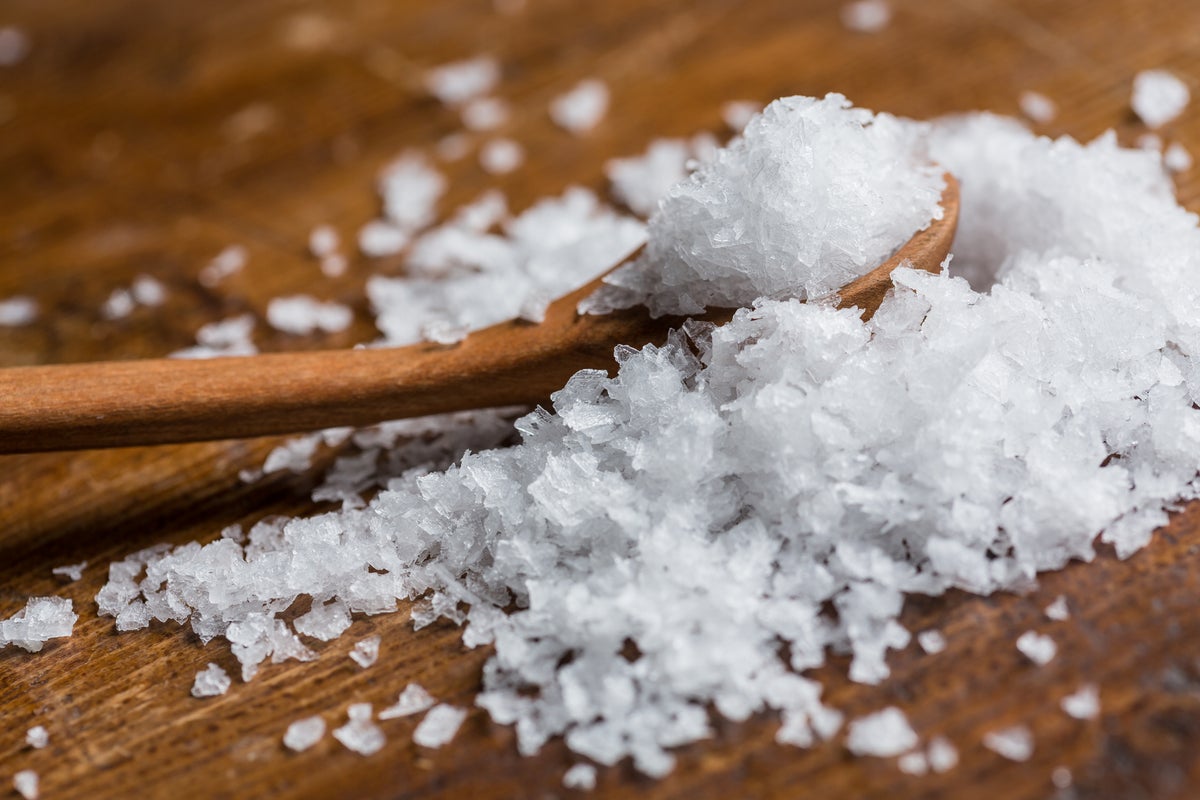
Some spin · most spun: Daily Mail 58/100 See every outlet’s spin ↓Photo as used by The Independent for “Maldon Salt faces questions after importing rock salt from Germany”How The Independent framed it: The Independent’s lead image shows white salt flakes on and around a wooden spoon. Its rustic food styling reinforces the product’s culinary and artisan associations rather than illustrating the imported salt or production process.
Maldon has defended adding rock salt to seawater after reporting about German supplies to its Essex factory. Its website now describes the process. Essex Trading Standards said an investigation in 2019 led to no further action, according to GB News.
How the coverage differs
The Independent focuses on Maldon’s artisan image and price, while the Daily Mail leads into a broader survey of premium foods. Only GB News mentions both the 2019 Trading Standards no-further-action conclusion and Canadian restrictions on naming mined salt as sea salt. Both The Independent and GB News describe Maldon’s explanation of its brine process; The Times was supplied as a headline and summary only, limiting comparison.
Maldon Salt has defended its production methods after an Observer investigation, reported by the Independent and GB News, described deliveries of German rock salt to its Essex facility. The reporting says salt supplied in K+S-branded bags is dissolved in water from the Blackwater Estuary before flakes are produced.S1S3
The company says rock salt comes from prehistoric seas and forms part of its longstanding salt-on-salt process. Its website describes seawater being settled and filtered, made into brine with what it calls ancient sea salt, then heated in open pans. Maldon maintains that the resulting flakes and their labelling comply with applicable legislation.R1S1
Why it matters
The issue raised by residents and campaigners is what customers understand about the product's origin. GB News quotes local resident Linsay Everest calling for clearer information so buyers can make an informed choice. Countryside Alliance chief Tim Bonner described the labelling as misleading; Maldon disputes that assessment through its defence of the description.S3S1
The distinction is between where the flakes are manufactured and where the salt entering that process originates. The supplied reporting describes an Essex production process using both estuary water and imported mined salt. It does not provide a verified percentage showing how much of each finished box derives from either source.S1S3
The Independent quotes University College London chemistry professor Andrea Sella saying the two salt sources cannot be separated once blended. That addresses what happens in the brine. It does not, by itself, decide whether a particular product description meets food-labelling requirements.S1
The background
The reported regulatory history is significant. Essex Trading Standards told GB News that allegations passed to it by the Food Standards Agency were fully investigated in 2019, with no further action required at that time. That is an account of the earlier investigation, not a newly announced ruling on the latest coverage.S3
Canada applies a specific distinction in its published guidance. The Canadian Food Inspection Agency says the name sea salt refers to processed salt from an existing sea and cannot be used for salt from a mine. GB News reports that Maldon uses different branding for Canada. Canadian guidance does not establish the legal position in Britain.R2S3
What happens next
The company has already expanded its public explanation of the production method, according to the Independent. The newspaper said it had contacted the National Food Crime Unit for comment. Its report contains no announced new enforcement action, recall or finding that Maldon's product is unsafe.S1
The remaining information gaps concern the proportions of the ingredients and whether authorities will issue any fresh assessment. K+S told the reporting that it supplies salt to Britain from European sites but would not discuss individual customers. The reviewed accounts therefore do not independently establish a continuing weekly import total.S3
Fact check: every point labelled
What is confirmed, what is only reported, and what is claim or speculation. Every point links to its source.
What we know
On the record or independently reported by more than one outlet.
confirmedMaldon's website describes settling and filtering seawater, adding ancient sea salt to make brine and heating it in open pans.R1
confirmedEssex Trading Standards said its investigation of allegations referred by the FSA in 2019 required no further action at that time.S3
confirmedCanadian guidance limits the sea-salt name to processed salt from an existing sea and excludes mined salt.R2
confirmedThe supplied reporting announces no new enforcement action, recall or finding of unsafe product and gives no verified finished-product ingredient ratio.S1S3
Reported but not yet confirmed
Reported as fact, but from a single origin.
reportedThe Observer, as reported by the Independent and GB News: The Observer investigation described German rock salt deliveries to Maldon's Essex factory in K+S-branded bags and its addition to estuary water.S1S3
reportedGB News: Maldon uses different branding for the Canadian market.S3
reportedThe Independent: Maldon expanded its website explanation and the Independent sought comment from the National Food Crime Unit.S1
Claims and disputes
What people say. Not established fact.
claimedMaldon Salt: The process is longstanding and rock salt originates in prehistoric seas.S1
claimedMaldon Salt: Maldon's products and labelling comply with applicable legislation.S1
claimedAndrea Sella: The two salt sources cannot be separated once blended.S1
claimedK+S: K+S supplies salt to Britain from European sites but would not discuss specific customers.S3
opinionLinsay Everest: Buyers should receive clearer information about the production method.S3
Context the headlines leave out
The quoted Trading Standards decision relates to an investigation in 2019. The Canadian guidance applies to a different jurisdiction.S3R2
Still unknown
The verified proportion of mined salt in the finished flakes.
Whether UK authorities will issue any fresh assessment.
The verified continuing volume and origin of deliveries.
Key questions
Does Maldon acknowledge using rock salt?
Yes. It says rock salt from prehistoric seas dissolves into seawater to make the brine from which its flakes are formed.S1R1
Have UK authorities found the method unlawful?
GB News quotes Essex Trading Standards saying its 2019 investigation required no further action. The supplied reporting contains no new finding of illegality.S3S1
Do Canadian rules differ?
Canadian guidance says mined salt cannot be labelled sea salt. That guidance concerns Canada and does not settle the UK position.R2
How much imported salt is in a box?
The supplied reports do not establish a verified proportion of the finished product derived from mined salt.S1S3
Spin meter
How each outlet framed this story, scored on the wording and choices in that article, not on the outlet’s reputation.
Headlines compared: The Independent presents the imports as raising questions, while GB News calls the finding a ‘bombshell’. The Daily Mail uses Maldon to introduce a wider warning about premium-food ‘knock-offs’, whereas The Times states the production detail without dramatic language.
Daily MailFraming: Not political · Spin 58/100 · Headline matches story: partly
“The posh foods that aren't what they seem: As Maldon Sea Salt is revealed to use German rock salt, experts reveal the 'premium' kitchen ingredients that could be cheap knock-offs”
Straight reportingHeavy spin
The Daily Mail uses Maldon as an introduction to a broader warning about premium foods that may not match shoppers’ expectations.
Why? 3 framing techniques
loaded languagecheap knock-offs The headline links Maldon to a derogatory fraud-like category without establishing that its product is a knock-off.
emphasisafter beloved British brand Maldon Sea Salt was revealed to use German rock salt Using Maldon to introduce examples of food adulteration implies a connection without establishing an equivalent finding about its salt.
omission The Daily Mail does not explain Maldon’s seawater-and-brine process or include its response and the 2019 no-further-action conclusion.
GB NewsFraming: Not political · Spin 35/100 · Headline matches story: yes
“Bombshell investigation reveals Maldon Sea Salt actually uses German rock salt”
Straight reportingHeavy spin
GB News presents the rock-salt use as a dramatic revelation but also details Maldon’s defence, the 2019 regulatory conclusion and Canadian labelling.
Why? 3 framing techniques
loaded languageBombshell investigation The dramatic label heightens the apparent impact of the finding beyond the factual description of the production method.
speculation as factconcluded that Maldon is operating within the law This presents the 2019 no-further-action conclusion as a broader current legal determination.
emphasisquietly amended its website The word ‘quietly’ gives the website change a potentially secretive tone without establishing an intention to conceal it.
The IndependentFraming: Not political · Spin 30/100 · Headline matches story: yes
“Maldon Salt faces questions after importing rock salt from Germany”
Straight reportingHeavy spin
The Independent frames the imported salt as a question about Maldon’s artisan image and premium pricing, while including the company’s explanation.
Why? 2 framing techniques
emphasishelped justify the cost The comparison with cheaper salt frames Maldon’s production method as a question of premium value.
omission The Independent does not mention that Essex Trading Standards concluded in 2019 that no further action was required.
The TimesFraming: Not political · Spin 5/100 · Headline matches story: unknown
“Maldon uses rock salt from Germany to make its sea salt flakes - The Times”
Straight reportingHeavy spin
The Times states the use of German rock salt in a factual headline; no fuller article was supplied.
Timeline
2019 — Essex Trading Standards investigated allegations and said no further action was required at that time.S3
November 2026 — Reporting about rock salt deliveries prompted questions and Maldon's defence of its production method.S1S3
This story was written and checked by AI agents using only the sources above, then published automatically. Facts are labelled by how well they are supported. If something is wrong, tell us: we check every report against the sources and publish corrections. Editorial policy