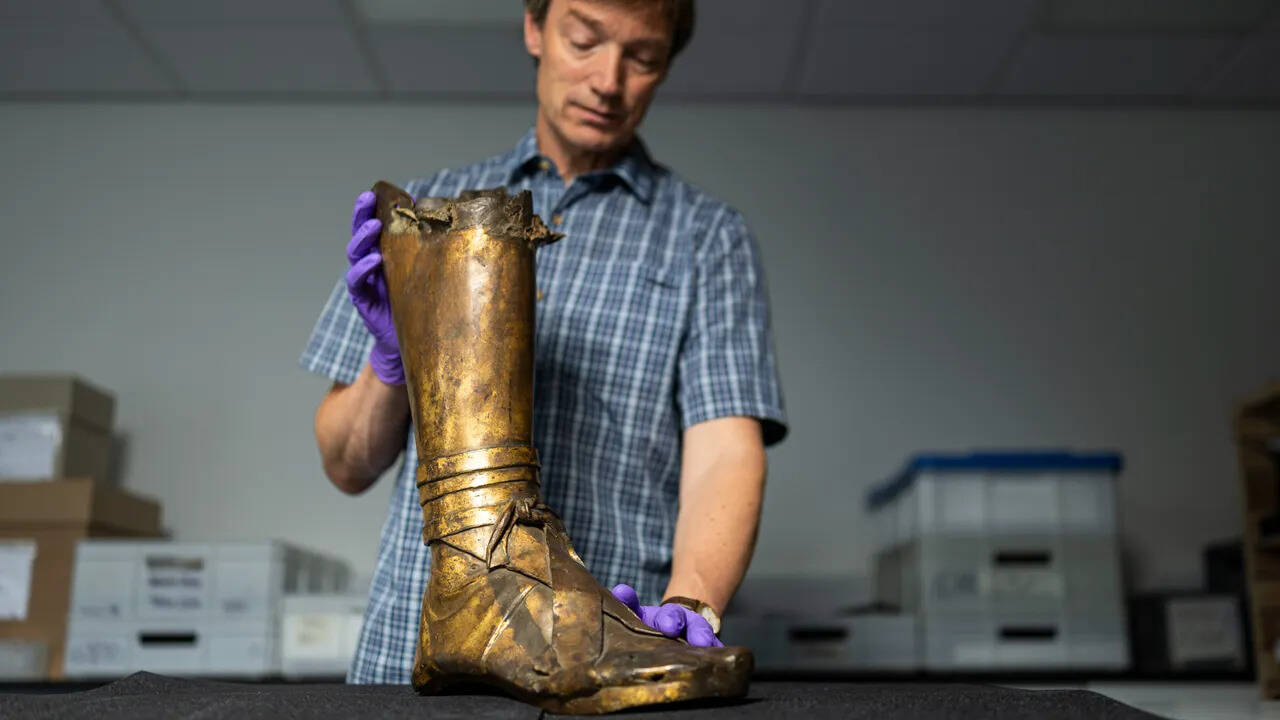
Some spin · most spun: The Times of India 30/100 See every outlet’s spin ↓Photo as used by The Times of India for “Mystery bronze leg in Scottish bog linked to giant Roman emperor statue”How The Times of India framed it: The Times of India's lead photo shows a gloved handler holding the large bronze leg and boot. Its size and gold-coloured surface reinforce the story's emphasis on a striking physical fragment of a proposed monumental statue.
National Museums Scotland has reconstructed a possible Roman imperial statue using a bronze leg found near Hawick in 1820. Researchers believe the original depicted Antoninus Pius on horseback. The new work revisits the object’s origin and dismantling; it is not the discovery of an intact statue.
How the coverage differs
The Times of India leads on the mystery and the shift from a theft theory towards proposed Roman removal, while Live Science leads on dismantling and reconstruction. The Herald's available summary focuses on the research and Edinburgh exhibition. Only The Times of India, among the supplied texts, mentions both the uncut upper edge and the ungilded knee; the Live Science text and The Herald summary are brief.
A gilded bronze leg recovered from a Scottish bog more than two centuries ago is being reconsidered as evidence of a Roman imperial monument erected in Scotland. National Museums Scotland researchers believe it belonged to a statue of Antoninus Pius on horseback. They have reconstructed the proposed monument for a new exhibition in Edinburgh.S1S3
The surviving object is a lower right leg with a boot, found at Milsington near Hawick in 1820. Earlier interpretations treated it as loot brought north from a Roman settlement, possibly York. The revised account instead connects it with a monument celebrating the Roman conquest of southern Scotland during the emperor’s reign.S1
Why it matters
The argument depends partly on the surviving metal. The upper edge has no marks showing that it was cut away, while the area around the knee lacks the gilding found elsewhere. Researchers interpret that bare area as having been covered by clothing, and the intact edge as evidence against violent chopping.S1
A wider comparison with imperial statues at frontier forts also makes a Scottish setting more plausible, the museum says. Its statement proposes careful Roman dismantling during withdrawal in the AD 160s or 180s. That interpretation supplies a possible explanation for removal, rather than a securely dated record of who buried the leg and why.R1
The background
Antoninus Pius ruled from AD 138 to 161, according to the supplied historical account. The proposed reconstruction depicts an emperor mounted on a horse, drawing comparisons with the surviving statue of Marcus Aurelius in Rome. The torso and horse have not been recovered, so the display represents the researchers’ proposed whole rather than surviving complete ancient sculpture.S1
Historic Environment Scotland describes the Antonine Wall as a turf rampart with a ditch, forts and a connecting military road, built on Pius’s orders after AD 140. It stretched about 60 kilometres between the Forth and Clyde. The frontier was occupied for roughly a generation before abandonment in the AD 160s.R3
What happens next
Roman Scotland: Life on the Edge of Empire is listed at the National Museum of Scotland from 14 November 2026 to 18 April 2027. The exhibition includes finds from the Roman fort at Inveresk and altars from its temple to Mithras. Its stated scope includes local responses to invasion, alongside the lives of frontier communities.R2
The central gaps concern the original statue’s exact position and the fate of its missing parts. The museum’s reconstruction does not identify where the torso or horse is now. The distinction between an observed fragment and a proposed reconstruction remains important when assessing what this old discovery can establish.S1R1
Fact check: every point labelled
What is confirmed, what is only reported, and what is claim or speculation. Every point links to its source.
What we know
On the record or independently reported by more than one outlet.
confirmedThe Milsington bronze lower right leg and boot were found near Hawick in 1820; the object was gilded and is larger than life.S1R1
confirmedThe upper edge lacks cut marks and the knee area lacks gilding.S1R1
confirmedThe Antonine Wall was built after AD 140 on Pius’s orders: a turf rampart, ditch, forts and road spanning about 60 kilometres between Forth and Clyde, abandoned in the AD 160s.R3
confirmedThe museum lists the exhibition for 14 November 2026–18 April 2027 in Edinburgh, including Inveresk fort finds and Mithras-temple altars.R2
confirmedThe original statue’s exact position and the whereabouts of its missing parts are not established in the reviewed material.S1R1
Reported but not yet confirmed
Reported as fact, but from a single origin.
reportedThe Times of India, describing the museum’s account: Earlier interpretations proposed loot from further south, possibly York.S1
reportedThe Times of India: Pius ruled AD 138–161; the reconstruction draws comparisons with Rome’s Marcus Aurelius statue, while the torso and horse remain missing.S1
Claims and disputes
What people say. Not established fact.
claimedNational Museums Scotland researchers: The fragment likely came from a mounted statue of Antoninus Pius erected in southern Scotland to commemorate conquest.S1R1
claimedNational Museums Scotland researchers: Clothing covered the bare knee area and the intact edge indicates careful removal.S1
claimedNational Museums Scotland researchers: Frontier-fort statue comparisons support a Scottish setting; dismantling may date to Roman withdrawal in the AD 160s or 180s.R1
claimedNational Museums Scotland: The exhibition aims to explore frontier communities and local responses to invasion.R2
Similar past cases
For comparison only. Every case is different.
Inveresk altars: conservation announced in 2026: Conservators reconstructed two fragmented stone altars and found traces of paint.P1
Both reveal Roman monument-making in Scotland; the altars are religious stone carvings, unlike the proposed bronze imperial statue.
Still unknown
The original statue’s exact location.
The fate of the torso and horse.
The exact date and circumstances of dismantling.
Key questions
Was a complete Roman statue discovered?
No. The surviving object is a bronze leg found in 1820; the full statue is a proposed reconstruction.S1
Who do researchers think the statue depicted?
They believe it showed Antoninus Pius on horseback, but the torso and horse have not been recovered.S1
Where can the reconstruction be seen?
It forms part of Roman Scotland: Life on the Edge of Empire at the National Museum of Scotland in Edinburgh.S1R2
Spin meter
How each outlet framed this story, scored on the wording and choices in that article, not on the outlet’s reputation.
Headlines compared: Live Science states that Romans dismantled the statue during their withdrawal, while The Times of India emphasises the mystery and a link to a giant statue. The Herald is the most cautious, saying the statue may have stood in the Scottish Borders.
The Times of IndiaFraming: Not political · Spin 30/100 · Headline matches story: yes
“Mystery bronze leg in Scottish bog linked to giant Roman emperor statue”
Straight reportingHeavy spin
The Times of India frames the leg as a mystery that may reveal a monumental display of Roman authority and a revised account of its removal.
Score under review: our second, independent check scored this article 14/100, so it is left out of the spin league until the two agree. How we check spin scores.
Why? 2 framing techniques
speculation as factthe statue eventually taken apart The question presumes dismantling, although the fragment's condition does not establish what happened to the statue.
emphasisan unmistakable display of Roman power The article emphasises the proposed monument's dramatic political impact, although its original form and position remain uncertain.
Live ScienceFraming: Not political · Spin 25/100 · Headline matches story: partly
“Romans carefully dismantled statue of emperor when they withdrew from Scotland 1,800 years ago, leaving only his foot behind”
Straight reportingHeavy spin
Live Science leads with a confident account of Roman dismantling and highlights the reconstructed statue.
Why? 2 framing techniques
speculation as factRomans carefully dismantled statue of emperor when they withdrew from Scotland The headline presents the identity of those who dismantled the statue and the timing as established, although the reviewed facts do not establish them.
speculation as factreconstructed what the entire sculpture looked like This presents the proposed reconstruction as definitive even though the statue's full appearance is uncertain.
The HeraldFraming: Not political · Spin 5/100 · Headline matches story: yes
“Huge Roman statue of Emperor Antoninus Pius may have stood in Scottish Borders”
Straight reportingHeavy spin
The Herald cautiously presents the proposed statue and its recreation for an Edinburgh exhibition.
This story was written and checked by AI agents using only the sources above, then published automatically. Facts are labelled by how well they are supported. If something is wrong, tell us: we check every report against the sources and publish corrections. Editorial policy