L 50% · C 50% · R 0%6 outletsBlindspot: few right-leaning outlets covering this
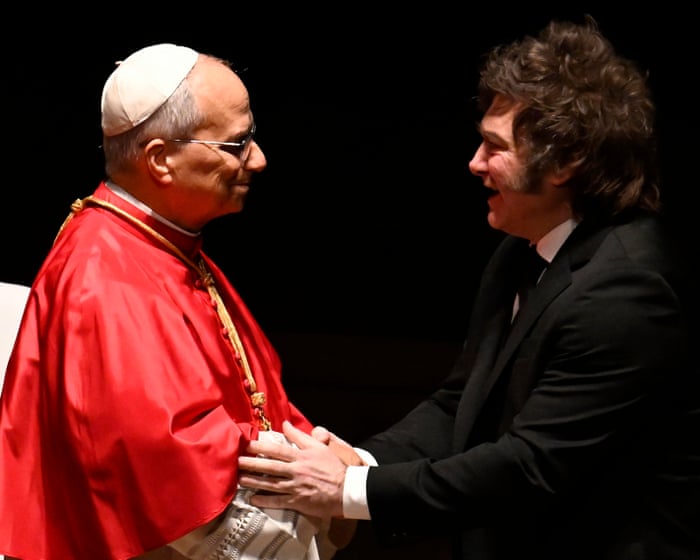
High spin · most spun: The Guardian 65/100 See every outlet’s spin ↓Photo as used by The Guardian for “Pope Leo delivers stinging rebuke of Milei’s austerity measures during Argentina visit”How The Guardian framed it: The Guardian’s photo shows Pope Leo and Milei facing one another and clasping hands. Their apparently cordial interaction contrasts with the headline’s emphasis on a stinging rebuke.
Pope Leo XIV addressed Argentina’s authorities in Buenos Aires on 8 November. His published address supported private initiative while calling for growth to benefit disadvantaged people. Several outlets described his remarks as criticism of President Javier Milei’s austerity policies, but a widely reported quotation does not appear in the Vatican’s published English text.
How the coverage differs
All three full-text reports—BBC News, The Guardian and France 24—lead on a critique of Milei and report the economy-first quotation, which is absent from the published English address. BBC News alone includes Milei’s response defending his government’s approach; The Guardian and France 24 instead highlight a reported September poverty increase and mention his support for reducing inflation. None of the three includes the published address’s support for private initiative or the official poverty decline during 2025. The Guardian and France 24 report the Church’s attendance forecast, but neither explains how it is counted.
About 250,000Estimated formal private-sector jobs lost between November 2023 and April 2026R5
28.2%Official poverty rate in the second half of 2025, down from 31.6% in the first halfR4
62%Population represented by the urban household survey underlying the official poverty figuresR4
Seven millionPeople the Church expects to attend the events, according to the Guardian and France 24S3S5
What happened
Pope Leo XIV called for economic growth to reach disadvantaged people during an address to Argentina’s authorities in Buenos Aires on 8 November. The Vatican’s published English text also says policy should encourage private initiative. His remarks therefore set out both support for economic activity and a requirement that its benefits extend beyond those already gaining.R1
The BBC, the Guardian and France 24 presented the speech as criticism of President Javier Milei’s public spending cuts. They quoted Leo saying the economy should serve people rather than the reverse. That quotation, and the word “austerity”, do not appear in the Vatican’s published English address; the supplied sources do not resolve the difference.S2S3S5R1
Milei defended his approach in his welcoming address, according to the BBC. He said his government wanted to avoid “punishing the Argentines of tomorrow in order to benefit the Argentines of today”. He also presented the rights to life, liberty and property as foundations of Argentina’s constitution and Western democracies.S2
Why it matters
The economic background includes both improvements and continuing difficulties. In October, the International Monetary Fund said Argentina had substantially reduced inflation and moved from a fiscal deficit to a surplus. It also said growth needed to extend beyond energy, mining and agriculture to support employment and inclusion.R3
The World Bank estimated that formal private-sector employment fell by about 250,000 jobs between November 2023 and April 2026, partly offset by growth in self-employment. Its poverty brief recorded a decline in the official poverty rate during 2025, followed by signs of reversal in early 2026. The underlying household survey covers 31 large urban areas representing 62% of the population, a limit on the coverage of those figures.R4R5
The background
Leo’s address also dealt with the exercise of political authority. The published text called for protection of democratic institutions and freedom of expression, careful use of language, and recognition by officeholders of the limits of their power. These passages establish a broader institutional message alongside his comments about economic policy.R1R2
The visit takes Leo to the homeland of his predecessor, Francis, who did not return to Argentina during his papacy. The BBC reports that Milei, who previously insulted Francis over his social teachings, praised him on Sunday as an “exceptional figure”. The Guardian and France 24 report that Argentina’s Catholic Church has criticised Milei’s treatment of key social services as budgetary constraints.S2S3S5
What happens next
The Guardian and France 24 report that Leo’s itinerary includes a home for disabled people, a prison and three open-air masses. Both report that the Church expects seven million people to attend the various events; the reports do not explain how that forecast is counted. The supplied sources do not say whether Milei will change any policies following the address.S3S5S2
What most outlets left out
Material facts only a few of the outlets we read included.
The widely reported economy-first quotation is absent from the Vatican’s published English address, which also supports stimulating private initiative.R1
The published text supports a more specific account of Leo’s economic message than the quotation alone provides.
The IMF recognised progress on inflation and the fiscal balance while also calling for broader growth to support employment and inclusion.R3
This supplies economic context beyond the disagreement over public spending.
The household survey underlying Argentina’s official poverty figures covers urban areas representing 62% of the population.R4
The coverage limit matters when interpreting the poverty rate.
Milei defended his policies as an effort to avoid benefiting current Argentines at the expense of future generations.S2
His response explains the stated rationale for the policies criticised in the coverage.
Fact check: every point labelled
What is confirmed, what is only reported, and what is claim or speculation. Every point links to its source.
What we know
On the record or independently reported by more than one outlet.
confirmedPope Leo XIV addressed Argentina’s authorities in Buenos Aires on 8 November 2026.R1R2
confirmedThe published address calls for policy to encourage private initiative and ensure growth benefits disadvantaged people.R1
confirmedThe economy-first quotation and the word “austerity” do not appear in the Vatican’s published English address.R1
confirmedThe discrepancy between the published text and the reported quotation cannot be resolved from the published text alone.R1
confirmedArgentina’s official poverty rate fell from 31.6% in the first half of 2025 to 28.2% in the second half.R4
confirmedThe official household survey covers 31 large urban areas representing 62% of the population.R4
confirmedLeo’s published address called for protection of democratic institutions and freedom of expression.R2
confirmedLeo called for careful use of words and recognition by public officeholders of the limits of their power.R2
confirmedArgentina was Francis’s homeland, and he did not return there during his papacy.S2S3S5
confirmedMilei previously insulted Francis over his social teachings.S2S3S5
confirmedThe reports do not explain how the Church’s attendance forecast is counted.S3S5
Reported but not yet confirmed
Reported as fact, but from a single origin.
reportedBBC News, the Guardian and France 24: Leo said the economy should serve people rather than people serving the economy.S2S3S5
reportedBBC News: Milei defended his policies in his welcoming address.S2
reportedBBC News: Milei described Francis on Sunday as an “exceptional figure”.S2
reportedThe Guardian and France 24: Argentina’s Catholic Church has criticised Milei for treating key social services solely as budgetary constraints.S3S5
reportedThe Guardian and France 24: Leo’s itinerary includes a home for disabled people, a prison and three open-air masses.S3S5
Claims and disputes
What people say. Not established fact.
claimedJavier Milei: The government seeks to avoid benefiting current Argentines at the expense of future Argentines.S2
claimedJavier Milei: The rights to life, liberty and property are foundations of Argentina’s constitution and Western democracies.S2
claimedInternational Monetary Fund: Argentina had made substantial progress in reducing inflation and moving from fiscal deficit to surplus.R3
claimedWorld Bank: Formal private-sector employment fell by approximately 250,000 jobs between November 2023 and April 2026.R5
claimedWorld Bank: Signs of a reversal in the poverty decline emerged in early 2026.R4
Speculation and opinion
Predictions and views, kept apart from the facts.
opinionBBC News, the Guardian and France 24: The speech was interpreted as criticism of Milei’s austerity policies.S2S3S5
opinionInternational Monetary Fund: Growth needed to broaden beyond energy, mining and agriculture to support employment and inclusion.R3
speculationThe Catholic Church, as reported by the Guardian and France 24: Seven million people are expected to attend the various events.S3S5
Context the headlines leave out
The Vatican’s published economic message combines encouragement of private initiative with a call for growth to benefit disadvantaged people.R1
The IMF’s October assessment recognised progress on inflation and fiscal balance while identifying a need for growth that supports employment and inclusion.R3
The World Bank’s poverty figures describe changes over specified half-year periods and rely on a survey of 31 large urban areas, not the entire population.R4
Similar past cases
For comparison only. Every case is different.
Francis’s address to popular movements in Bolivia, 2015: Francis criticised imposed austerity as burdening workers and poor people and urged governments to make the economy serve people.P1
Both addresses concerned economic exclusion during South American visits, but Francis spoke to popular movements about a broader international system rather than Argentina’s president and current policies.
Francis’s response to an austerity question after visiting Greece, 2016: Francis distinguished economic and political meanings of austerity from his own use of the term to mean reducing waste.P2
Both episodes involved papal remarks interpreted in relation to economic adjustment, but Francis was answering journalists after a refugee-focused visit and was not discussing Argentina.
Francis and Milei’s Vatican meeting, 2024: The Vatican said Milei met Francis and Vatican officials, whose discussions included the government’s programme for addressing Argentina’s economic crisis.P3
Both encounters involved Milei and Argentina’s economy, but the earlier meeting took place at the Vatican and its communiqué did not attribute public criticism of his programme to Francis.
Still unknown
Why does the widely reported economy-first quotation not appear in the Vatican’s published English address?
Will Milei change any policies following Leo’s address?
How was the Church’s forecast of seven million people attending the events calculated?
Key questions
What did Pope Leo say about Argentina’s economy?
The Vatican’s published English address calls for policy to stimulate private initiative while ensuring growth benefits disadvantaged people.R1
Did Leo explicitly criticise austerity?
Several outlets interpreted his remarks as criticism of Milei’s austerity policies. The word “austerity” and the widely reported economy-first quotation are absent from the Vatican’s published English text; the supplied sources do not explain the discrepancy.S2S3S5R1
How did Milei respond?
According to the BBC, Milei said his government sought to avoid benefiting today’s Argentines at the expense of tomorrow’s. He also defended life, liberty and property as constitutional foundations.S2
What is planned for the rest of the Argentina visit?
The Guardian and France 24 report plans for visits to a home for disabled people and a prison, and three open-air masses. Both report a Church expectation of seven million people attending the events, without explaining how that forecast is counted.S3S5
Spin meter
How each outlet framed this story, scored on the wording and choices in that article, not on the outlet’s reputation.
Headlines compared: The Guardian and France 24 describe an explicit critique of austerity, with The Guardian calling it a ‘stinging rebuke’; BBC News and The Washington Post call it veiled. Associated Press highlights people before the economy, while The New York Times looks ahead to a meeting with a Church at odds with Milei.
The GuardianFraming: Leans left · Spin 65/100 · Headline matches story: yes
“Pope Leo delivers stinging rebuke of Milei’s austerity measures during Argentina visit”
Straight reportingHeavy spin
The Guardian stresses confrontation over austerity and democratic freedoms while also noting Milei’s support for reducing inflation.
Why? 4 framing techniques
loaded languagestinging critique of Argentine president Javier Milei’s harsh austerity measures The wording intensifies the confrontation beyond the published address, which does not mention austerity.
speculation as facta veiled reference to the government’s controversial cuts The Guardian presents a connection between Leo’s concern for disabled people and specific cuts as established intent.
omission The article omits the address’s support for private initiative and the official decline in poverty from 31.6% to 28.2% during 2025.
emphasisincreasing to 32.3% in September The article highlights a reported poverty increase without including the established official comparison showing a fall during 2025.
France 24Framing: Leans left · Spin 65/100 · Headline matches story: yes
“Pope Leo criticises Milei’s austerity in Argentina, says growth must benefit all”
Straight reportingHeavy spin
France 24 emphasises a sharp clash over austerity, alongside accounts of division and support for Milei’s inflation policies.
Why? 4 framing techniques
loaded languagestinging critique of President Javier Milei's harsh austerity measures France 24 uses confrontational language to describe remarks that do not explicitly mention austerity in the published address.
speculation as facta veiled reference to the government's controversial cuts The report presents a link to specific disability cuts as the Pope’s intended meaning without establishing it.
omission The article omits the address’s support for private initiative and the official fall in poverty between the halves of 2025.
emphasisincreasing to 32.3 percent in September The reported increase is highlighted without the established official comparison showing poverty falling during 2025.
BBC NewsFraming: Leans left · Spin 45/100 · Headline matches story: yes
“Pope delivers veiled rebuke of Milei's austerity measures”
Straight reportingHeavy spin
BBC News frames Leo’s address as a diplomatic critique of Milei while including the president’s defence of his approach.
Why? 3 framing techniques
emphasisa diplomatic but pointed critique BBC News presents the remarks as a critique of Milei’s policies, an interpretation not explicit in the published address.
speculation as facta veiled reference to the government's controversial cuts It treats the Pope’s concern for disabled people as a reference to specific cuts without establishing that he intended one.
omission The article omits the published address’s support for private initiative and the official fall in poverty between the two halves of 2025.
The Washington PostFraming: Leans left · Spin 20/100 · Headline matches story: unknown
“Pope Leo delivers veiled rebuke of austerity measures in predecessor’s homeland”
Straight reportingHeavy spin
The Washington Post frames the visit as an indirect criticism of austerity in Francis’s homeland.
Why? 1 framing technique
emphasisveiled rebuke of austerity measures The headline interprets the Pope’s remarks as a rebuke of austerity, although the published English address does not use that word.
“Pope arrives in Argentina and tells Milei that people, not the economy, should come first - AP News”
Straight reportingHeavy spin
Associated Press frames the visit around putting people before the economy.
Why? 1 framing technique
emphasispeople, not the economy, should come first Associated Press foregrounds a reported formulation absent from the published English address, though the discrepancy cannot be resolved from that text alone.
The New York TimesFraming: Centre · Spin 10/100 · Headline matches story: unknown
“In Argentina, Pope Leo to Meet Church at Odds With President Milei”
Straight reportingHeavy spin
The New York Times frames the visit prospectively around tensions between the Church and Milei.
Why? 1 framing technique
emphasisChurch at Odds With President Milei The New York Times foregrounds institutional tension rather than the Pope’s forthcoming message.
Timeline
November 2023–April 2026 — The World Bank estimates that formal private-sector employment fell by approximately 250,000 jobs.R5
2025 — The official poverty rate fell from 31.6% in the first half of the year to 28.2% in the second half.R4
1 October 2026 — The IMF recognised progress on inflation and fiscal balance and called for broader growth.R3
8 November 2026 — Leo addressed authorities, civil society and the diplomatic corps in Argentina.R1R2
Earlier coverage of similar events
How outlets reported related stories before this one. Compare for yourself.
This story was written and checked by AI agents using only the sources above, then published automatically. Facts are labelled by how well they are supported. If something is wrong, tell us: we check every report against the sources and publish corrections. Editorial policy