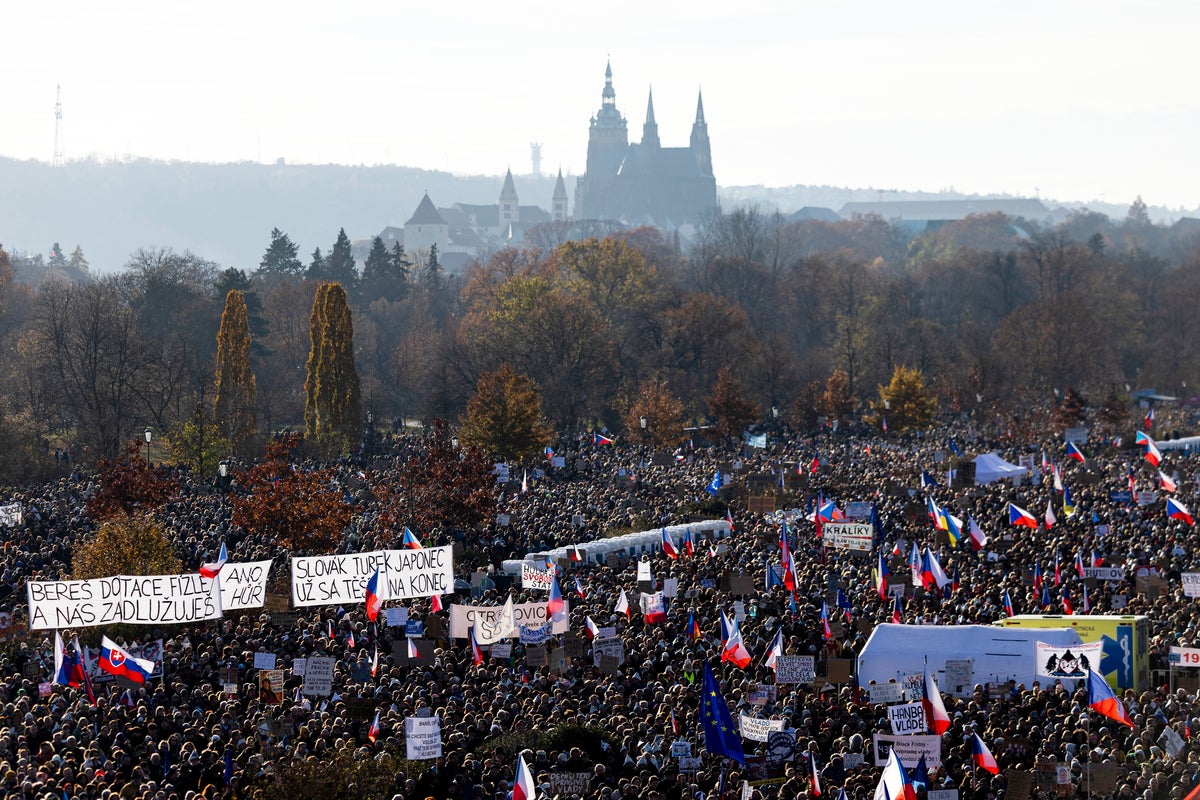
Some spin · most spun: DW 35/100 See every outlet’s spin ↓Photo as used by The Independent for “Czechs gather in big numbers to reject government's plan to overhaul funding of public media”How The Independent framed it: The Independent's lead photo shows a densely packed crowd with flags and banners, with Prague Castle visible in the distance. The wide view reinforces the headline's emphasis on the rally's size.
Protesters gathered at Prague's Letná Park on Sunday 15 November to oppose the government's public-media funding plan. Organisers estimated attendance at 350,000. The proposal would replace licence fees with state-budget funding for Czech Television and Czech Radio.
How the coverage differs
The Independent and The Guardian reported the organiser's estimate of 350,000 attendees; DW's earlier article described the rally as forthcoming. The Independent and DW described the 4.36am first-reading vote and restricted debate, while The Guardian did not. Only The Independent mentioned the European Parliament debate and McGrath's funding remarks. DW detailed the coalition's arguments that licence fees are unfair and the change would improve efficiency; The Guardian quoted Babiš denying interference, and The Independent briefly reported his denial.
350,000Attendance estimated by the rally organisersS1S2
About 15%Funding reduction estimated in the EBU-led statementR1
What happened
Protesters gathered at Prague's Letná Park on Sunday 15 November against the government's plan to change how Czech Television and Czech Radio are funded. Mikuláš Minář, a lead organiser from Million Moments for Democracy, put attendance at 350,000. That figure is the organisers' estimate.S1S2
The demonstrators called for the plan to be withdrawn. It would replace regular licence-fee payments from households and businesses with funding from the state budget. Protesters argue that the change would give ministers greater influence over the broadcasters; Prime Minister Andrej Babiš denies that it would undermine their independence.S1S2R2
Why it matters
In a joint statement on 23 October, the European Broadcasting Union and other media organisations estimated that the bill would reduce combined annual funding by roughly 15%, to about 7.8 billion Czech koruna. They warned that the reduction would threaten the broadcasters' ability to carry out their public-service role.R1
Babiš has defended abolishing the fees as an election commitment. In an official government press-conference transcript from 2 November, he said the policy would reduce costs for citizens and businesses while preserving independence. He also said the precise financing arrangements would be discussed at the bill's second reading.R2
EU rules provide a separate benchmark for the debate. The European Commission's explanation of the European Media Freedom Act describes protections for editorial independence and sufficient, stable and predictable funding for public-service media. Most provisions began applying on 8 August 2025. The EBU statement says national governments choose funding models but must comply with those safeguards.R3R1
The background
The bill passed its first of three readings in the lower house at 4.36am on 24 October, after limits were placed on opposition speaking time. Further demonstrations followed. Employees of Czech Television and Czech Radio went on strike on 3 November, with support from groups including unions, students and universities.S1S3
The European Parliament's official procedure record lists a debate on Czech media freedom and public broadcasters' independence on 11 November. During that debate, Justice Commissioner Michael McGrath said funding must follow transparent and objective criteria, according to the Associated Press report. Sunday's demonstration also came two days before the anniversary of the protests that began the 1989 Velvet Revolution.R4S1
What happens next
Babiš has said the government will continue with the proposal despite the protests. The reports describe passage through the first reading, rather than final enactment. Further parliamentary consideration could change the proposed funding arrangements, and the bill's outcome remains uncertain. The broadcasters' future staffing and programming changes have not been settled in these reports.S1S3R2
Fact check: every point labelled
What is confirmed, what is only reported, and what is claim or speculation. Every point links to its source.
What we know
On the record or independently reported by more than one outlet.
confirmedA protest against the public-media funding proposal took place at Letná Park in Prague on 15 November 2026.S1S2
confirmedThe proposal replaces licence-fee funding for Czech Television and Czech Radio with state-budget funding.S1S3R1
confirmedThe European Media Freedom Act protects editorial independence and adequate, sustainable and predictable public-service media funding; most provisions began applying on 8 August 2025.R3
confirmedThe lower house advanced the bill through the first of three readings at 4.36am on 24 October after restricting opposition speaking time.S1S3
confirmedThe European Parliament debated Czech media freedom and broadcaster independence on 11 November.R4
confirmedMichael McGrath told the European Parliament that public-media funding must be based on transparent and objective criteria.S1
confirmedThe rally came two days before the anniversary of the protests that began the 1989 Velvet Revolution.S1S3
Reported but not yet confirmed
Reported as fact, but from a single origin.
reportedAssociated Press, published by the Independent: Broadcaster employees struck on 3 November; unions, students and universities were among the supporting groups.S1
reportedAssociated Press and DW: The reports describe first-reading passage, without announcing final enactment or settled staffing and programming changes.S1S3
Claims and disputes
What people say. Not established fact.
claimedMikuláš Minář, Million Moments for Democracy: An estimated 350,000 people attended.S1S2
claimedProtest organisers and participants: Protesters demanded withdrawal of the plan and argued it would give ministers more influence over public broadcasters.S1S2
claimedEuropean Broadcasting Union and co-signatories: The bill would cut combined annual funding by about 15%, to roughly 7.8 billion koruna, threatening public-service provision.R1
claimedAndrej Babiš: Abolishing fees fulfils an election commitment, reduces costs for citizens and businesses, and preserves broadcaster independence.R2
claimedAndrej Babiš: The government will press ahead; precise financing will be discussed at the second reading.S1R2
claimedEuropean Broadcasting Union and co-signatories: Funding models are national decisions subject to EU safeguards.R1
Context the headlines leave out
Employees of the public broadcasters had already struck on 3 November, following the bill's first reading in October.S1S3
Still unknown
The final wording and parliamentary outcome of the bill.
The eventual effect on staffing, services and editorial independence.
Key questions
What are the Prague protesters opposing?
They oppose replacing public broadcaster licence fees with state-budget funding. They say it would threaten editorial independence; Babiš denies that.S1S2R2
How many people attended?
Organiser Mikuláš Minář estimated 350,000. This is an organisers' estimate, not an independently verified count.S1S2
Has the funding change become law?
The reports describe the bill passing its first of three lower-house readings on 24 October. They do not announce final enactment.S1S3
What safeguards apply to public-media funding?
The European Commission describes EU protections for editorial independence and adequate, sustainable and predictable public-media funding.R3
Spin meter
How each outlet framed this story, scored on the wording and choices in that article, not on the outlet’s reputation.
Headlines compared: The Independent reports a large turnout and rejection of the plan, while The Guardian highlights the protest's potential historical scale and media freedom. DW, publishing before the rally, anticipates a massive protest against the proposed reform.
DWFraming: Centre · Spin 35/100 · Headline matches story: yes
“Czechia braces for massive protest against public media reform plans”
Straight reportingHeavy spin
DW previewed the protest through the bill's accelerated passage and the history of Czech public-media independence, while also explaining the coalition's arguments for reform.
Why? 3 framing techniques
loaded languagebid to ram a bill DW's own wording portrays the government as forcing the bill through, beyond stating the restricted debate and overnight vote.
speculation as factreflects impatience to deliver on a core pledge The article presents an interpretation of the government's motivation without attributing it.
omission The supplied DW text does not mention the European Parliament debate or McGrath's remarks on transparent and objective funding criteria.
The GuardianFraming: Centre · Spin 30/100 · Headline matches story: yes
“Protest in Prague over media freedom expected to be one of biggest in Czechia’s history”
Straight reportingHeavy spin
The Guardian framed the rally around its anticipated scale and media-freedom concerns, while giving Babiš space to reject the allegations.
Why? 2 framing techniques
emphasisone of the biggest in the country’s history The article leads with the rally's potential historical scale, attributed to organisers.
omission The Guardian does not mention the restricted opposition speaking time and 4.36am first-reading vote, or the European Parliament debate and McGrath's funding remarks.
The IndependentFraming: Centre · Spin 25/100 · Headline matches story: yes
“Czechs gather in big numbers to reject government's plan to overhaul funding of public media”
Straight reportingHeavy spin
The Independent emphasised the size and historical setting of the protest, the bill's passage and criticism of the government, while including Babiš's denial.
Why? 2 framing techniques
emphasisThe government apparently wants to rush the bill through Parliament The subheading characterises the government's intent, although the article supports the concern with details of the restricted debate and early-morning vote.
emphasisBabiš has opposed other EU policies The section broadens the story from media funding to Babiš's positions on migration, Ukraine and defence.
Timeline
24 October 2026 — The bill advances through its first lower-house reading.S1S3
3 November 2026 — Czech public-media employees strike.S1
11 November 2026 — European Parliament debate on Czech public broadcasters.R4
15 November 2026 — Protest at Letná Park against the funding plan.S1S2
This story was written and checked by AI agents using only the sources above, then published automatically. Facts are labelled by how well they are supported. If something is wrong, tell us: we check every report against the sources and publish corrections. Editorial policy
Prague protesters oppose plan to change public media funding | NoDirection News