L 50% · C 50% · R 0%4 outletsBlindspot: few right-leaning outlets covering this
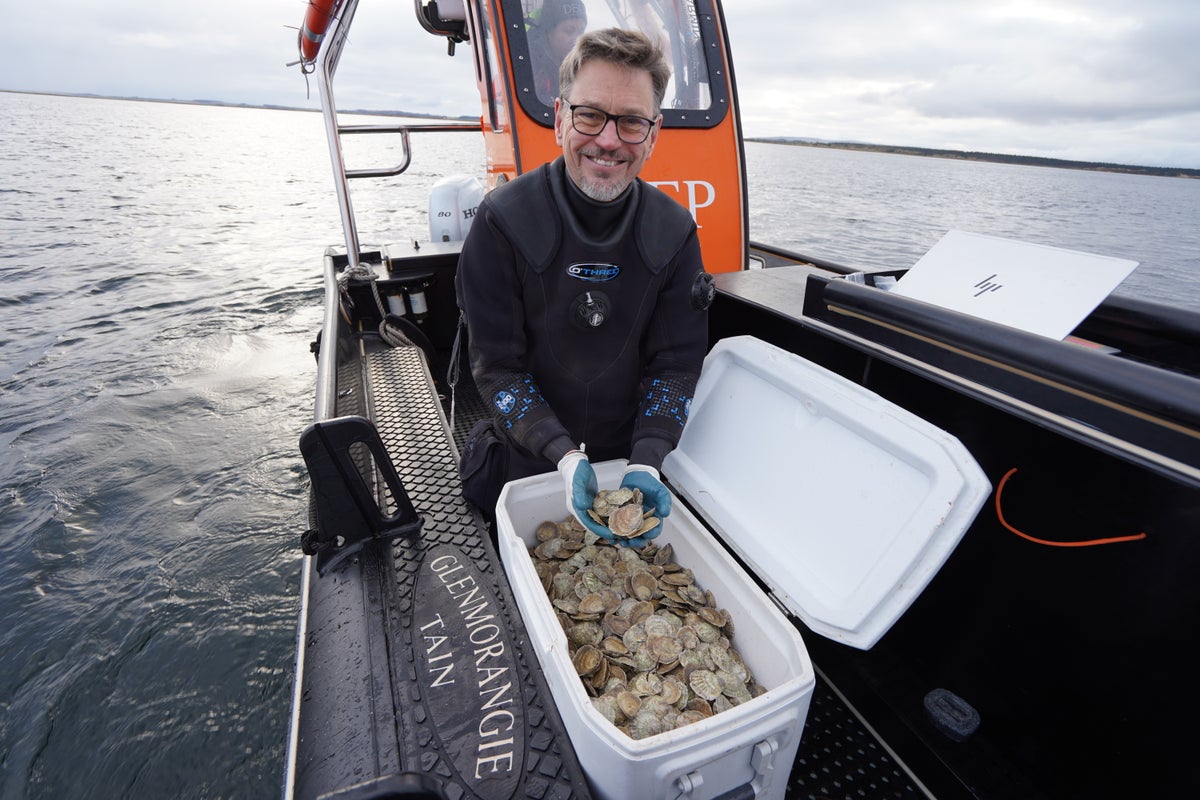
Low spin · most spun: The Herald 20/100 See every outlet’s spin ↓Photo as used by The Independent for “Oysters went extinct in the Dornoch Firth over 100 years ago. Now they’re making a comeback”How The Independent framed it: The Independent’s lead image shows a smiling man on a boat holding oysters over a container of shellfish. It gives the restoration story a hands-on and optimistic impression.
The Dornoch Environmental Enhancement Project has announced evidence of natural oyster reproduction at its Scottish restoration site. Researchers found young oysters and returned to see that some had grown. Further releases and monitoring are planned.
How the coverage differs
All four outlets highlighted the return of oysters after an absence of around a century, though only a headline and summary were available for The Herald. The Guardian and The Times of India provided extensive historical and ecological context and discussed continuing threats, including predation; The Independent instead gave more space to project partners’ reactions and further releases. The Independent described more than 140,000 juvenile oysters as released by October 2026, while The Guardian and The Times of India described approximately 140,000 adult oysters as deposited or introduced. Only The Guardian mentioned criticism of government policies on drag-net fisheries.
More than 140,000Oysters released by October 2026, according to the project partnerR1
Four million by 2031Project target, not a current population countS1
What happened
Researchers restoring native oysters in Scotland's Dornoch Firth say the shellfish are reproducing naturally at a site where they disappeared more than a century ago. The discovery concerns baby oysters, known as spat, produced in the restored habitat. It marks a different stage from simply placing oysters in the water and recording their survival.S1S4
The Marine Conservation Society's project announcement says Heriot-Watt University scientists identified the young oysters and museum specialists in Scotland and Wales checked images. A later visit found some had grown to about the size of a 50p coin. The project presents this as evidence of successful reproduction, rather than a completed restoration.R1S1
Why it matters
Project leader Professor Bill Sanderson says the team must continue adding oysters until births outpace losses to predators such as crabs and starfish. Natural breeding therefore does not yet establish that the population can sustain itself. The target is around four million oysters by 2031, with additional funding sought to support that work.S1S4
The intended benefits extend beyond the oysters themselves. Sanderson describes reefs as habitat for other marine life, structures that stabilise seabed sediments and populations that filter water. These are reasons for restoring the habitat; the current discovery does not quantify the biodiversity or water-quality gains already achieved at Dornoch.S4S1
The background
The partnership brings together Heriot-Watt, the Marine Conservation Society and whisky producer Glenmorangie. The Independent reports that 300 oysters from Loch Ryan were introduced in 2017 as part of a project begun 12 years ago. The original Dornoch population is thought to have been lost through fishing in the late nineteenth century.S1
The sources use different descriptions of the roughly 140,000 oysters introduced. The Guardian calls them adults, while the Independent and the Marine Conservation Society describe juveniles. The project partner dates its total of more than 140,000 releases to October 2026; this should not be confused with a count of naturally born young.S1S4R1
Sanderson told the Independent that about 3,000 oysters were reaching maturity across two established beds. Research associate Gurjameer Ramday, who found the spat, said warm conditions in 2025 and 2026 had encouraged close observation. His explanation of those conditions is the researcher's account, not a measured attribution of every breeding success.S1
What happens next
The team plans to keep monitoring oyster numbers and changes in biodiversity while continuing releases. The Independent reports that another 5,000 oysters were placed in the firth last week. The next test is whether young oysters continue to survive and reproduce in sufficient numbers to reduce dependence on those additions.S1S4
What most outlets left out
Material facts only a few of the outlets we read included.
Museum specialists in Scotland and Wales checked images of the young oysters.R1
This describes how the project sought verification of the identification.
Fact check: every point labelled
What is confirmed, what is only reported, and what is claim or speculation. Every point links to its source.
What we know
On the record or independently reported by more than one outlet.
confirmedThe project announced evidence of natural reproduction at Dornoch after local extinction more than a century ago.S1R1
Reported but not yet confirmed
Reported as fact, but from a single origin.
reportedThe Independent: The partnership involves Heriot-Watt, the Marine Conservation Society and Glenmorangie; 300 oysters from Loch Ryan were introduced in 2017 during a project begun 12 years ago.S1
reportedThe Independent: The original local population is thought to have been lost through fishing in the late nineteenth century.S1
reportedThe Independent: Another 5,000 oysters were placed in the firth last week, and monitoring and releases will continue.S1
Claims and disputes
What people say. Not established fact.
claimedMarine Conservation Society: Young oysters were identified, images checked by Scottish and Welsh museum specialists, and some subsequently grew to about 50p-coin size.R1
claimedBill Sanderson: Births must outpace losses to crabs and starfish before the population can sustain itself.S4
claimedBill Sanderson: The project aims for about four million oysters by 2031 and seeks further funding.S1
claimedBill Sanderson: Oyster reefs support other species, stabilise sediments and filter water.S4
disputedDiffering descriptions in the Guardian, Independent and Marine Conservation Society: The Guardian describes the roughly 140,000 introduced oysters as adults; the Independent and project partner describe juveniles.S1S4R1
claimedMarine Conservation Society: More than 140,000 oysters had been released by October 2026; that is not a count of naturally produced young.R1S1
claimedBill Sanderson: About 3,000 oysters were reaching maturity across two beds.S1
claimedGurjameer Ramday: Warm conditions in 2025 and 2026 encouraged close observation for spat.S1
Context the headlines leave out
The released population, the young born at the site and the future target are different measures.S1S4R1
Similar past cases
For comparison only. Every case is different.
Restoration Forth, reported June 2026: Heriot-Watt reported 60,000 oysters introduced and an 88% survival rate.P1
Both projects restore Scottish native oyster populations, but the cited Forth result measures survival rather than demonstrating natural breeding.
Still unknown
The number of naturally produced young that will survive to maturity.
When births will consistently outpace losses.
Measured long-term changes to biodiversity and water quality at the site.
Key questions
Is the restoration complete?
No. Sanderson says births must outpace losses to predators and further oysters will be added.S4S1
Are the 140,000 oysters all naturally born at the site?
No. That figure describes releases, rather than the number of offspring produced at Dornoch.S1R1
What is the longer-term goal?
The team aims for around four million oysters by 2031 and a population able to sustain itself.S1S4
Spin meter
How each outlet framed this story, scored on the wording and choices in that article, not on the outlet’s reputation.
Headlines compared: The Independent emphasised the Dornoch Firth’s local comeback, while The Herald used the more dramatic phrase “Back from the dead”. The Times of India led with wild reproduction and the number restored; The Guardian emphasised conservationists’ role in reversing local extinction.
The HeraldFraming: Not political · Spin 20/100 · Headline matches story: unknown
“Back from the dead: Baby oysters return to Scottish firth after 100 years”
Straight reportingHeavy spin
The Herald used a dramatic headline and summary to present the discovery as a reef comeback.
Why? 2 framing techniques
loaded languageBack from the dead The dramatic phrase presents the return of a locally extinct population as a resurrection.
emphasisBaby boom proves a lost Scottish reef is coming back The summary emphasises a broader reef recovery based on evidence of natural reproduction.
The GuardianFraming: Not political · Spin 18/100 · Headline matches story: yes
“Return of the wild oyster: conservationists bring shellfish back from local extinction off Scottish coast”
Straight reportingHeavy spin
The Guardian framed the discovery as a hopeful conservation breakthrough, while placing it alongside historical decline and ongoing risks.
Why? 2 framing techniques
loaded languageheralding a remarkable turnaround for the species The phrase gives the local restoration effort an upbeat significance for the species more broadly.
emphasisproof of a breakthrough in marine conservation The opening foregrounds the achievement, although the article later describes continuing threats and uncertainty.
The IndependentFraming: Not political · Spin 16/100 · Headline matches story: yes
“Oysters went extinct in the Dornoch Firth over 100 years ago. Now they’re making a comeback”
Straight reportingHeavy spin
The Independent framed the discovery as a restoration success, emphasising the project’s work and its partners’ reactions.
Why? 2 framing techniques
emphasisproof that targeted restoration can work The article foregrounds project partners’ celebratory assessments while noting that monitoring and further releases will continue.
omission Unlike The Guardian and The Times of India, the article does not discuss predation or other continuing threats to the restored population.
The Times of IndiaFraming: Not political · Spin 12/100 · Headline matches story: yes
“Scottish oysters reproduce in wild after 100 years, 140,000 restored”
Straight reportingHeavy spin
The Times of India framed the discovery as a conservation milestone within a wider account of oyster decline, ecological benefits and remaining threats.
Why? 1 framing technique
emphasisThe discovery marks an important milestone The article highlights the restoration achievement while also discussing threats and the work still needed.
Timeline
2017 — The project introduced 300 Loch Ryan oysters.S1
October 2026 — The project partner reports cumulative releases exceeding 140,000 oysters.R1
11 November 2026 — The Marine Conservation Society announced natural reproduction at the restored site.R1
This story was written and checked by AI agents using only the sources above, then published automatically. Facts are labelled by how well they are supported. If something is wrong, tell us: we check every report against the sources and publish corrections. Editorial policy