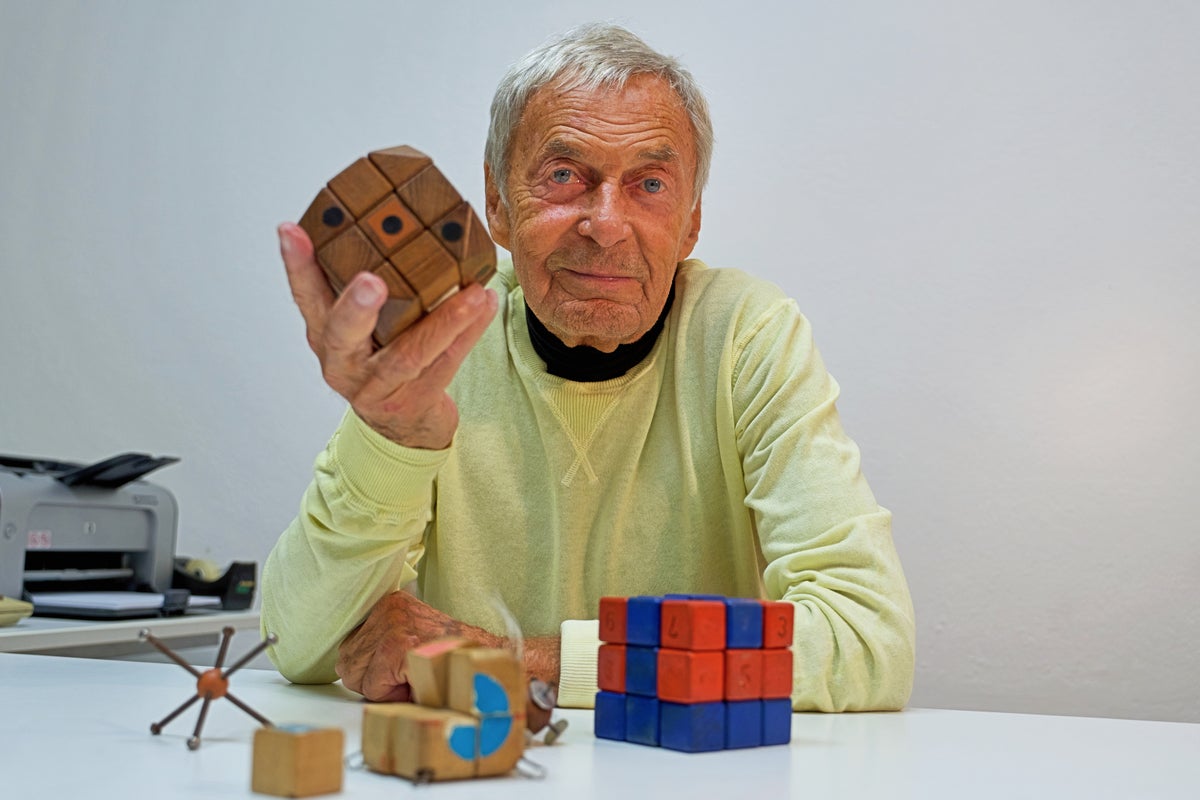
Low spin · most spun: The Independent 20/100 See every outlet’s spin ↓Photo as used by The Independent for “An iconic puzzle comes home as production of the Rubik's Cube returns to Hungary”How The Independent framed it: The Independent’s lead photo shows Ernő Rubik holding a wooden puzzle beside a modern cube and other objects. It foregrounds the inventor and the puzzle’s development, reinforcing the article’s personal and historical framing.
An automated Rubik's Cube production line opened at Jász-Plasztik in Jászberény on 10 November. Inventor Ernő Rubik attended the launch. The project brings manufacturing back to Hungary more than five decades after he developed the puzzle.
How the coverage differs
Euronews and The Independent both describe the automated line and a target of up to or around one million cubes annually; only The Independent identifies Spin Master as the trademark owner. Only The Independent discusses competitive solving and the 2.51-second record, without identifying it as a single-solve record. The Associated Press material supplied consists only of a headline and matching summary, so its wider coverage cannot be compared.
Rubik's Cube manufacturing has returned to Hungary with the opening of an automated production line at Jász-Plasztik's factory in Jászberény on 10 November. The city's announcement identifies the company as an official supplier to Spin Master, the Canadian business behind the Rubik's brand.R1R2
Inventor Ernő Rubik, 82, attended the launch, according to the Associated Press report carried by The Independent. Robotic arms assemble the puzzles and test how they work and withstand use. Rubik contrasted that process with the manual assembly used in the product's early years.S3
Project director János Kasza said the company planned to manufacture around one million cubes annually and had hired 27 employees because of the investment, according to the city. The annual figure is a production target, rather than evidence that a year's output has already been achieved.R1
Why it matters
The return connects the puzzle's Hungarian origins with its present international ownership and supply arrangements. Rubik's official history records Spin Master's acquisition in 2021. At the opening, Spin Master executive Steven Radewych said the investment would bring production closer to key markets, according to the city's account.R1R2
The manufacturing change is distinct from the invention itself. Rubik developed the puzzle in 1974 while teaching design in Budapest. The AP account describes his wooden prototype as an object assembled from 27 blocks, designed to turn along multiple axes, before he began producing it for sale.S3
The background
The first Hungarian sales came in 1977, when 5,000 units were offered as the Magic Cube in specialist Budapest shops, according to AP. Rubik said growing demand exceeded the production capacity available in Hungary. Licensing to overseas toy companies followed, and manufacturing moved abroad.S3
The brand's own timeline dates its global launch and change of name to Rubik's Cube to 1980. Rubik told AP that around 200 million were sold between 1980 and 1983. That historical sales figure describes the initial international boom, not the new factory's anticipated annual output.S3R2
Competitive solving remains another part of the puzzle's use. The World Cube Association's Guangzhou Grand Open 2026 results record Xuanyi Geng's 2.51-second single solve as a world record. A single solve and an average across attempts are separate categories in those results.R3
What happens next
The stated objective is sustained annual production at the new line. The sources reviewed do not provide a completed annual output figure or a date when the one-million target will be reached. They also do not establish how the move will affect retail prices.R1S1S3
Fact check: every point labelled
What is confirmed, what is only reported, and what is claim or speculation. Every point links to its source.
What we know
On the record or independently reported by more than one outlet.
confirmedThe automated production line opened at Jász-Plasztik in Jászberény on 10 November 2026, returning Rubik's Cube manufacturing to Hungary.R1
confirmedJász-Plasztik is an official supplier to Spin Master for the project.R1
confirmedSpin Master acquired the Rubik's brand in 2021.R2
confirmedRubik developed the puzzle in 1974 while teaching design in Budapest.R2S3
confirmedThe brand history records the 1980 global launch under the Rubik's Cube name.R2
confirmedThe Guangzhou Grand Open 2026 results record Xuanyi Geng's 2.51-second single solve as a world record; single and average results are separate categories.R3
confirmedThe production target is not a completed annual output total, and the reviewed sources establish no date for reaching it or retail-price effect.R1S1S3
Reported but not yet confirmed
Reported as fact, but from a single origin.
reportedAssociated Press via The Independent: Ernő Rubik, aged 82, attended the launch.S3
reportedAssociated Press via The Independent: Robotic arms assemble cubes and test functionality and durability; Rubik contrasted this with early manual assembly.S3
reportedAssociated Press via The Independent: The wooden prototype comprised 27 blocks and could turn on multiple axes.S3
reportedAssociated Press via The Independent: In 1977, 5,000 units were offered as the Magic Cube in specialist Budapest shops.S3
reportedAssociated Press via The Independent: Demand exceeded available Hungarian production capacity, followed by overseas licensing and manufacture.S3
Claims and disputes
What people say. Not established fact.
claimedJános Kasza: The production target is around one million cubes annually.R1
claimedJános Kasza: The investment led to 27 employees being hired.R1
claimedSteven Radewych: The investment would bring manufacturing closer to key markets.R1
claimedErnő Rubik: Around 200 million cubes were sold between 1980 and 1983.S3
Context the headlines leave out
The one-million annual target concerns this production line. It is not a figure for historic worldwide sales.R1S3
Still unknown
When the line will achieve its stated annual production target.
The effect, if any, on retail prices.
Key questions
Where are the new Hungarian Rubik's Cubes being made?
At Jász-Plasztik's factory in Jászberény, where the automated line opened on 10 November 2026.R1
How many cubes will the line make?
The company says it plans to produce around one million a year. This is a target, not a reported completed annual total.R1
Who owns the Rubik's brand?
The official brand history records its acquisition by Canada's Spin Master in 2021.R2
When was the Rubik's Cube invented?
Rubik developed it in 1974. The brand's history dates the global launch under the Rubik's Cube name to 1980.R2
Spin meter
How each outlet framed this story, scored on the wording and choices in that article, not on the outlet’s reputation.
Headlines compared: Euronews leads with the time elapsed since the invention and the return of production. Associated Press and The Independent use the same more sentimental ‘comes home’ framing.
The IndependentFraming: Not political · Spin 20/100 · Headline matches story: yes
“An iconic puzzle comes home as production of the Rubik's Cube returns to Hungary”
Straight reportingHeavy spin
The Independent frames the return as an emotional homecoming and celebrates the cube’s history, cultural appeal and continuing competitive popularity.
Why? 4 framing techniques
emotional appealcomes home The Independent’s homecoming metaphor gives the production move a sentimental significance beyond the manufacturing facts.
loaded languagepopular and beloved puzzles The affectionate description emphasises the puzzle’s cultural appeal rather than simply reporting its history.
omission The Independent gives the 2.51-second world record without specifying that it is a single-solve record, a category distinct from average results.
omission The Independent identifies Spin Master as the trademark owner but does not name Jász-Plasztik as its supplier for the project.
EuronewsFraming: Not political · Spin 10/100 · Headline matches story: yes
“Rubik's Cube production returns to Hungary more than 50 years after invention”
Straight reportingHeavy spin
Euronews presents the return of manufacturing as a milestone in the puzzle’s history, with emphasis on the automated line and its planned capacity.
Why? 1 framing technique
omission Euronews does not identify Jász-Plasztik as the supplier or Spin Master as the brand owner, leaving the companies behind the production project unclear.
Associated PressFraming: Not political · Spin 5/100 · Headline matches story: unknown
“An iconic puzzle comes home as production of the Rubik’s Cube returns to Hungary - AP News”
Straight reportingHeavy spin
Associated Press frames the return of production as a homecoming in the headline and summary available.
Why? 1 framing technique
emphasiscomes home Associated Press uses a homecoming metaphor to give the manufacturing move a sentimental emphasis.
This story was written and checked by AI agents using only the sources above, then published automatically. Facts are labelled by how well they are supported. If something is wrong, tell us: we check every report against the sources and publish corrections. Editorial policy
Rubik's Cube production returns to Hungary with automated line in Jászberény | NoDirection News