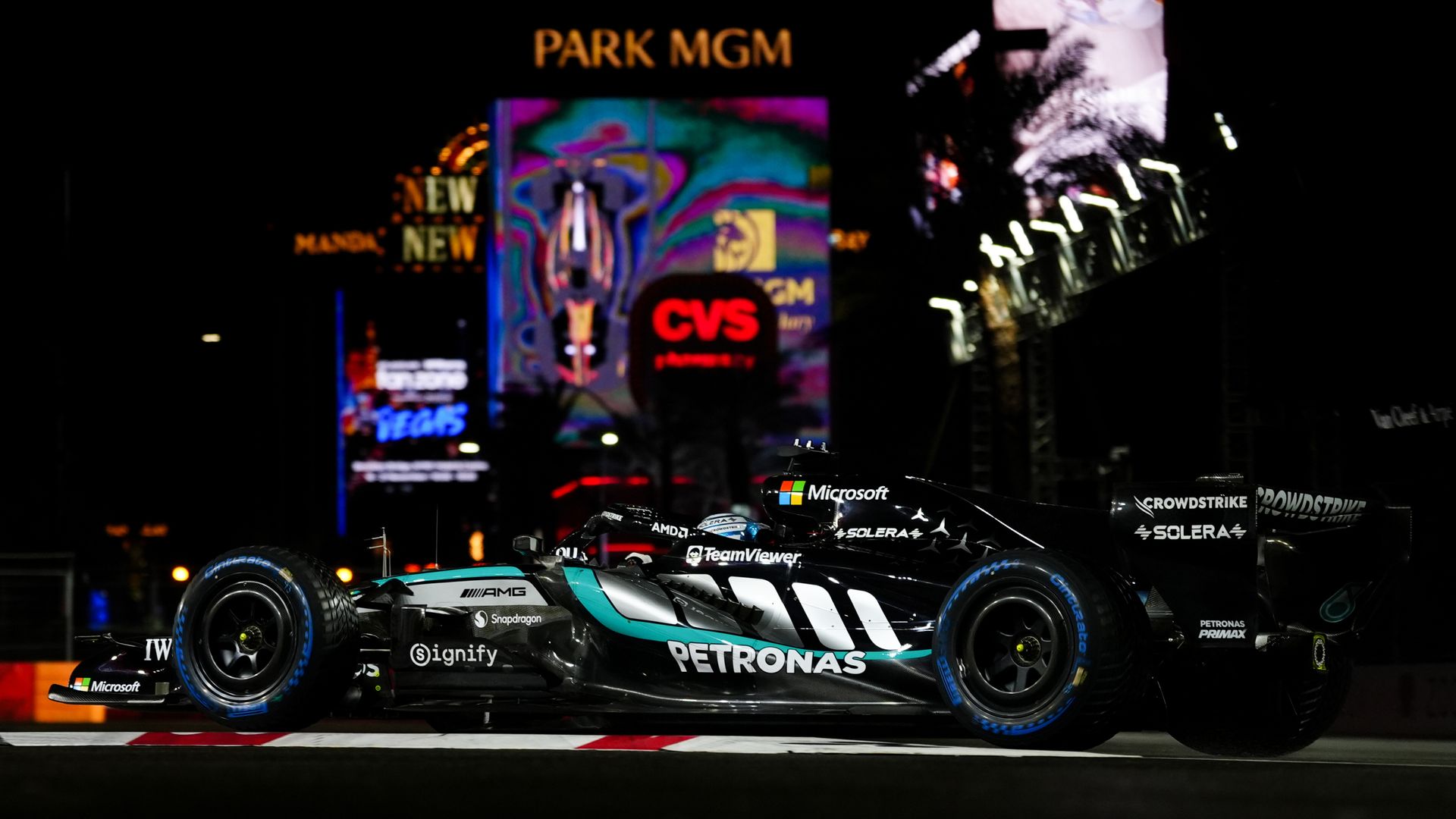
George Russell led second practice by 0.071 seconds from Pierre Gasly, with Charles Leclerc third. Russell said his lap came when the track was driest and questioned Mercedes’ underlying pace.
What happened
George Russell finished fastest in the second practice session for the Las Vegas Grand Prix, setting his best lap as the chequered flag appeared. His Mercedes recorded 1:47.272, leaving Alpine’s Pierre Gasly 0.071 seconds behind and Ferrari’s Charles Leclerc third.S2
The order changed in the closing moments of a session held on a wet track. Isack Hadjar and Oscar Piastri completed the first five, followed by Lewis Hamilton, Lando Norris, Kimi Antonelli, Franco Colapinto and Fernando Alonso.S2
Gasly’s final attempt came close to displacing Russell. The Race reported that the Alpine driver lost time in a large oversteer slide after a quick opening two sectors, leaving the margin at the finish below a tenth of a second.S5
Why it matters
The wet opening practice had produced no representative lap times, leaving teams short of running when the second hour began. Conditions improved enough for drivers to move from full wet tyres to intermediates, but the track remained too damp for slick tyres throughout Thursday’s sessions.S2S5
Leclerc suggested trying slicks, but Ferrari discouraged that option. Russell also rejected the idea when Mercedes asked about conditions. Those exchanges accompanied a session in which times kept improving as the track dried, rather than a settled sequence of laps on an unchanged surface.S5
Max Verstappen ended up thirteenth and recorded only one timed lap, late in the session. He reported problems with his Red Bull. The Race described a radio exchange in which his engineer suggested the engine needed to reach temperature, an explanation Verstappen rejected.S2S5
Russell said the headline time did not mean Mercedes had the quickest car. In his assessment, McLaren and Leclerc had shown stronger pace, while he benefited from completing a lap when the surface was driest and Norris was not running. He said Mercedes had further work to understand its performance.S1
The background
Norris was among the early drivers to change to intermediates and lowered the benchmark to 1:50.930. Leclerc then broke through the 1:50 mark, while Hadjar briefly went fastest before the Ferrari driver responded with a 1:47.605. Russell and Gasly improved again at the end.S2
The session’s red flag came with just over ten minutes remaining, when plastic debris needed to be cleared near the final corner. Running resumed for a last opportunity to improve. Hadjar’s late challenge was interrupted when he encountered Oliver Bearman’s Haas through the closing corners.S2
Several drivers also ran beyond the corners as they searched for grip. Alonso went deep at Turn 5 and narrowly missed the barriers, Norris recovered after leaving the track at Turn 14, and Verstappen overshot Turn 7.S2
Mercedes has fitted Antonelli with its revised turbocharger and a sixth internal combustion engine, which brings a five-place grid penalty. Russell is retaining the previous turbo specification. Mercedes deputy team principal Bradley Lord described the expected gain as only tens of milliseconds and said dry running was needed to assess it.S1
What happens next
Russell said teams might not understand the extent of tyre graining until race day. He contrasted last year’s one-stop race with the more severe graining and two-stop strategy of the preceding year, highlighting a question that Thursday’s wet running had left unanswered.S1
Pirelli’s preview also identifies possible graining in cool conditions with low grip. The tyre supplier considers one stop the likely fastest strategy on paper. That remains a forecast, rather than a strategy demonstrated by the wet practice session.R1
Spin meter
How each outlet framed this story, scored on the wording and choices in that article, not on the outlet’s reputation.
Headlines compared: Formula1.com focuses on Russell’s warning about Mercedes’ pace despite topping the session. The FIA, Sky News, Motorsport.com, Autosport, BBC News and ESPN lead with the result and conditions, while The Race uses a broader explanatory headline.
Motorsport.comFraming: Not political · Spin 13/100 · Headline matches story: yes
“F1 Las Vegas GP: George Russell pips Pierre Gasly in tricky FP2”
Straight reportingHeavy spin
Motorsport.com recounts the session in detail while adding drama to Gasly’s result and Red Bull’s difficulties.
Why? 2 framing techniques
loaded languageRed Bull’s misery
This dramatic description gives Red Bull’s practice problems a stronger emotional colour than the reported difficulties alone.
emphasisa shock second for Alpine
Calling Gasly’s result a shock highlights its surprise value alongside the explanation that the track was improving.
AutosportFraming: Not political · Spin 13/100 · Headline matches story: yes
“F1 Las Vegas GP: Russell fastest in damp FP2 from Gasly”
Straight reportingHeavy spin
Autosport provides a detailed session account, with added emphasis on Alpine’s surprise result and Red Bull’s problems.
Why? 2 framing techniques
loaded languageRed Bull’s misery
This dramatic description gives Red Bull’s practice problems a stronger emotional colour than the reported difficulties alone.
emphasisa shock second for Alpine
Calling Gasly’s result a shock highlights its surprise value alongside the explanation that the track was improving.
Formula1.comFraming: Not political · Spin 12/100 · Headline matches story: yes
“Russell admits Mercedes lacking pace despite topping FP2”
Straight reportingHeavy spin
Formula1.com frames Russell’s fastest time through his caution about Mercedes’ underlying pace and the questions ahead of the race.
Why? 1 framing technique
emphasisrealistically we probably were not the fastest
Formula1.com foregrounds Russell’s assessment of Mercedes’ pace rather than presenting his fastest lap as evidence of an advantage.
The RaceFraming: Not political · Spin 12/100 · Headline matches story: yes
“What happened in wet Las Vegas Grand Prix FP2”
Straight reportingHeavy spin
The Race highlights Gasly’s near-upset and Verstappen’s troubled session in a concise account of the wet practice.
Why? 1 framing technique
emphasisnarrowly denied Pierre Gasly and Alpine an upset result
The Race frames the close finish as a near-upset for Alpine rather than simply a practice-session ranking.
Sky NewsFraming: Not political · Spin 8/100 · Headline matches story: yes
“Russell fastest as rain limits running in Las Vegas GP practice”
Straight reportingHeavy spin
Sky News emphasises rain’s effect on running and the uncertainty it leaves for the rest of the weekend.
Why? 1 framing technique
emphasisthe times are likely to matter very little
Sky News stresses the limited predictive value of the wet-session results because dry conditions are expected later.
BBC NewsFraming: Not political · Spin 7/100 · Headline matches story: yes
“Russell fastest in Las Vegas practice after rain”
Straight reportingHeavy spin
BBC News presents the result alongside drivers’ assessments of the conditions and the challenges expected in dry running.
Why? 1 framing technique
emphasisthe session was incident-free
The BBC stresses the absence of serious incidents without mentioning the established off-track excursions.
ESPNFraming: Not political · Spin 6/100 · Headline matches story: yes
“Russell goes fastest in wet conditions in FP2 in Vegas”
Straight reportingHeavy spin
ESPN briefly highlights Russell finishing ahead of Leclerc without identifying the second-placed driver.
Why? 1 framing technique
omission ESPN’s short summary names Leclerc but omits Gasly, who finished between him and Russell.
FIAFraming: Not political · Spin 2/100 · Headline matches story: yes
“F1 – Russell beats Gasly and Leclerc to top spot in wet Las Vegas FP2”
Straight reportingHeavy spin
The FIA presents a chronological account of the changing conditions, incidents and final order.