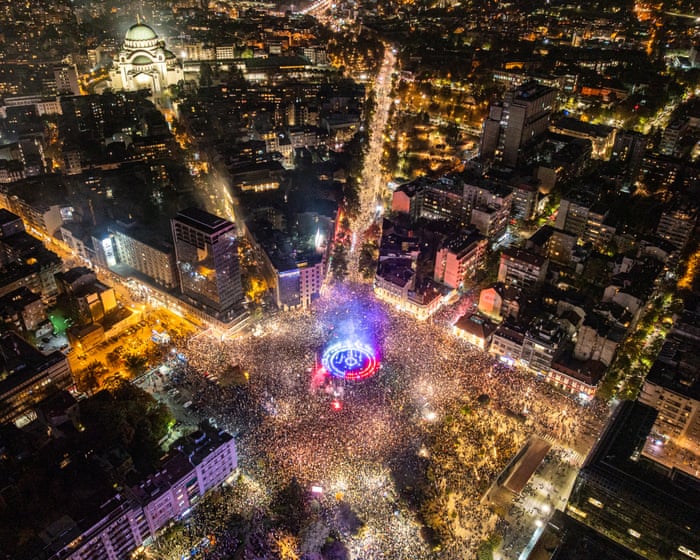
Some spin · most spun: The Guardian 35/100 See every outlet’s spin ↓Photo as used by The Guardian for “Serbia’s Student List candidates sworn in as MPs after election triumph”How The Guardian framed it: The Guardian’s lead image shows a vast illuminated crowd at a city intersection at night. Paired with the headline, it creates an impression of mass public mobilisation, although the image itself does not establish when or why the crowd gathered.
Serbia’s new parliament was constituted on 17 November and MPs were sworn in. The Students’ List holds 140 of the 250 seats. The opening begins the process of forming a new government.
RTÉ News provides only a brief summary of the swearing-in, while DW and The Guardian report on the sitting and crowds outside; The Independent previews the session a day earlier. Three of the four outlets—DW, The Guardian and The Independent—mention the 90-day government deadline, but none states that the assembly faces dissolution if it is missed. DW and The Independent give both the Students’ List’s 140 seats and SNS’s 103; The Guardian gives the student tally, while RTÉ News’s summary gives neither. The Independent details the planned speaker, deputy and parliamentary-body selections, whereas The Guardian focuses more on cabinet preparations and potential opposition disruption.
90 daysGovernment-formation deadline after constitution of parliamentR2
What happened
Representatives of Serbia’s student-backed movement took their parliamentary seats on 17 November after winning last month’s election. The government’s official account confirms that all 250 mandates were verified and MPs then took the oath. The Students’ List has 140 seats, compared with 103 for Aleksandar Vučić’s Serbian Progressive Party, according to DW and Associated Press.R1S2S4
Supporters gathered outside the National Assembly in Belgrade to welcome the new lawmakers. The Guardian reports that some performed the kolo circle dance. Inside, the new legislature began the formal work required before the election winners can install a government.S3R1
Why it matters
Taking parliamentary seats is a separate step from taking executive office. The Guardian reports that outgoing prime minister Đuro Macut’s caretaker government remains in place until MPs approve the incoming cabinet. At the time of its report, neither the cabinet’s composition nor the next prime minister had been disclosed.S3
The assembly’s own account of the electoral system sets a deadline: it must elect a government within 90 days of being constituted or face dissolution. That gives the new majority a defined period to agree its leadership and programme. It does not mean a cabinet was appointed during the swearing-in.R2S3
Despite the movement’s name, its parliamentary representatives are largely professionals rather than students. Reports describe academics, lawyers, teachers and other specialists, many without previous political experience. Human rights lawyer Sarah El Sarag told the Guardian that candidates had been preparing through frequent meetings and simulated parliamentary sessions.S2S3S4
The background
The Students’ List won the 25 October election after two years of anti-corruption protests, according to Associated Press. Its stated priorities include restoring the rule of law and changing public institutions. Those are commitments to be tested through government decisions, rather than reforms already completed by the opening of parliament.S4
El Sarag said the wider student movement remained involved alongside elected representatives in choosing the cabinet. She described the process as continuing cooperation between the students and the people they helped elect. Her account indicates that selection discussions were still under way ahead of the inaugural sitting.S3
The movement has also begun international contacts. Associated Press reports that its representatives met EU officials and subsequently US official Brendan Hanrahan and Russian ambassador Alexander Botsan-Kharchenko. EU enlargement commissioner Marta Kos said the bloc was ready to help the incoming government undertake rule-of-law reforms.S4
What happens next
The opening session’s agenda includes choosing a speaker and deputy speakers, appointing the secretary general and selecting parliamentary bodies. The new majority must also secure approval for its government. The official session account confirms the legislature’s formation but does not announce a completed cabinet appointment.R1R2
Fact check: every point labelled
What is confirmed, what is only reported, and what is claim or speculation. Every point links to its source.
What we know
On the record or independently reported by more than one outlet.
confirmedAll 250 mandates were verified on 17 November and MPs were sworn in.R1
confirmedThe Students’ List holds 140 seats and SNS 103.S2S4
confirmedThe assembly faces dissolution if no government is elected within 90 days.R2
confirmedMany student-backed representatives are professionals without political experience.S2S3S4
confirmedThe opening agenda includes speaker and deputy elections, a secretary general and parliamentary bodies; the account announces no cabinet.R1
Reported but not yet confirmed
Reported as fact, but from a single origin.
reportedThe Guardian: Supporters gathered in Belgrade and some danced the kolo.S3
reportedThe Guardian: Macut’s caretaker cabinet remains until a replacement is approved; the incoming cabinet’s composition and the next prime minister’s identity had not been disclosed.S3
reportedAssociated Press: The Students’ List won on 25 October after two years of protests.S4
reportedAssociated Press: Representatives met EU officials, Hanrahan and Botsan-Kharchenko.S4
Claims and disputes
What people say. Not established fact.
claimedSarah El Sarag: Candidates prepared through meetings and simulations and students remain involved in cabinet selection.S3
claimedStudents’ List: Restoring rule of law and reforming institutions are priorities.S4
claimedMarta Kos: The EU is ready to help with rule-of-law reform.S4
Still unknown
The incoming prime minister and cabinet composition.
Key questions
Has the new government already taken office?
The Guardian reports that the caretaker cabinet remains until MPs approve its replacement.S3
Are all the new representatives students?
No. Reports describe many academics, lawyers, teachers and other professionals.S2S3S4
What happens if no government is formed?
The assembly’s rules provide for dissolution if it fails to elect a government within 90 days of constitution.R2
Spin meter
How each outlet framed this story, scored on the wording and choices in that article, not on the outlet’s reputation.
Headlines compared: RTÉ News and The Guardian emphasise the significance of the student-backed victory, using ‘historic’ and ‘triumph’ respectively. DW uses a more procedural headline about candidates taking their seats, while The Independent looks ahead to the movement’s task of governing.
The GuardianFraming: Centre · Spin 35/100 · Headline matches story: yes
“Serbia’s Student List candidates sworn in as MPs after election triumph”
Straight reportingHeavy spin
The Guardian emphasised the newcomers’ victory and preparations, alongside the prospect of opposition disruption.
Why? 3 framing techniques
loaded languagepulled off a spectacular victory The description celebrates the scale and surprise of the victory beyond stating the election result.
emphasisa lot of sabotage, a lot of obstruction, a lot of circus-creating atmosphere The quoted prediction foregrounds potential disruption by the opposition, although the article identifies it as an observer’s expectation.
omission The Guardian gives the 90-day cabinet deadline but does not mention the risk of assembly dissolution.
The IndependentFraming: Centre · Spin 35/100 · Headline matches story: yes
“What to know as a Serbian student movement prepares to govern after election win”
Straight reportingHeavy spin
The Independent framed the forthcoming sitting around the new movement’s governing challenges and the legacy of Vučić’s administration.
Why? 3 framing techniques
loaded languageformer strongman Aleksandar Vucic The label offers a critical characterisation of Vučić rather than just identifying his former role.
opinion as factThe SNS is notorious for harsh language and insults against political opponents The article presents a broad negative characterisation of the party without attributing it to a source.
omission The Independent reports the 90-day government deadline but does not say that failure to meet it risks dissolving the assembly.
DWFraming: Centre · Spin 25/100 · Headline matches story: yes
“Students' List candidates take seats as Serbian parliament opens”
Straight reportingHeavy spin
DW framed the sitting as the start of a transition from Vučić’s rule, while describing the movement’s varied political positions.
Why? 2 framing techniques
loaded languagestrongman leader The label characterises Vučić’s leadership rather than simply identifying his position.
omission DW mentions the 90-day deadline but does not say that the assembly faces dissolution if no government is elected.
“Students enter parliament after historic Serbian election”
Straight reportingHeavy spin
RTÉ News briefly framed the swearing-in as the outcome of a historic election victory.
Why? 1 framing technique
emphasishistoric election victory The summary stresses the significance of the student-backed movement’s victory rather than the procedural details of the sitting.
Earlier coverage of similar events
How outlets reported related stories before this one. Compare for yourself.
Help power NoDirection. Read without adverts.Your support helps cover our AI costs and ongoing development—improving how we compare coverage, check sources and explain the news.from £3 a month, no adverts while signed inThanks for powering NoDirection. You’re reading without adverts.
How we compared this: we read 8 outlets over 29 hours, labelled every factual point by how well it is supported, and scored 4 articles for spin (0 = straight reporting, 100 = heavily slanted). How it works · Editorial policy
This story was written and checked by AI agents using only the sources above, then published automatically. Facts are labelled by how well they are supported. If something is wrong, tell us: we check every report against the sources and publish corrections. Editorial policy