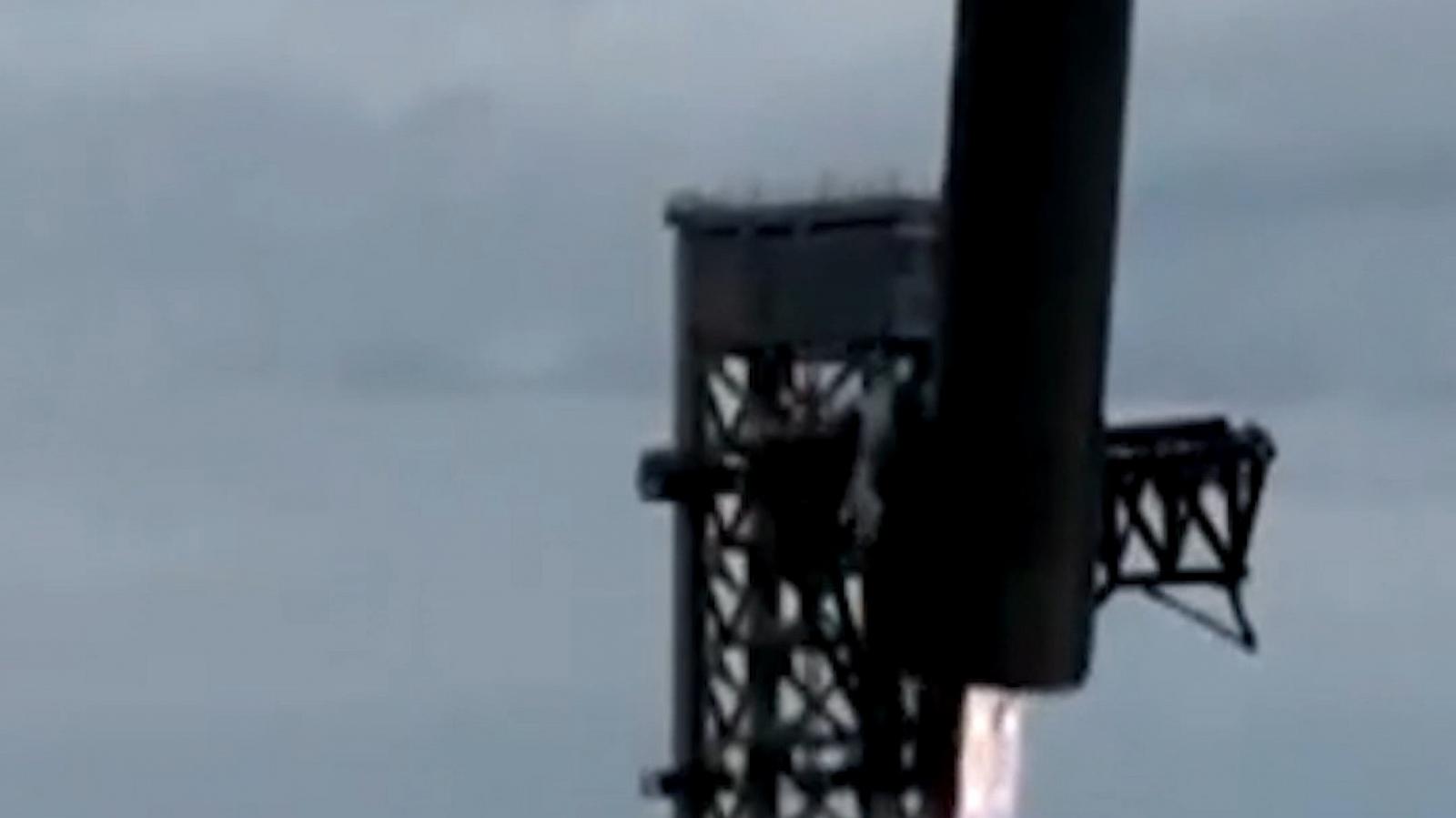
Low spin · most spun: GB News 20/100 See every outlet’s spin ↓Photo as used by ABC News for “WATCH: SpaceX Starship caught by launch pad arms”How ABC News framed it: ABC News’s image shows the Starship upper stage beside the launch tower, with a bright engine plume visible below it. The close, dramatic view supports the headline’s focus on the catch.
SpaceX has caught a Starship upper stage with its launch tower's mechanical arms for the first time after an orbital flight. The spacecraft launched from Texas on 13 November and returned the next day. The booster was lost, so the mission did not achieve the planned recovery of both stages.
How the coverage differs
Six of the ten sources—Channel 4 News, Breitbart, The Guardian, The Independent, Euronews and GB News—mention the aborted or failed booster recovery; all except Channel 4 News also say the booster exploded. Four—Channel 4 News, Breitbart, The Independent and GB News—mention the satellite deployment. The Independent and GB News include earlier booster catches, while ABC News and the Irish Independent provide only summaries and NBC News and France 24 provide no substantive video narration in the supplied text.
About 22 hoursTime in space before the upper-stage catchS6S10
What happened
SpaceX caught the upper stage of its Starship rocket at its Texas launch site on 14 November, completing its first tower catch of a spacecraft returning from orbit. The vehicle descended into the launch tower's mechanical arms after roughly 22 hours in space. It had launched the previous day on Starship's fifteenth full-scale test flight.S1S2S5S6S7
The spacecraft reached orbit and deployed 26 Starlink satellites, but the Super Heavy booster did not return to the tower. Its catch attempt was abandoned and it was diverted offshore, where it exploded. The two stages therefore had different outcomes: the upper stage was recovered, while the booster was lost.S6S10
Why it matters
The two recoveries were intended to take place on the same mission. Catching the upper stage completed one part of that plan, but Friday’s booster loss ruled out a double recovery. The vehicle that returns from orbit is distinct from the Super Heavy booster that provides the launch’s initial thrust.S3S6S10
Recovery and reuse are separate steps. SpaceX’s pre-flight account recorded three earlier booster catches and two reflights, and described this as the first catch attempt for its newer booster version. None of the accounts of Saturday’s upper-stage recovery establishes that this particular spacecraft has subsequently flown again.R1S6S10
The background
Channel 4 reports that the upper stage completed 14 circuits of Earth during the 22-hour mission. The Independent puts its orbital altitude at about 265km. SpaceX reported that the spacecraft’s systems, including its heat shield, appeared to work well; that assessment is the company’s account of the test.S2S6
SpaceX's updated mission account says the booster's return burn ended early because of low fuel mass, with the underlying cause still under investigation. Kate Tice had explained that the guidance system detected an incorrect position and triggered an offshore diversion and self-destruction. These are the company's explanations; a completed investigation has not been announced in the material reviewed.R3S6
What happens next
NASA's November programme update targets an Artemis III mission in Earth orbit in 2027 to test rendezvous, docking and operations between Orion and lander test vehicles from SpaceX and Blue Origin. Four astronauts would undertake a planned 14-day mission. NASA targets an Artemis IV Moon landing in 2028. Those are future programme goals, rather than capabilities all demonstrated by this satellite-launch and recovery flight.R2
SpaceX also expects to start Starship launches from Florida’s Kennedy Space Center in the coming months, according to the Independent. The reports do not specify when this particular upper-stage spacecraft will fly again. The booster investigation also remains unfinished, according to the company’s mission update.S6R3
Fact check: every point labelled
What is confirmed, what is only reported, and what is claim or speculation. Every point links to its source.
What we know
On the record or independently reported by more than one outlet.
confirmedSpaceX caught a Starship upper stage at its Texas launch tower on 14 November 2026, the first such catch after orbit; it launched on 13 November on the fifteenth full-scale test and returned roughly 22 hours later.S1S2S5S6S7
confirmedThe upper stage reached orbit and deployed 26 Starlink satellites; the Super Heavy booster was diverted offshore after its catch was abandoned and exploded.S6S10
confirmedFlight 15 was intended to recover both stages at the launch site; the booster loss prevented that outcome.R1S6S10
confirmedBefore Flight 15, SpaceX said it had made three booster catches and two reflights; this was the first return-and-catch attempt for a Super Heavy V3 booster.R1
confirmedThe previous mission was Starship's first orbital flight.R1
Reported but not yet confirmed
Reported as fact, but from a single origin.
reportedChannel 4 and the Independent: Flight 15 completed 14 circuits of Earth at an altitude of about 265km.S2S6
reportedThe Independent and GB News: The reports do not give a date for reflight of the recovered upper stage.S6S10
reportedBreitbart: Super Heavy provides initial thrust; the upper-stage spacecraft travels to orbit.S3
Claims and disputes
What people say. Not established fact.
claimedSpaceX: Low fuel mass ended the booster's return burn early; guidance detected an incorrect position and triggered an offshore diversion and self-destruction. The underlying cause remains under investigation.R3S6
claimedNASA: Artemis III is targeted for a 14-day Earth-orbit mission with four astronauts in 2027, testing rendezvous, docking and operations with Orion and SpaceX and Blue Origin lander vehicles; Artemis IV targets a 2028 Moon landing.R2
claimedSpaceX: The spacecraft's systems, including its heat shield, appeared to work well.S6
claimedSpaceX: Starship launches from Kennedy Space Center are expected to begin in the coming months.S6
Context the headlines leave out
The successful upper-stage catch and the unsuccessful booster recovery were different parts of the same test flight.S6S10
Similar past cases
For comparison only. Every case is different.
Starship Flight 5, October 2024: NASA's inspector general records a booster catch using the launch tower arms.P1
The shared technique is a tower-arm catch; the 2024 milestone concerned the first-stage booster.
Still unknown
The completed findings of the booster investigation, including the underlying cause of low fuel mass.
When the recovered upper-stage vehicle will fly again.
When both stages will be recovered from the same flight.
Key questions
Did SpaceX catch both Starship stages?
No. The upper stage was caught on 14 November, but the Super Heavy booster was lost after its catch attempt was abandoned.S6S10
Was this the first Starship tower catch?
It was the first catch of the upper-stage spacecraft after an orbital flight. SpaceX had previously caught Super Heavy boosters.S6S10
Does this mean the recovered spacecraft has flown again?
No reflight of this vehicle is established by the reports. SpaceX's goal is to recover both stages for reuse.S6S10
How does this relate to NASA's Moon programme?
NASA plans Earth-orbit lander tests for Artemis III in 2027 and an Artemis IV lunar landing in 2028. These remain programme targets.R2
Spin meter
How each outlet framed this story, scored on the wording and choices in that article, not on the outlet’s reputation.
Headlines compared: ABC News, NBC News, The Guardian, The Independent, Euronews and the Irish Independent chiefly describe the return or catch. Breitbart, France 24 and GB News emphasise its historic or breakthrough character, while Channel 4 News leads on its possible importance for moon missions. NBC News’s headline is less precise about what performed the catch.
GB NewsFraming: Not political · Spin 20/100 · Headline matches story: yes
“Elon Musk's SpaceX catches giant Starship rocket as it returns to Earth in major breakthrough”
Straight reportingHeavy spin
GB News uses dramatic language and celebratory quotes while detailing the booster loss and investigation.
Why? 2 framing techniques
loaded languagesnatched out of the sky The dramatic wording makes the controlled mechanical catch sound more cinematic.
selective quotethe Holy Grail of space flight A SpaceX spokesman’s exuberant description reinforces the achievement-focused framing.
BreitbartFraming: Not political · Spin 18/100 · Headline matches story: yes
“Elon Musk's SpaceX Achieves Historic First by Catching Returning Starship with Mechanical Arms”
Straight reportingHeavy spin
Breitbart celebrates the historic catch while reporting the booster explosion and missed double-catch goal.
Why? 2 framing techniques
emphasisthis innovative catching method The description emphasises the achievement’s novelty, although the article also reports the failed double catch.
selective quoteLook at her! Baby, she’s back! The excited SpaceX commentator’s reaction gives the account a celebratory tone.
The IndependentFraming: Not political · Spin 17/100 · Headline matches story: yes
“SpaceX’s Starship returns to launch pad from orbit for first time”
Straight reportingHeavy spin
The Independent describes a dramatic catch but gives substantial detail on the booster failure and earlier catches.
Why? 1 framing technique
loaded languageThe sci-fi-like capture helped overshadow the failure of the booster recovery The cinematic description and claim that the catch overshadowed the failure add interpretation to the two outcomes.
ABC NewsFraming: Not political · Spin 15/100 · Headline matches story: yes
“WATCH: SpaceX Starship caught by launch pad arms”
Straight reportingHeavy spin
ABC News presents the upper-stage catch as a reusability milestone.
Why? 1 framing technique
omission The summary does not mention that the booster catch was abandoned and the booster exploded, preventing the intended double catch.
Irish IndependentFraming: Not political · Spin 15/100 · Headline matches story: yes
“SpaceX’s Starship returns from orbit and is caught by giant mechanical arms”
Straight reportingHeavy spin
The Irish Independent highlights the catch and SpaceX officials’ reusability claim.
Why? 1 framing technique
omission The summary attributes a full-reusability claim to SpaceX officials but does not mention the failed booster recovery.
Channel 4 NewsFraming: Not political · Spin 12/100 · Headline matches story: partly
“SpaceX rocket ‘catch’ could be historic moment for moon missions”
Straight reportingHeavy spin
Channel 4 News highlights the catch’s potential significance for lunar missions while noting the aborted booster recovery.
Why? 2 framing techniques
emphasishistoric moment for moon missions The headline foregrounds potential lunar missions, although the short text does not explain that connection.
omission Channel 4 News mentions that the booster catch was aborted but not that the booster exploded.
NBC NewsFraming: Not political · Spin 10/100 · Headline matches story: partly
“SpaceX Rocket Successfully Catches Part of Starship Rocket”
Straight reportingHeavy spin
NBC News presents the catch in a brief video headline; no substantive video narration is available for assessment.
Why? 1 framing technique
omission The available headline and page text do not explain that tower arms caught the upper stage or that the booster was lost.
France 24Framing: Not political · Spin 10/100 · Headline matches story: unknown
“SpaceX makes rocketry history by recapturing massive reusable rocketship”
Straight reportingHeavy spin
France 24 frames the catch as a historic achievement in its headline, with the video content unavailable for assessment.
Why? 1 framing technique
emphasismakes rocketry history The headline foregrounds the achievement’s historic character; the available page text does not include the video’s account.
The GuardianFraming: Not political · Spin 8/100 · Headline matches story: yes
“SpaceX’s Starship returns to launch pad from orbit – video”
Straight reportingHeavy spin
The Guardian balances the orbital return milestone against the failed double-catch plan.
Why? 1 framing technique
emphasisa milestone in the company’s efforts to make the craft suitable for human spaceflight The Guardian highlights the catch’s potential relevance to human spaceflight alongside the failed booster recovery.
EuronewsFraming: Not political · Spin 8/100 · Headline matches story: yes
“Watch: SpaceX catches Starship in midair on return to launch tower”
Straight reportingHeavy spin
Euronews leads on the successful catch and briefly notes the booster explosion.
Why? 1 framing technique
emphasisCrowds gathered at the site cheered The crowd reaction adds a celebratory detail, though Euronews also reports the missed double catch.
Timeline
13 November 2026 — Starship launched; the booster recovery failed.S6S10
14 November 2026 — The launch tower caught the returning upper-stage spacecraft.S6S7S10
This story was written and checked by AI agents using only the sources above, then published automatically. Facts are labelled by how well they are supported. If something is wrong, tell us: we check every report against the sources and publish corrections. Editorial policy