L 50% · C 50% · R 0%6 outletsBlindspot: few right-leaning outlets covering this
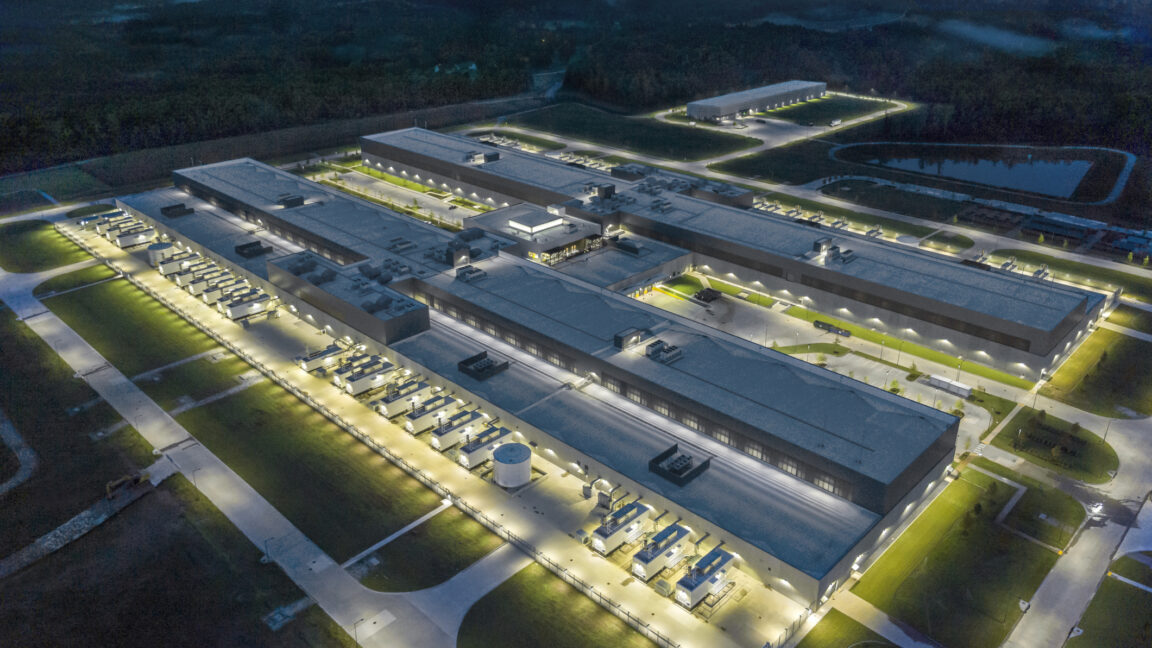
Some spin · most spun: The Guardian 58/100 See every outlet’s spin ↓Photo as used by Ars Technica for “Hyperscale data centers use 2% of US electricity”How Ars Technica framed it: Ars Technica uses an aerial night-time photograph of a large, brightly lit data-centre complex. Its scale and lighting reinforce the headline’s focus on electricity use.
A study published in Nature Sustainability examines 403 large US data centres. Its estimates concern May 2024 to April 2025 and depend on operating assumptions. The work does not isolate electricity used specifically for artificial intelligence.
How the coverage differs
Ars Technica leads on electricity use and explains the generation mix; The Hill’s available summary leads on the Denmark comparison and notes that estimates use scenarios. The Guardian connects the study to AI growth, climate impacts and local opposition, while Ars Technica says the study cannot isolate AI data-centre energy use. Only Ars Technica, among the three supplied texts, discusses the exclusion of on-site generation from the study’s figures. None of the supplied texts fully explains both assumed facility loads and annual regional generation averages.
68–99 TWhEstimated electricity use across operating scenariosS3
25.7 million tonnesCentral estimate of attributable carbon dioxide emissionsS3
What happened
Researchers estimate that 403 US hyperscale data centres accounted for about 1.8% of national electricity consumption during the year ending April 2025. The study, published in Nature Sustainability on 16 November, puts their annual electricity use between 68 and 99 terawatt-hours across different operating scenarios. These are modelled estimates for the studied facilities, not a live reading of today's demand.S2S3R1
The central emissions estimate is about 25.7 million metric tonnes of carbon dioxide. Ars Technica reports a scenario range of 21 million to 31 million tonnes. The Guardian compares the central figure with Denmark's annual carbon emissions, while the Hill's headline describes it as larger; the underlying estimate concerns emissions attributable to electricity generation.S1S2S3R2
Why it matters
The distinction between a model and a meter reading matters here. Nature's accompanying explanation says the analysis uses assumed facility loads and annual regional electricity mixes. It does not trace the electricity actually delivered to each site, and the results apply to the 403 validated facilities.R2
The estimated generation mix was 54% fossil fuels, 25% renewables and 21% nuclear, according to the accounts of the study. Ars Technica says natural gas supplied most of the fossil-fuel share. The figures describe the electricity associated with the sampled centres, rather than every source of energy used by the wider technology industry.S1R2
There is also a boundary around what the analysis counts. Ars Technica reports that it excludes on-site generation behind the electricity meter, citing xAI's use of gas turbines in Tennessee during the study period as an example. It also notes that repeating the analysis could track growth, while cautioning that the study cannot identify AI's electricity use alone.S1
The background
The Harvard-led team used satellite imagery and Environmental Protection Agency data. Harvard's release says the available information did not separate general computing from AI-specific work. That limits what the results can establish about the carbon cost of a particular AI service.R1
Co-author Francesca Dominici told the Guardian that continued construction since the study period makes the results a conservative view of current demand. That is her assessment of an expanding industry, not a measured 2026 total. The publication date and the period analysed are therefore different dates with different meanings.S3
What happens next
The researchers say they plan further work on health effects, which this study did not directly measure. Updated evidence would also be needed to quantify demand after April 2025. Neither the study's historical estimate nor the separate pollution projections discussed in news coverage establish present-day health damage from these 403 facilities.R1S3
Fact check: every point labelled
What is confirmed, what is only reported, and what is claim or speculation. Every point links to its source.
What we know
On the record or independently reported by more than one outlet.
confirmedNature Sustainability published the study on 16 November, covering 403 facilities between May 2024 and April 2025.R1S2S3
confirmedThe model uses assumed loads and annual regional generation averages, not traced individual supplies, and its results are limited to the 403 validated facilities.R2
confirmedThe team used satellite imagery and EPA data; the information did not separate general computing from AI, and health effects were not directly measured.R1
confirmedThe Guardian compares the estimate with Denmark's annual emissions; the Hill headline calls it larger.S2S3
Reported but not yet confirmed
Reported as fact, but from a single origin.
reportedArs Technica: The analysis excludes behind-the-meter generation; xAI used gas turbines in Tennessee during its study period.S1
Claims and disputes
What people say. Not established fact.
claimedThe study's authors: The sampled facilities used an estimated 68–99 terawatt-hours, about 1.8% of national consumption in the central scenario, with central emissions of 25.7 million tonnes and a 21–31 million tonne range.S1S3R2
claimedThe study's authors: The estimated electricity mix was 54% fossil fuels, 25% renewables and 21% nuclear, with natural gas dominating the fossil share.S1R2
claimedFrancesca Dominici, speaking to the Guardian: Continued construction makes the historical estimates a lower bound for current emissions.S3
claimedThe researchers, quoted by Harvard: The researchers plan to examine health effects in further work.R1
Context the headlines leave out
The facilities' power demand and the carbon emissions associated with generating that electricity are different quantities.S1S3
Still unknown
The sampled facilities' actual metered consumption.
Electricity demand attributable specifically to AI.
The industry's measured 2026 footprint and associated health effects.
Key questions
Is this a measurement of all US data centres?
No. Nature says the results apply to the 403 validated facilities and rely on estimated operating loads.R2
Does it measure AI's electricity use alone?
No. The available information could not separate AI-specific operations from general computing.R1
Does the study describe electricity use in 2026?
It was published in 2026 but examines May 2024 to April 2025.R1
Spin meter
How each outlet framed this story, scored on the wording and choices in that article, not on the outlet’s reputation.
Headlines compared: Ars Technica leads with the share of US electricity used by hyperscale data centres. The Hill says their emissions exceed Denmark’s, while The Guardian describes them as equivalent and emphasises a surge in data centres.
The GuardianFraming: Leans left · Spin 58/100 · Headline matches story: yes
“Surge of US datacenters adds equivalent of Denmark’s annual emissions, study finds”
Straight reportingHeavy spin
The Guardian frames data-centre growth as a climate and public-health concern, linking the study to AI expansion, fossil fuels and local opposition.
Why? 5 framing techniques
loaded languageThe frantic buildout The description characterises expansion as uncontrolled rather than simply reporting its pace.
emotional appealroasting heatwaves in Europe, wildfire smoke in North America and the disastrous landslide The list connects the data-centre story to vivid examples of climate-related harm beyond the study’s measured scope.
emphasisalmost certainly a conservative estimate The article emphasises the possibility that emissions have grown since the study period, rather than the model’s other uncertainties.
omission The supplied text does not explain that the estimates use assumed loads and regional generation averages, or that the data did not distinguish AI from general computing.
selective quotewould unleash deadly air pollution A campaigner’s warning about a separate proposed project adds a stark health-risk frame to the study coverage, although the study did not directly measure health effects.
Ars TechnicaFraming: Not political · Spin 22/100 · Headline matches story: yes
“Hyperscale data centers use 2% of US electricity”
Straight reportingHeavy spin
Ars Technica frames the findings around electricity consumption, emissions calculations and the growing significance of on-site generation.
Why? 2 framing techniques
omission The supplied text does not explain that facility loads were assumed and that regional annual generation averages cannot trace individual supplies.
emphasisThis matters because the types of generators being used are much less efficient than utility power plants The discussion highlights the potential emissions impact of on-site generators, while acknowledging that they may not greatly affect this study’s figures.
The HillFraming: Not political · Spin 18/100 · Headline matches story: yes
“US data centers emit more greenhouse gases than Denmark, Harvard study finds”
Straight reportingHeavy spin
The Hill leads with the comparison between estimated data-centre emissions and Denmark’s annual emissions.
Why? 2 framing techniques
emphasisemit more greenhouse gases than Denmark The Hill foregrounds a country comparison and presents the estimated emissions as larger than Denmark’s, whereas The Guardian describes them as equivalent.
omission The available summary mentions scenarios but does not explain the assumed loads or regional generation averages used in the model.
Timeline
May 2024–April 2025 — Period examined by the study.R1
16 November 2026 — Study published in Nature Sustainability.R1
Earlier coverage of similar events
How outlets reported related stories before this one. Compare for yourself.
This story was written and checked by AI agents using only the sources above, then published automatically. Facts are labelled by how well they are supported. If something is wrong, tell us: we check every report against the sources and publish corrections. Editorial policy