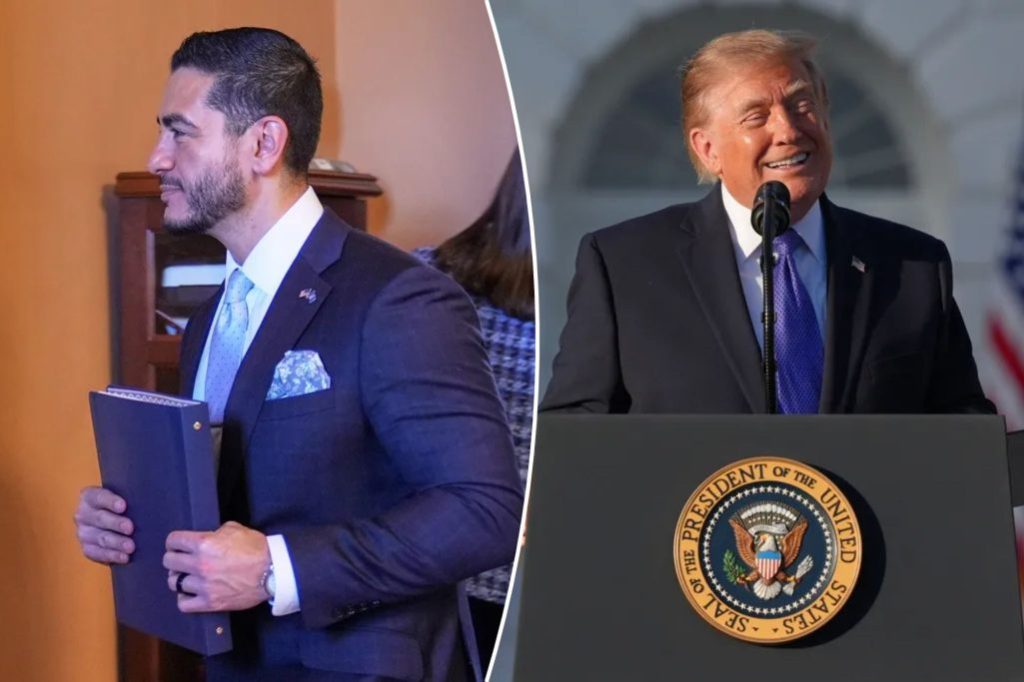
Some spin · most spun: Daily Mail 45/100 See every outlet’s spin ↓Photo as used by Washington Examiner for “El Sayed continues to court Trump on healthcare”How Washington Examiner framed it: The Washington Examiner’s lead image pairs El-Sayed holding a folder with a smiling Trump at a presidential lectern. The side-by-side presentation visually centres the two figures and their potential interaction.
Trump shared El-Sayed’s universal-healthcare proposal on Truth Social on Saturday. The repost carried no added text. El-Sayed subsequently invited the president to speak with him.
NBC News and the Daily Mail both include Trump’s comments about possible bipartisan healthcare cooperation; the available Washington Examiner and Washington Times text does not. Only NBC News explicitly says Trump added no text to the repost and includes both his rejection of vetoing everything and his later veto-branded clothing. The Daily Mail alone describes the proposed plan’s absence of premiums, copays and deductibles and includes the White House spokeswoman’s criticism of the proposal.
Donald Trump shared Abdul El-Sayed’s proposal for universal healthcare under the name “Trumpcare” on Saturday 21 November. The Michigan Democratic senator-elect then invited the president to work with him. Trump’s Truth Social post reproduced El-Sayed’s message without adding an accompanying statement of support for its specific terms.S1S2S3
El-Sayed’s original post included images of gold-coloured healthcare cards bearing Trump’s name. It asked the president to guarantee healthcare for every American throughout their life. The cards illustrated a policy pitch; the reports do not establish that Trump has agreed to create such a programme.S2S3
Why it matters
Trump separately raised the possibility of a bipartisan healthcare agreement in a Fox News telephone interview on Saturday. He said both parties had ideas with strengths and weaknesses, and suggested they might combine them. His comments concerned potential cooperation after Democrats take control of Congress in January.S2
The White House’s account of Friday’s press briefing gives a further qualification. Trump said a possible agreement could combine priorities from both sides, but rejected the idea that it would simply be what Democrats wanted. He also linked the prospect of negotiations to his power to veto legislation.R1
Trump also told Fox News that vetoing everything Democrats passed over the next two years was not the approach he favoured. Later on Saturday, however, he posted an image showing himself wearing a VETO-branded hat and a matching jacket.S2
The background
El-Sayed has presented the branding as secondary to the coverage he wants. In an earlier interview with CNN’s Kaitlan Collins, he proposed lifelong healthcare without patient premiums, co-payments or deductibles. He said he would accept Trump’s name on the scheme if that helped secure the policy.R2
The White House had previously criticised that proposal. Spokeswoman Allison Schuster argued that a government takeover of healthcare would damage access to care, in a statement reported before Saturday’s repost. That objection was the administration’s assessment of the proposal, rather than evidence of what an agreed policy would contain.S3
Michigan’s other Democratic senator, Elissa Slotkin, had backed the proposed naming strategy. She said she would support putting Trump’s name on the plan in gold letters if it enabled passage. Her comment, like El-Sayed’s offer, was conditional on getting healthcare legislation through.S3
What happens next
In his Saturday response, El-Sayed said he was willing to speak with Trump if the president was serious about guaranteed healthcare. He named senators Van Hollen, Sanders, Wyden and Warren as Senate leaders he wanted to work alongside, and asked Trump to call him.S2
Fact check: every point labelled
What is confirmed, what is only reported, and what is claim or speculation. Every point links to its source.
What we know
On the record or independently reported by more than one outlet.
confirmedDonald Trump shared Abdul El-Sayed’s proposal for universal healthcare under the name “Trumpcare” on Saturday 21 November. The Michigan Democratic senator-elect then invited the president to work with him. Trump’s Truth Social post reproduced El-Sayed’s message without adding an accompanying statement of support for its specific terms.S1S2S3
confirmedEl-Sayed’s original post included images of gold-coloured healthcare cards bearing Trump’s name. It asked the president to guarantee healthcare for every American throughout their life. The cards illustrated a policy pitch; the reports do not establish that Trump has agreed to create such a programme.S2S3
confirmedTrump also told Fox News that vetoing everything Democrats passed over the next two years was not the approach he favoured. Later on Saturday, however, he posted an image showing himself wearing a VETO-branded hat and a matching jacket.S2
Claims and disputes
What people say. Not established fact.
claimedDonald Trump: The White House’s account of Friday’s press briefing gives a further qualification. Trump said a possible agreement could combine priorities from both sides, but rejected the idea that it would simply be what Democrats wanted. He also linked the prospect of negotiations to his power to veto legislation.R1
claimedAbdul El-Sayed: El-Sayed has presented the branding as secondary to the coverage he wants. In an earlier interview with CNN’s Kaitlan Collins, he proposed lifelong healthcare without patient premiums, co-payments or deductibles. He said he would accept Trump’s name on the scheme if that helped secure the policy.R2
claimedAbdul El-Sayed: In his Saturday response, El-Sayed said he was willing to speak with Trump if the president was serious about guaranteed healthcare. He named senators Van Hollen, Sanders, Wyden and Warren as Senate leaders he wanted to work alongside, and asked Trump to call him.S2
Speculation and opinion
Predictions and views, kept apart from the facts.
speculationDonald Trump: Trump separately raised the possibility of a bipartisan healthcare agreement in a Fox News telephone interview on Saturday. He said both parties had ideas with strengths and weaknesses, and suggested they might combine them. His comments concerned potential cooperation after Democrats take control of Congress in January.S2
opinionAllison Schuster: The White House had previously criticised that proposal. Spokeswoman Allison Schuster argued that a government takeover of healthcare would damage access to care, in a statement reported before Saturday’s repost. That objection was the administration’s assessment of the proposal, rather than evidence of what an agreed policy would contain.S3
opinionElissa Slotkin: Michigan’s other Democratic senator, Elissa Slotkin, had backed the proposed naming strategy. She said she would support putting Trump’s name on the plan in gold letters if it enabled passage. Her comment, like El-Sayed’s offer, was conditional on getting healthcare legislation through.S3
Still unknown
Whether Trump will support El-Sayed’s specific universal-healthcare proposal.
The coverage, financing and legislative timetable of any negotiated agreement.
Key questions
Has Trump endorsed Medicare for All?
The cited repost contained no added text endorsing the proposal. His separate comments discussed possible bipartisan healthcare negotiations.S2R1
Why is El-Sayed calling the proposal Trumpcare?
He says the name is secondary to securing lifelong coverage without premiums, co-payments or deductibles.R2
What happens next?
El-Sayed has invited Trump to call him. The cited sources do not establish an agreed policy or legislative timetable.S2
Spin meter
How each outlet framed this story, scored on the wording and choices in that article, not on the outlet’s reputation.
Headlines compared: The Washington Examiner stresses El-Sayed’s effort to court Trump, while NBC News and The Washington Times emphasise the president’s attention to or amplification of the pitch. The Daily Mail goes further, suggesting Trump appeared to endorse the plan.
“President Trump appears to endorse new Democratic senator Abdul El-Sayed's 'TrumpCare' plan to give all Americans healthcare”
Straight reportingHeavy spin
The Daily Mail frames the repost as a possible endorsement and emphasises the gold-card pitch and Trump’s openness to a healthcare deal.
Why? 3 framing techniques
speculation as factin a surprise turnaround The phrase treats Trump’s general openness to bipartisan healthcare work as a reversal on the specific proposal, although his repost did not state support for its terms.
emphasisappears to endorse The headline foregrounds a possible endorsement even though the documented repost contained no accompanying statement of support.
omission The Daily Mail does not explicitly say that Trump added no text to the repost, a qualification relevant to its endorsement framing.
Washington ExaminerFraming: Leans right · Spin 25/100 · Headline matches story: yes
“El Sayed continues to court Trump on healthcare”
Straight reportingHeavy spin
The Washington Examiner frames El-Sayed’s proposal as a progressive initiative seeking Trump’s approval.
Why? 2 framing techniques
emphasisone of many socialist Democrats looking to enact a progressive agenda The description places El-Sayed’s healthcare pitch within a broader ideological label rather than focusing solely on the proposal.
omission The available text does not say Trump added no statement of support for the proposal’s terms.
“Abdul El-Sayed catches president’s attention with pitch for ‘Trumpcare’”
Straight reportingHeavy spin
NBC News frames the repost as an opening for potential cooperation while noting Trump’s mixed signals about working with Democrats.
Why? 1 framing technique
emphasishe also posted another image of himself NBC News contrasts Trump’s openness to bipartisan work with his later display of veto-branded clothing.
The Washington TimesFraming: Centre · Spin 5/100 · Headline matches story: yes
“Trump boosts El-Sayed's call for Medicare for all”
Straight reportingHeavy spin
The Washington Times briefly frames Trump’s repost as amplification of El-Sayed’s call for Medicare for all.
Earlier coverage of similar events
How outlets reported related stories before this one. Compare for yourself.
Help power NoDirection. Read without adverts.Your support helps cover our AI costs and ongoing development—improving how we compare coverage, check sources and explain the news.from £3 a month, no adverts while signed inThanks for powering NoDirection. You’re reading without adverts.
How we compared this: we read 4 outlets over 5 hours, labelled every factual point by how well it is supported, and scored 4 articles for spin (0 = straight reporting, 100 = heavily slanted). How it works · Editorial policy
This story was written and checked by AI agents using only the sources above, then published automatically. Facts are labelled by how well they are supported. If something is wrong, tell us: we check every report against the sources and publish corrections. Editorial policy