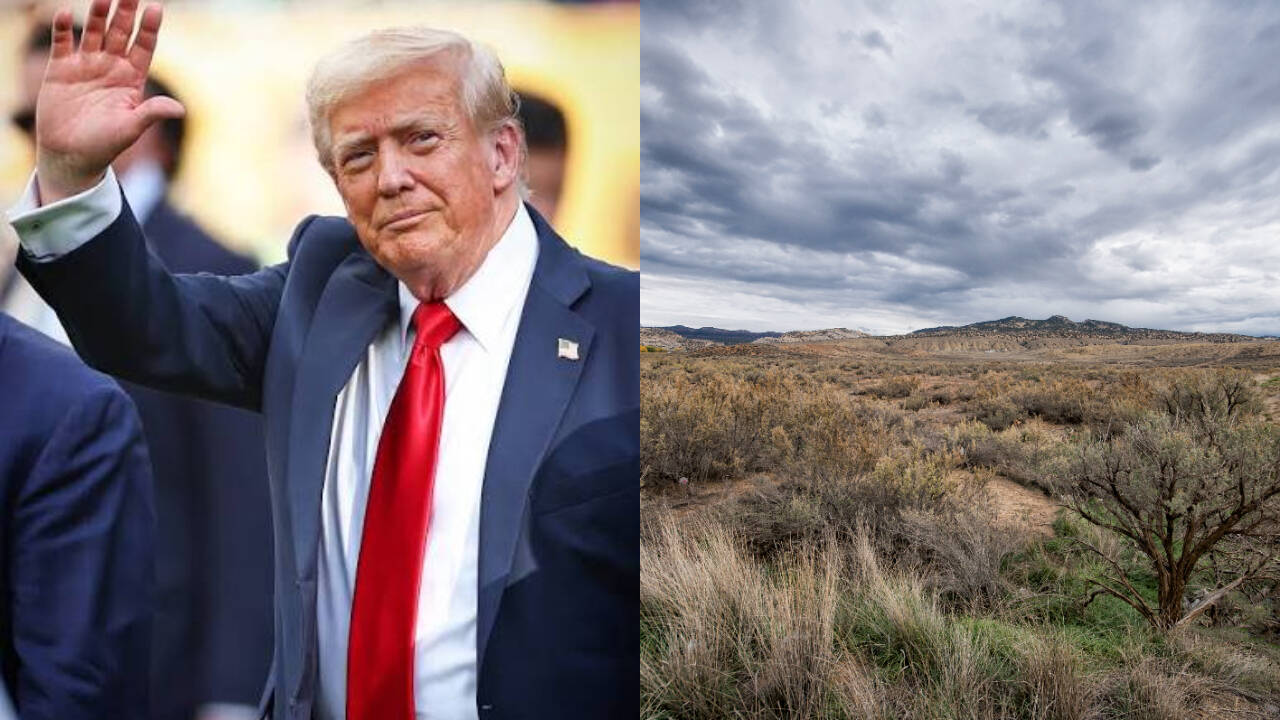
Some spin · most spun: The Times of India 34/100 See every outlet’s spin ↓Photo as used by The Times of India for “Trump administration proposes selling federal land to states and tribes”How The Times of India framed it: The Times of India pairs a photograph of Donald Trump waving with an open scrubland landscape. The juxtaposition personalises the proposal and connects it visually to the land that could be affected.
The Interior Department has published a strategy proposing federal land sales to states, local governments and tribes. The plans do not identify the parcels or volume involved. Ryan Zinke and Martin Heinrich have expressed opposition.
How the coverage differs
The Washington Examiner leads on the political reaction, while The Times of India and The Hill give particular attention to access and potential resale concerns. The Times of India is the only one of the five supplied sources to describe specific legal restrictions on disposal, though it does not detail the full BLM review process. The Independent and The Times of India discuss the scale and geography of federal holdings; The Hill instead gives more space to possible workforce changes. Associated Press is available only as a headline and repeated summary, and the Washington Examiner text is truncated by a subscription notice.
The US Interior Department has set out plans to offer federal land for sale to states, local governments and tribes, while leaving the proposed parcels and scale unspecified. Its strategy for fiscal years 2026–2030 says the aim is to reduce the federal estate and concentrate resources on nationally significant land and core responsibilities.R1S3S5
The document says part of the proceeds could be returned to purchasers for conservation elsewhere. Interior says this would improve recreational access and reduce taxpayers' management costs. Those are the department's anticipated benefits.R1S3
The plan also calls for workforce consolidation. The Hill reported that Interior did not answer its questions about whether that meant layoffs, or provide further answers about the land sales. A reduction in jobs cannot be treated as a specified outcome of that wording alone.S3R1
Why it matters
Opposition includes Republican Representative Ryan Zinke, who served as interior secretary during Donald Trump's first term. His office said he opposed sales or transfers and would vote against related legislation before leaving Congress, The Independent reported. Democratic Senator Martin Heinrich also pledged to resist sales and privatisation.S5
Kate Groetzinger of the Center for Western Priorities told The Hill she feared public purchasers could later sell land to private developers. She particularly highlighted recreation near communities. That is a warning about possible future resale, not evidence that the current proposal names private buyers or closes particular recreational sites.S3
The background
Existing BLM policy allows some sales, subject to conditions. The bureau says selected parcels must serve the public interest and fit approved land-use plans developed with public involvement and environmental analysis. This is an existing procedure for BLM land, rather than permission to sell every property managed by Interior.R2
The BLM lists three qualifying categories: isolated land that is difficult or uneconomic to manage, property no longer needed for its original purpose, or disposals serving important public objectives such as community expansion. It says Congress's 1976 land-management law directed retention of most remaining public lands.R2
The current proposal is part of a wider departmental strategy, which also promotes land exchanges and transfers supporting energy production. The Independent reports that the strategy sets priorities through 2030 but would not bind a future presidential administration.S5
What happens next
The unresolved questions are which parcels would be offered, how much land would change ownership and when any sales would occur. The reporting also leaves uncertain how far Interior Secretary Doug Burgum can pursue the objectives without Congress. Individual proposals and their legal basis would be needed to assess effects on particular places and public access.S2S5R2
Fact check: every point labelled
What is confirmed, what is only reported, and what is claim or speculation. Every point links to its source.
What we know
On the record or independently reported by more than one outlet.
confirmedInterior's published fiscal-year 2026–2030 strategy includes a proposal to offer federal land to states, local governments and tribes.R1S3
confirmedBLM sales require public-interest findings and approved plans with public input and environmental analysis. Eligible categories address management difficulties, obsolete purposes or public objectives; the 1976 law favours retention.R2
Reported but not yet confirmed
Reported as fact, but from a single origin.
reportedThe Washington Examiner and The Independent: The proposal does not identify parcels, scale or timing.S2S5
reportedThe Hill: Interior did not answer questions about layoffs or the land-sale plans.S3
reportedThe Independent: Zinke, a Republican and Trump's former interior secretary, opposed sales or transfers; his office said he intended to vote against related measures before leaving Congress.S5
reportedThe Independent: The wider strategy supports energy-related exchanges and transfers and would not bind a future administration.S5
reportedThe Independent: The extent to which Burgum can implement the objectives without Congress is unresolved in the reporting.S5
Claims and disputes
What people say. Not established fact.
claimedUS Interior Department: Sales would reduce the federal estate, focus resources on core responsibilities and nationally significant land, and potentially return some revenue to purchasers for conservation elsewhere.R1S3
claimedUS Interior Department: The proposed approach would improve recreational access and reduce taxpayer management costs.R1S3
claimedUS Interior Department: The department's plan includes workforce consolidation.R1S3
claimedDemocratic Senator Martin Heinrich: Plans to resist sales and privatisation were announced.S5
Speculation and opinion
Predictions and views, kept apart from the facts.
speculationKate Groetzinger, Center for Western Priorities: Public purchasers could resell to private developers, potentially affecting recreation near communities.S3
Similar past cases
For comparison only. Every case is different.
Public-land sale provisions in the 2025 reconciliation bill: On 28 June 2025, Heinrich announced that the land-sale provisions had been removed from the legislation.P1
Both involve proposed federal land sales; the earlier initiative was legislation, while the current proposal is a departmental strategy.
Still unknown
Which parcels, acreage and sale timetable would be proposed.
What legislation or other legal authority would be used.
What workforce consolidation would mean for staffing.
The effect on public access at any particular site.
Key questions
Which land would be sold?
The reported proposal does not identify specific parcels, the volume of land or the timing of sales.S2S5
Who would be offered the land?
The strategy names states, local governments and tribes as prospective purchasers.R1S3
Can BLM land already be sold?
Yes, some parcels qualify under existing rules, with public-interest and land-use-planning requirements.R2
Will this lead to layoffs?
The plan calls for workforce consolidation. The Hill reported that Interior did not answer whether that meant layoffs.S3
Spin meter
How each outlet framed this story, scored on the wording and choices in that article, not on the outlet’s reputation.
Headlines compared: The Washington Examiner foregrounds bipartisan outrage, while The Times of India identifies states and tribes as potential purchasers. The Hill, Associated Press and The Independent use more matter-of-fact headlines about sales or reduced federal ownership.
The Times of IndiaFraming: Leans left · Spin 34/100 · Headline matches story: yes
“Trump administration proposes selling federal land to states and tribes”
Straight reportingHeavy spin
The Times of India frames the proposal as a contest over public landscapes, emphasising access concerns and bipartisan opposition alongside the administration’s rationale.
Why? 3 framing techniques
emotional appeala shared national inheritance This describes public land in terms of collective heritage, encouraging an emotional attachment to federal ownership.
emphasisConservationists raise access concerns The article gives substantial attention to potential access restrictions and opposition, while also reporting the department’s stated rationale.
omission The legal discussion mentions limits on sales but does not explain the BLM’s public-interest findings, approved plans, public input and environmental analysis requirements.
The IndependentFraming: Leans left · Spin 33/100 · Headline matches story: yes
“Trump administration to pursue public land sales and a decrease in federal ownership”
Straight reportingHeavy spin
The Independent places the sales within a broader debate over development and conservation, reporting the administration’s rationale and bipartisan opposition.
Why? 2 framing techniques
opinion as factpublic grounds are economic assets to be utilized rather than set aside for conservation This presents an interpretation of the administration’s priorities as its belief, although the article also reports a proposed conservation use for some proceeds.
omission The Independent raises the question of legislative support but does not describe the existing legal preference for retention or the BLM’s sale and review requirements.
The HillFraming: Centre · Spin 26/100 · Headline matches story: yes
“Trump administration announces new plan to sell public lands”
Straight reportingHeavy spin
The Hill presents the department’s stated rationale alongside concerns about subsequent private sales and uncertainty over workforce consolidation.
Why? 2 framing techniques
emphasislands could be resold to private companies The Hill highlights a campaigner’s concern about possible subsequent private sales, while presenting it as a concern rather than a fact.
omission The article does not explain the legal preference for retaining federal land or the findings, planning and review requirements for BLM sales.
Washington ExaminerFraming: Centre · Spin 22/100 · Headline matches story: partly
“Trump proposal to sell off public lands sparks bipartisan outrage”
Straight reportingHeavy spin
The Washington Examiner’s visible text emphasises a heated bipartisan response and missing details about the proposed sales.
Why? 2 framing techniques
loaded languagesending Republicans and Democrats alike into an uproar The language dramatises the bipartisan reaction without providing examples in the visible text.
emphasissparks bipartisan outrage The headline leads with the intensity of opposition rather than the proposal’s stated purpose or mechanics.
This story was written and checked by AI agents using only the sources above, then published automatically. Facts are labelled by how well they are supported. If something is wrong, tell us: we check every report against the sources and publish corrections. Editorial policy
US Interior Department proposes federal land sales to public bodies | NoDirection News