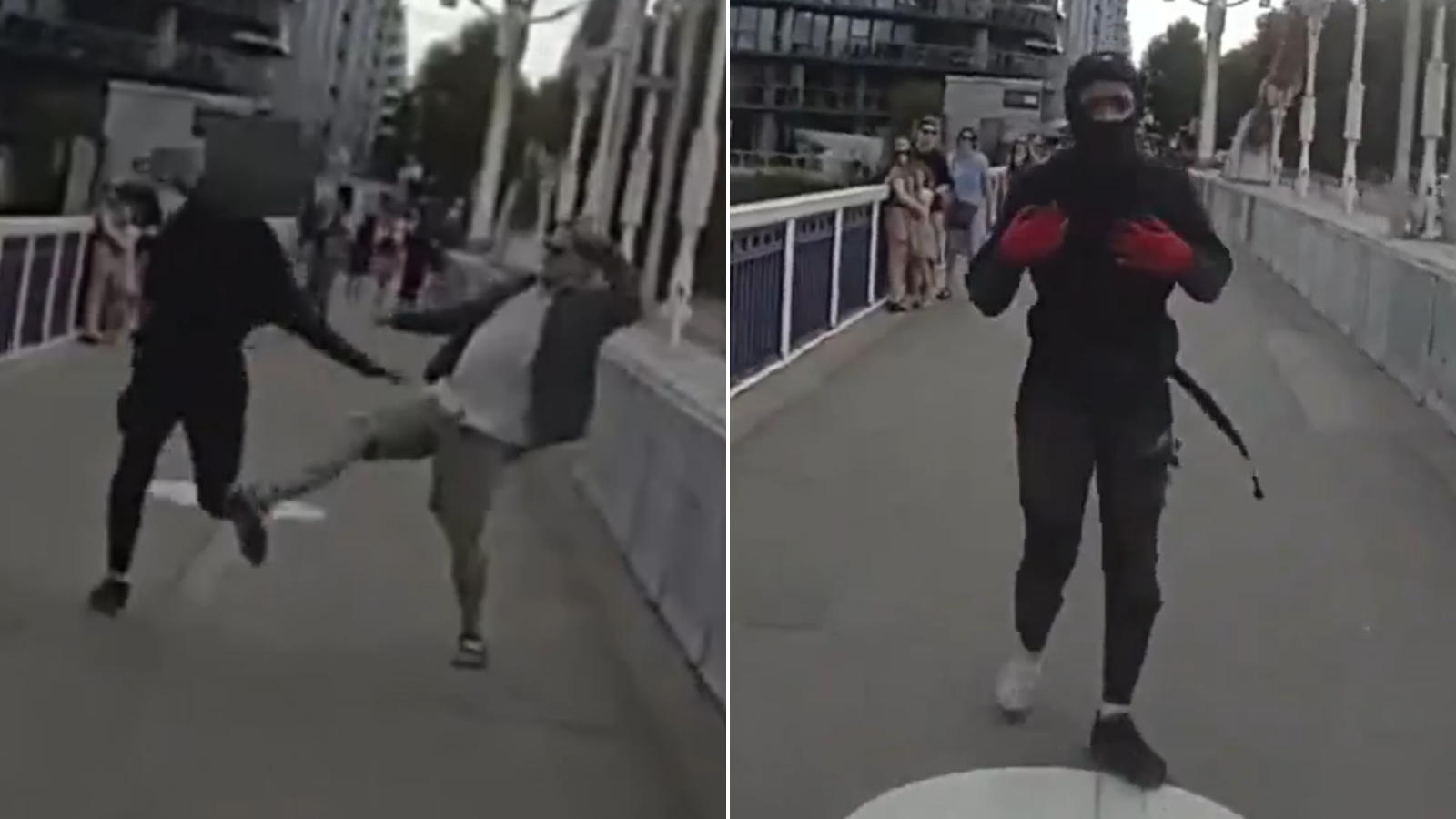
Some spin · most spun: Daily Mail 42/100 See every outlet’s spin ↓Photo as used by GB News for “Watch: Armed phone snatcher caught after being chased by drone in dramatic police chase”How GB News framed it: GB News used a split image showing the pursuit on a bridge, including the apparent trip and a masked figure running towards the camera. It reinforces the headline’s focus on the drama of the chase.
Wesley Rodrigues has received an 18-month custodial sentence at Southwark Crown Court. He pleaded guilty to theft, dangerous driving and possession of an offensive weapon. Police tracked him by drone before arresting him on Chelsea Bridge on 22 August.
How the coverage differs
All four outlets highlighted the drone’s role, but only the Daily Mail’s headline mentioned the passer-by who tripped Rodrigues; the Daily Mirror also included that detail in its text. The Daily Mirror and the Daily Mail discussed the wider drone programme and higher arrest rates for drone-attended incidents, without quantifying the difference. The Daily Mail alone included detailed victim accounts and wider phone-theft figures; ITV News was available only as a headline and repeated summary.
More than 2,300Incidents attended in the trial, according to the MetR2
What happened
Wesley Rodrigues, 18, of Walthamstow, was sentenced to 18 months in custody at Southwark Crown Court on Monday, 16 November. He had pleaded guilty at the same court on 6 October to theft, dangerous driving and possession of an offensive weapon. The Metropolitan Police released footage of the operation that led to his arrest.R1S1
Officers were alerted on 22 August after several people reported that their phones had been stolen in central London. A drone was deployed at 1.34pm and identified Rodrigues riding a Sur-Ron electric bike near Piccadilly. Its operator followed him and saw a further phone theft while directing officers on the ground towards him.R1S2
The interception took place on Chelsea Bridge, where a motorcycle officer knocked Rodrigues off the bike. He continued on foot and threw a knife into the Thames before a member of the public tripped him. Officers arrested him at 1.49pm, 15 minutes after the drone deployment.R1S2
Why it matters
The police account describes several parts of the arrest: aerial tracking, directions to ground officers, the motorcycle interception and the intervention by a passer-by. The drone supplied information rather than making the arrest itself. Detective Constable Maria Archer said officers recovered the stolen phones and returned them to their owners.R1S2
The Met is presenting the case alongside results from its Drone as First Responder trial. It says drones attended more than 2,300 incidents and reached the scene before other responders in three quarters of those cases. It also reports higher arrest rates where drones attended, but the release provides no numerical comparison of those rates or assessment separating the technology’s effect from other factors.R2S2
The background
Drone operators work from a control suite at Hammersmith Police Station and transmit live pictures to support officers. The Met says it operates seven drones from sites in Islington, Charing Cross and Kennington, with around 200 incident deployments each week. The footage can also be recorded for evidence.R2
The force’s claim that most drone responses take under two minutes concerns arrival at incidents, not the time taken to make an arrest. In this case, the published deployment and arrest times are 15 minutes apart. Those are different measures of the operation and should not be treated as interchangeable.R1R2S2
What happens next
The sentencing completes the stage of this case described in the police announcement. The Met says it will continue using the programme to support ground officers. Its wider claims about speed and arrest rates remain the force’s assessment of the trial, rather than proof that every deployment produces the same result.R1R2
Fact check: every point labelled
What is confirmed, what is only reported, and what is claim or speculation. Every point links to its source.
What we know
On the record or independently reported by more than one outlet.
confirmedWesley Rodrigues, 18, of Walthamstow, received an 18-month custodial sentence at Southwark Crown Court on 16 November 2026.R1
confirmedHe pleaded guilty on 6 October to theft, dangerous driving and possession of an offensive weapon.R1
confirmedThe Met released footage of the arrest operation.R1
confirmedMultiple phone-theft reports led to a drone deployment at 1.34pm on 22 August.R1
confirmedThe operator identified Rodrigues on a Sur-Ron electric bike near Piccadilly, observed another theft and guided ground officers.R1
confirmedA motorcycle officer intercepted the bike on Chelsea Bridge; Rodrigues fled on foot, threw a knife into the Thames and was tripped by a passer-by.R1
confirmedOfficers arrested him at 1.49pm, 15 minutes after deployment.R1
confirmedThe stolen phones were recovered and returned to their owners.R1
confirmedThe release does not quantify the arrest-rate difference or isolate the drone’s effect from other factors.R2
confirmedOperators work from Hammersmith, sending live images and recording footage for evidence.R2
confirmedThe response-time claim concerns drone arrival, whereas the case timeline measures deployment to arrest.R1R2
Claims and disputes
What people say. Not established fact.
claimedMetropolitan Police: The trial involved more than 2,300 incidents, with drones first on scene in three quarters and most responses under two minutes.R2
claimedMetropolitan Police: Arrest rates were higher in drone-attended incidents.R2
claimedMetropolitan Police: Seven drones operate from Islington, Charing Cross and Kennington, averaging around 200 incident deployments weekly.R2
claimedMetropolitan Police: The programme will continue supporting ground officers.R2
Context the headlines leave out
The arrest occurred in August, the guilty pleas in October and sentencing in November.R1
The trial statistics are the Met’s own assessment and do not provide a quantified causal comparison of arrest outcomes.R2
Still unknown
The size of the reported arrest-rate difference and how comparable the incidents were.
Key questions
What was Rodrigues sentenced for?
He admitted theft, dangerous driving and possession of an offensive weapon, and received an 18-month custodial sentence.R1
How did police use the drone?
An operator tracked the electric bike and directed officers on the ground. Rodrigues was arrested on Chelsea Bridge after a motorcycle interception and a foot pursuit.R1
Did the arrest take two minutes?
No. The police timeline records deployment at 1.34pm and arrest at 1.49pm. The force’s shorter response-time claim refers to drones arriving at incidents.R1R2
Spin meter
How each outlet framed this story, scored on the wording and choices in that article, not on the outlet’s reputation.
Headlines compared: GB News and the Daily Mirror emphasised the drama of the chase, with the Mirror highlighting the bike interception. The Daily Mail highlighted both drone tracking and the passer-by’s intervention, while ITV News used a shorter description of the drone-assisted capture.
Daily MailFraming: Not political · Spin 42/100 · Headline matches story: yes
“Moment police use drone to track armed phone thief as he speeds through central London on e-bike - before member of public ends chase by tripping him up”
Straight reportingHeavy spin
The Daily Mail emphasised the chase, victims’ experiences and wider phone-theft figures, while presenting the drone programme’s benefits strongly.
Why? 4 framing techniques
loaded languagedamning statistics The phrase casts phone-theft figures as an indictment rather than presenting them neutrally.
speculation as factThe DFR programme has already proven higher arrest rates The comparison does not establish that the drone programme caused the higher rates.
emphasisarrested within 15 minutes of being identified The established 15-minute interval runs from drone deployment to arrest, rather than from identification.
emotional appealtremendous loss The victim’s account foregrounds the personal consequences of the theft alongside the case details.
GB NewsFraming: Not political · Spin 30/100 · Headline matches story: yes
“Watch: Armed phone snatcher caught after being chased by drone in dramatic police chase”
Straight reportingHeavy spin
GB News framed the case as a dramatic drone-assisted chase and arrest.
Why? 2 framing techniques
loaded languagedramatic police chase The repeated description heightens the spectacle of an arrest documented in police footage.
omission GB News omits the passer-by’s role in tripping Rodrigues and his guilty pleas.
Daily MirrorFraming: Not political · Spin 29/100 · Headline matches story: yes
“Dramatic moment phone thief knocked off bike after being chased by police drone”
Straight reportingHeavy spin
The Daily Mirror combined a dramatic account of the interception with the Met’s claims about drone performance.
Why? 3 framing techniques
loaded languagea brave member of the public The description adds praise to the factual account of a passer-by tripping Rodrigues.
emphasisarrest rates were also higher for drone-attended incidents The Daily Mirror highlights the favourable comparison without quantifying the difference or establishing the drone’s independent effect.
emphasiswithin 15 minutes of the suspect being identified The case timeline measures 15 minutes from drone deployment to arrest, not from identification.
ITV NewsFraming: Not political · Spin 12/100 · Headline matches story: unknown
“Drone used to catch brazen armed thief snatching phones on e-bike - ITVX”
Straight reportingHeavy spin
ITV News presented the case briefly as a drone-assisted capture of an armed phone thief.
Why? 1 framing technique
loaded languagebrazen armed thief The adjective adds a judgemental tone to the brief description of the offence.
Timeline
22 August 2026, 1.34pm — Drone deployed following phone-theft reports.R1
22 August 2026, 1.49pm — Rodrigues arrested on Chelsea Bridge.R1
6 October 2026 — Guilty pleas entered at Southwark Crown Court.R1
16 November 2026 — An 18-month custodial sentence was imposed.R1
Earlier coverage of similar events
How outlets reported related stories before this one. Compare for yourself.
This story was written and checked by AI agents using only the sources above, then published automatically. Facts are labelled by how well they are supported. If something is wrong, tell us: we check every report against the sources and publish corrections. Editorial policy